As the FIFA World Cup approaches, international sports politics expert Jules Boykoff has warned that Donald Trump is following the “tried and true methods” of Benito Mussolini by using the tournament as a “political life raft” to distract from his unpopular Iran war and falling approval ratings – raising specific concerns about ICE presence at stadiums, travel bans blocking fans from participating nations, and the FIFA “grift machine” enabling a president who received a Peace Prize before launching a war.
Boykoff, a professor at Pacific University and former member of the US under-23 men’s national team, makes the argument in his new book Red Card, which explores how Trump has used the 2026 World Cup – hosted across the United States, Canada and Mexico – to engage in what he calls “sportswashing”: using sport to launder political image.
“If you look at the way Mussolini cozied up to the athletes at the World Cup in 1934, he just wanted to be around these kinds of macho guys,” Boykoff told HuffPost. “Well, you can see the same kind of thing that Trump does all the time.”
The Mussolini comparison – and why it applies
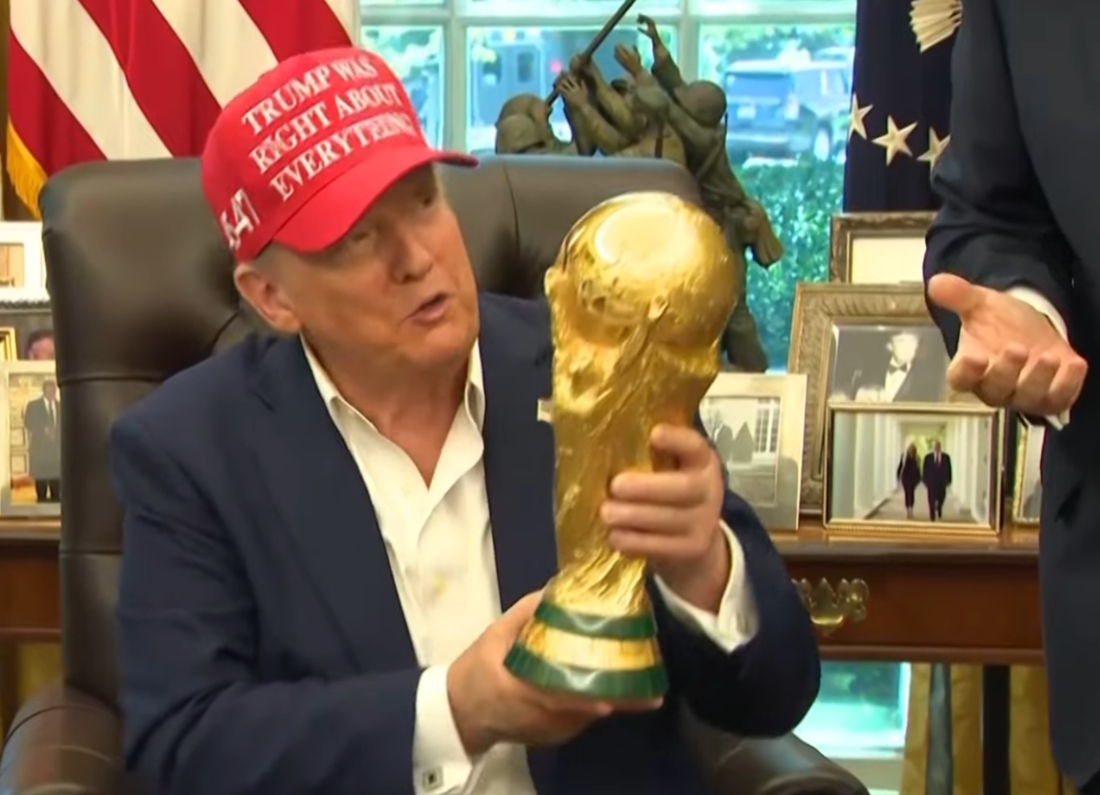
The 1934 World Cup was the second ever staged and the first to be hosted with explicit political purpose. Mussolini used it to promote fascism internationally, ensured Italy won through direct interference, and created his own trophy – the Coppa del Duce, larger than the standard Jules Rimet Trophy – to be presented to the victorious Italian team. The surrounding photographs show Il Duce surrounded by athletes, positioned as a man of vigour and national strength at the same moment his regime was consolidating authoritarian control.
Boykoff argues that Trump is deploying the same visual and political grammar. This year alone: Lionel Messi and Inter Miami were invited to the White House for a photo opportunity; Trump attended UFC matches; a UFC arena was constructed on the South Lawn of the White House; Trump announced plans to attend the NBA Finals. The Iran war is ongoing as we reported in our Trump and Iran coverage. Approval ratings are under sustained pressure.
“The worse that Donald Trump’s approval ratings get, the more incentive he has to cling to sports as a sort of political life raft,” Boykoff said.
The FIFA Peace Prize – before the Iran war
The most explicit example of sportswashing Boykoff identifies is the FIFA Peace Prize. Months before the Iran war began, FIFA president Gianni Infantino awarded Trump the prize, citing his “unwavering commitment to advancing peace and unity.” The prize was new – created specifically for this award, no previous recipient.
Boykoff called it “the most blatant example of Trump trying to sportswash via the World Cup.” He did not mince words about the relationship more broadly, describing FIFA as a “grift machine” – a reference to the corruption scandal that rocked football globally in the mid-2010s and resulted in multiple federal convictions of FIFA officials in the United States.
The specific timing of the FIFA Peace Prize – before a military action that has generated significant international criticism – is the detail that makes the sportswashing argument most concrete. As we reported in our Trump Israel PM piece, Trump claimed 99% approval in Israel and floated running for prime minister while military operations in the region were ongoing. The FIFA prize fits the same pattern: prestige associations accumulating faster than accountability can.
ICE at stadiums and the travel ban problem
Beyond the symbolic sportswashing, Boykoff raises substantive concerns about what the World Cup will mean in practice under Trump’s administration.
The 2026 tournament has been granted high-level special event assessment ratings, meaning enhanced federal law enforcement presence at venues. Human rights organisations and the journalist community have raised specific concerns about ICE – Immigration and Customs Enforcement – presence at matches, given that foreign fans are expected to flood US cities throughout the tournament.
The travel ban creates a specific and documented problem. Fans of Haiti, Iran and other countries subject to Trump’s travel restrictions are barred from entering the United States – meaning that citizens of nations whose teams have qualified cannot attend their own team’s matches. Trump, Boykoff notes, is “obviously putting lie to” FIFA’s “football unites the world” slogan by preventing people from qualifying nations from even watching matches.
The history of authoritarian sportswashing
Boykoff situates Trump within a longer historical lineage. Hitler’s 1936 Berlin Olympics – used to present Nazi Germany as a modern, civilised nation to an international audience – is the paradigm case. The 1978 World Cup under Argentina’s military junta, which was torturing and disappearing political prisoners while the games were played, is another.
More recently, Russia’s hosting of the 2018 World Cup attracted extensive criticism from human rights organisations. Qatar’s 2022 tournament generated years of debate about migrant worker deaths and the conditions under which infrastructure was built.
The 2026 World Cup is, Boykoff notes, the first since FIFA required bidding countries to lay out human rights risks and mitigation plans – a reform that followed the corruption scandal. “And yet we can see that there are serious concerns over human rights,” he said.
The stolen game
Boykoff ends on a personal note that reflects his specific position – a former professional player turned academic. “Because I’ve seen the power of soccer, or football, in action, I’m of the belief that it can bring us together and it’s worth fighting for,” he said.
His concern is that FIFA, Infantino and Trump are collectively stealing football from its genuine community – the fans, the players, the sporting traditions that have made the World Cup the most watched sporting event in human history – and replacing it with a political instrument.
The football itself will be real. The goals will be genuine. The moments of transcendence that make the sport worth watching will happen regardless. Whether the tournament around them has been compromised by the specific political purposes it has been recruited to serve is the question Boykoff’s book puts to every viewer watching in June.