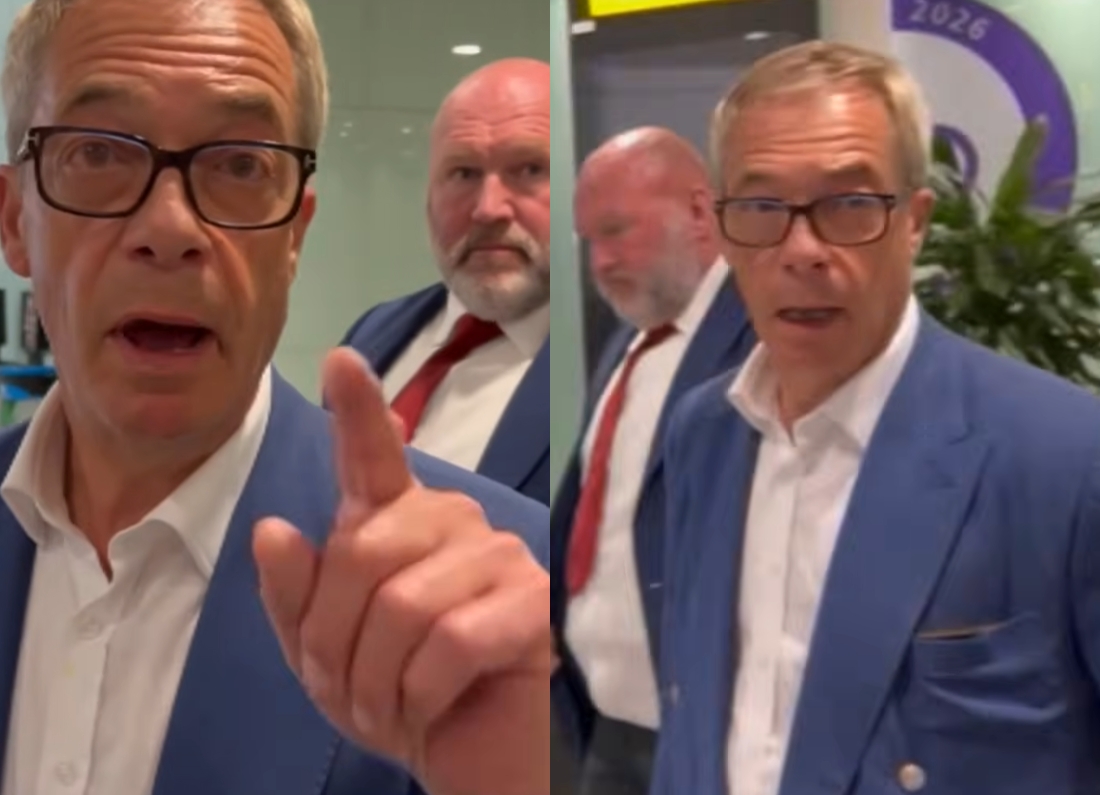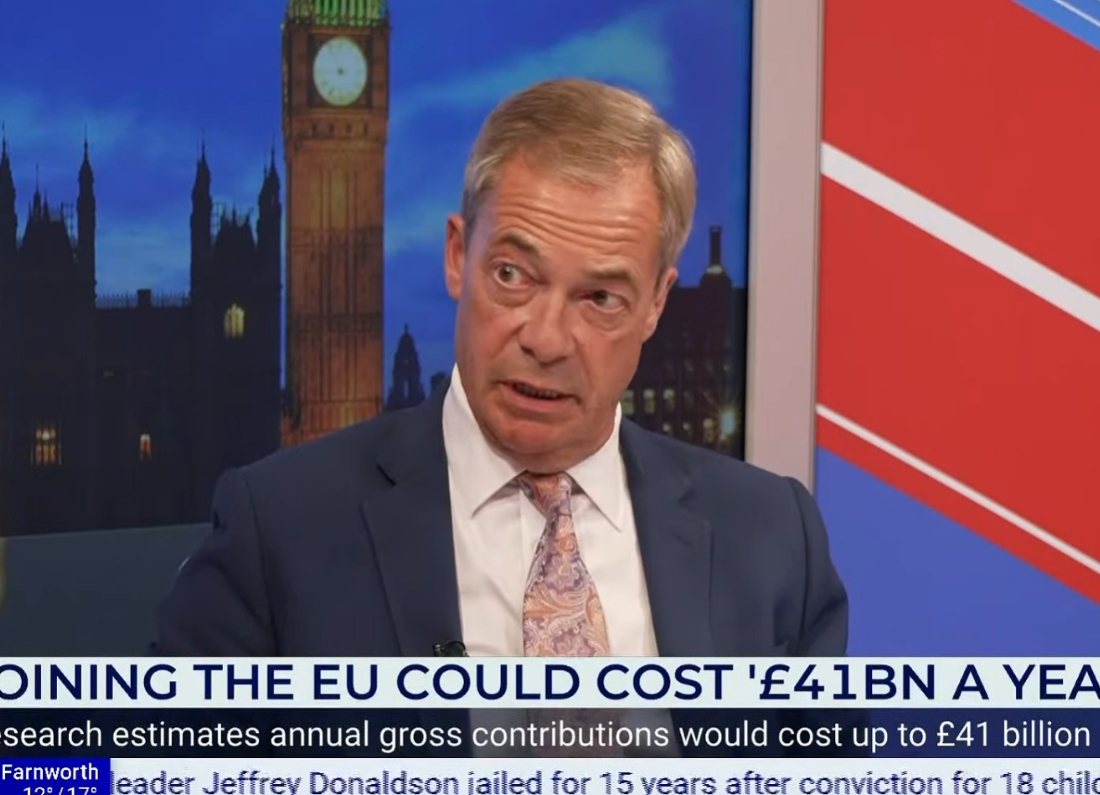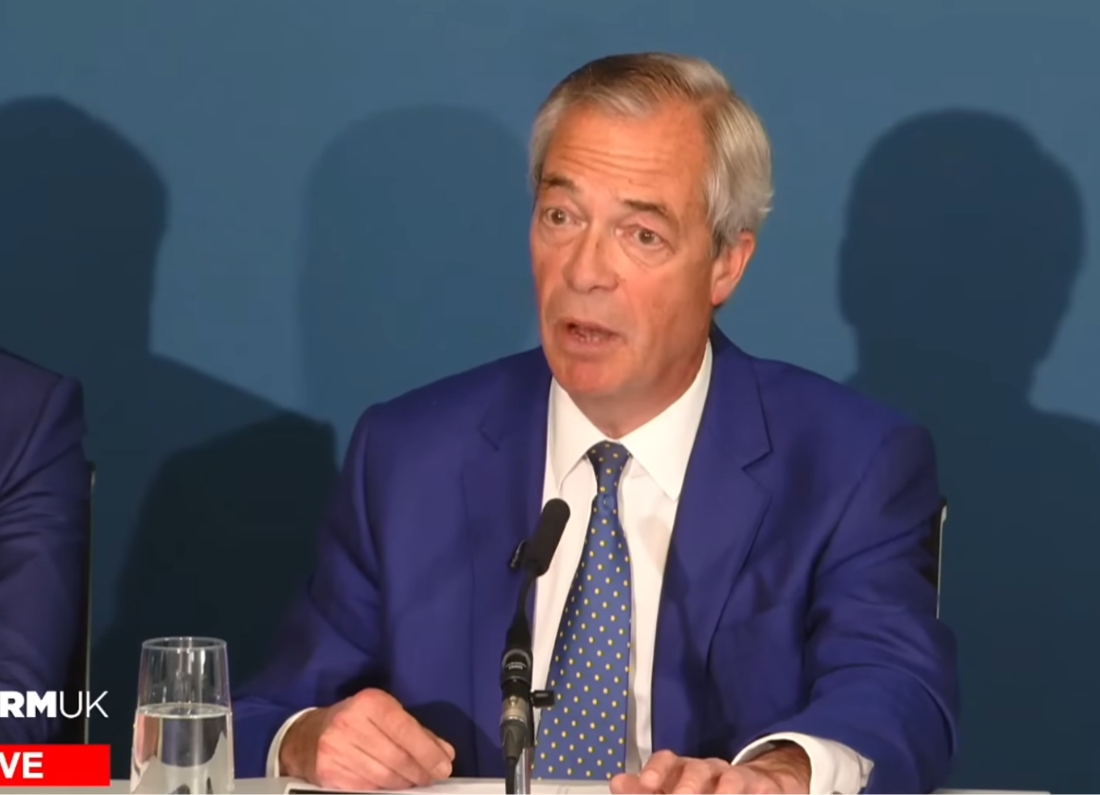
A judge referred Nigel Farage to the Attorney General for potential prosecution for contempt of court after finding that his public comments about the Manchester Airport assault trial – in which he called it an example of “two-tier justice” while the case was still ongoing – implied the guilt of the defendants. The Attorney General did not bring proceedings. Farage’s response was to call the judge’s action “disgraceful,” attack the state of the judiciary and promise that “the politicisation of the courts ends under a Reform government.”
The referral, which has now emerged through a written ruling by Judge Neil Flewitt KC, concerns a press conference held by Farage on 21 June last year. At that point the trial of Mohammed Fahir Amaaz, 20, and his brother Muhammad Amaad, 26, was ongoing. Amaaz was subsequently convicted of assaulting two female police officers and a member of the public at Manchester Airport’s Terminal 2 on 23 July 2024, during an incident in which PC Lydia Ward suffered a broken nose. Two juries failed to reach verdicts on further assault allegations, and the brothers will not face a third trial. Amaaz is due to be sentenced on June 26.
What the judge said
Judge Flewitt’s written ruling is specific. “I took the view that the observation made by Nigel Farage was potentially a contempt of court as it implied the guilt of the defendants. As Nigel Farage is a well-known politician with a considerable following and whose public utterances attract a lot of attention, I decided to refer the matter to the Attorney General so that he could consider whether there should be a prosecution for contempt of court.”
The judge also said that Farage’s intervention, “however unwelcome, would not adversely affect the fairness of the trial” – a finding that contextualises the referral: the judge found the comments potentially contemptuous, referred them to the appropriate authority for independent assessment, and concluded they had not ultimately impacted the trial’s fairness.
Lord Hermer, the Attorney General, did not bring contempt proceedings. The Attorney General’s Office confirmed that law officers did not issue proceedings in the case.
Why this matters
Contempt of court through prejudicing an active case – sometimes called “trial by media” – is a serious legal provision that exists to protect defendants’ right to a fair trial. The legal test is whether statements create a substantial risk of serious prejudice to ongoing proceedings. The judge found Farage’s comments potentially met that threshold, specifically because they implied guilt during an active trial, and because his political prominence and following gave his statements particular amplification.
The fact that the Attorney General did not prosecute does not mean the referral was improper or mistaken. The AG independently assessed whether proceedings were warranted and concluded they were not. This is how the system is designed to work: a judge refers potential contempt, the Attorney General independently reviews it.
Farage’s characterisation of the referral – “a disgraceful action from the judge” – conflates the judge’s procedurally proper referral with the prosecution that did not follow. A judge found a potential contempt and referred it to the appropriate authority. The appropriate authority decided not to prosecute. The judge did nothing improper.
Farage’s response – and what it says about his relationship with the judiciary
Farage’s statement is worth reading carefully. “This is a disgraceful action from the judge. Without Richard Tice and I, this case would have never gone to trial. It’s quite clear that our judiciary is in an even worse state than imagined. The politicisation of the courts ends under a Reform government.”
The specific phrase “the politicisation of the courts ends under a Reform government” is a threat to judicial independence dressed as its opposite. A judge who refers potential contempt for independent assessment by the Attorney General is performing a constitutional function. Describing that function as “politicisation” – and promising to end it – is itself a statement about how Reform would relate to an independent judiciary: as an obstacle to be overcome rather than a constitutional safeguard to be respected.
The broader pattern is consistent. As we reported in our Labour referring Farage’s Russia hacking claim to police, this is the same week in which Farage also failed to report his own Russian hacking claim to the authorities within Labour’s 24-hour deadline, requiring Labour to do it for him. As we reported in our formal Parliamentary Standards investigation piece, the Standards Commissioner is separately investigating his undeclared £5 million gift. Farage’s consistent response to accountability mechanisms of all kinds is to attack the institution deploying them.
The brothers’ solicitor – and the broader context
Aamer Anwar, the brothers’ solicitor, said: “We also lodged a dossier with the Attorney General on Mr Farage and several prominent far-right social media offenders. Dangerous pogrom-like attitudes have contributed to a culture of hostility in this case, and indeed any trial in this country involving defendants from a black, minority ethnic or Muslim community.”
He added: “The far-right regularly claim there is a two-tier justice system, yet they are the ones who operate outwith the law, incite social media hate, inflame conspiracy theories and attack the right to a fair trial.”
The “two-tier justice” framing that Farage deployed during the trial is the same framing at the heart of the EHRC complaint about Reform’s Islamophobia as we reported in our EHRC complaint piece. It is also the framing that Farage’s own Makerfield candidate Robert Kenyon deployed in his riot disinformation during the Southport murders, as we reported in our full Kenyon investigation.
The Manchester Airport case also has a specific complication that Farage’s “two-tier justice” framing obscured throughout: a video showed PC Zachary Marsden kicking and stamping on Amaaz during his arrest. Marsden and another officer are under investigation and face possible gross misconduct charges for their use of force.
The week’s accumulation
This is now a week in which Farage has had his Russian hacking claim referred to the Metropolitan Police and NCSC by Labour after he failed to report it himself; faces a continuing Parliamentary Standards investigation into his undeclared £5 million gift from Christopher Harborne as we reported in our Farage financial scandal coverage; and has had a judge’s referral of his comments to the Attorney General for potential contempt of court emerge publicly.
His response to all three has been consistent: attack the institution, promise Reform will fix it, decline to answer the underlying questions.