


Nigel Farage’s decision to resign as Clacton’s MP and immediately stand for the seat again was supposed to create a dramatic showdown between the Reform UK leader and the political establishment he claims is determined to destroy him.
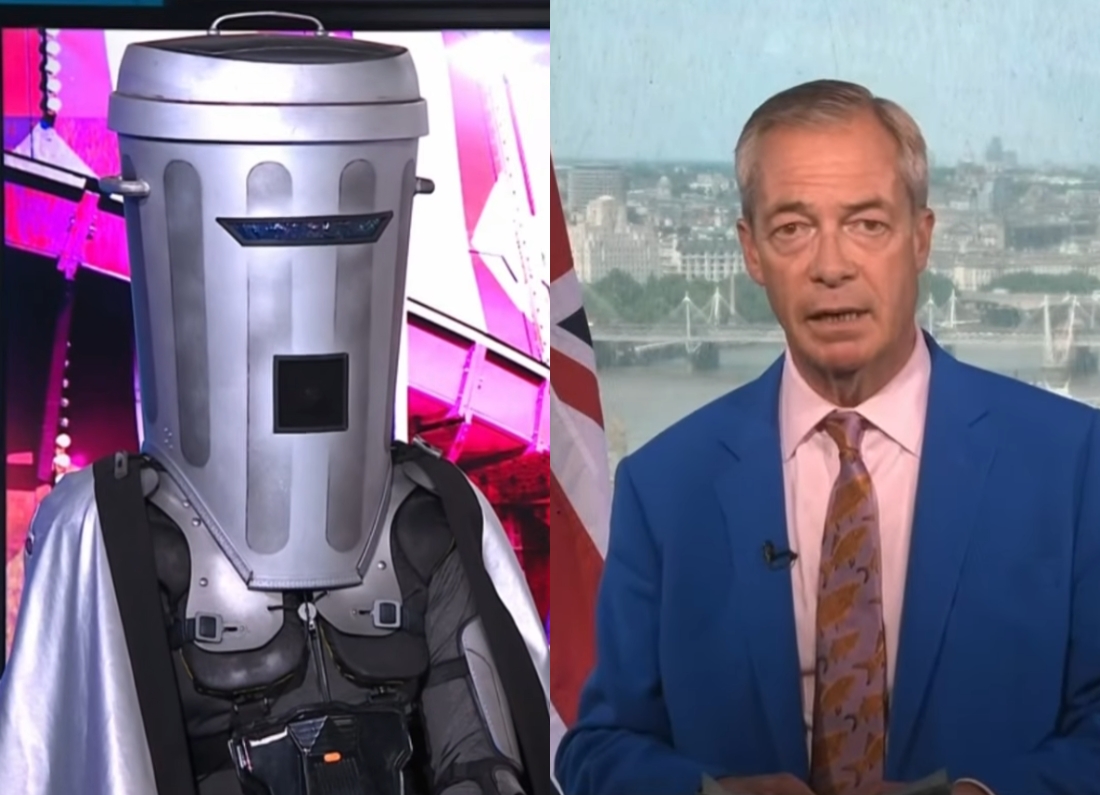
Instead, it has produced a spectacle that now has television presenters in Japan explaining why one of Britain’s best-known politicians is fighting for his career against a man wearing a silver bin on his head.
A Japanese television report on the Clacton by-election has gone viral after viewers shared clips of presenters trying to explain Count Binface, his unusual appearance and the uncomfortable polling confronting Farage.
You do not need to understand Japanese to appreciate what is happening. A photograph of Binface appears on screen while the presenter explains that his trademark is a “trash can mask and a cape”. Moments later, viewers are shown an Ipsos poll in which more British adults say they would prefer Binface to win than Farage.
For a campaign Farage intended to use as a public show of strength, this is becoming quite the international humiliation.
How Clacton became a global political joke
Farage triggered the by-election after coming under sustained scrutiny over a £5m gift from cryptocurrency billionaire Christopher Harborne and other financial support he has received.
He said the contest would allow the people of Clacton to judge him instead of leaving the matter to what he described as a hostile establishment. Critics argued that resigning and seeking immediate re-election was an attempt to sidestep or disrupt parliamentary investigations that could resume if he returns to the Commons.
The major political parties refused to play along. Labour, the Conservatives, the Liberal Democrats and the Greens all announced they would not field candidates, leaving Farage without the grand confrontation he had apparently hoped to stage.
Count Binface then stepped forward. The satirical candidate, played by comedy writer Jon Harvey, has become the most recognisable opponent in the contest. His manifesto includes building at least one affordable house, bringing back Ceefax and nationalising Adele. The campaign began as another comic intervention in British politics, but it has increasingly become an effective way of puncturing the theatrical seriousness surrounding Farage’s move.
Laurence Fox has also announced his intention to stand, alongside several fringe and independent candidates, although the final candidate list had not yet been confirmed when the Japanese report aired.
The moment Japanese viewers met Count Binface
The Japanese segment begins by presenting the race as the strange political story it is. One presenter points towards a photograph of Count Binface and explains his most immediately noticeable qualities: the bin-shaped helmet, the cape and the fact that he is challenging the leader of a British political party.
The report then moves to footage of Binface walking through London while offering viewers some background on his campaign. It is delivered with the measured seriousness of an international news report, which only makes the subject matter funnier.
The sight of presenters discussing a candidate who claims to be an intergalactic space warrior would be amusing enough. What makes the report especially painful for Farage is the polling displayed alongside it.
An Ipsos survey conducted on 8 and 9 July asked British adults whom they would prefer to win if the contest came down to Farage and Count Binface. Some 33% chose Binface, compared with 21% who preferred Farage. Another 32% said they wanted neither candidate to win.
That was a national preference question rather than a poll of Clacton voters, so it should not be treated as a forecast of the by-election result. There has not yet been a reliable constituency poll showing Binface ahead in the seat.
Even so, the symbolism is extraordinary. Farage leads a party that has recently topped national voting intention polls, yet when the public was offered a direct choice between him and a comedy candidate dressed as a bin, Farage came second.
That is the sort of result that travels.
Farage wanted “the people versus the establishment”
Farage framed the by-election as a chance to clear his name through the ballot box. The argument was that voters, rather than journalists or parliamentary officials, should decide whether the questions surrounding his financial arrangements mattered.
But winning an election would not establish whether Farage complied with parliamentary rules. It would show only that enough people in Clacton wanted him to remain their MP. The standards questions and the electoral question are not the same thing.
That distinction has been made repeatedly since the by-election was announced, yet Farage continues to present the contest as though victory would amount to exoneration.
By declining to field candidates, the major parties denied him the conventional battle he wanted. Instead of Farage against Labour or Farage against the Conservatives, the public received Farage against Count Binface, with Laurence Fox and several other novelty candidates circling the spectacle.
Farage wanted to turn the contest into a referendum on himself. His opponents have allowed it to become a referendum on whether the whole exercise deserves to be taken seriously.
The joke has reached America and Japan
The Japanese report is not the first sign that the by-election has escaped the boundaries of normal British political coverage.
MSNBC recently introduced the race to American viewers in a segment that asked whether Nigel Farage was “better than a trash can”. Presenter Katy Tur explained the £5m controversy, Farage’s resignation and Count Binface’s manifesto while visibly struggling to keep a straight face.
International outlets including Reuters, Euronews and the Associated Press have also covered the contest, largely because the underlying story is so difficult to resist: a high-profile populist resigns during a financial scandal, expects a dramatic fight and ends up sharing the stage with a comedy space warrior.
That is not the global coverage Reform would have wanted.
Farage has spent years cultivating an international profile, particularly through his relationship with Donald Trump and appearances in American conservative media. He likes being treated as a political insurgent with influence far beyond Westminster.
Now his international profile is helping news of the Count Binface contest spread around the world. As one person reacting to the Japanese clip put it, Farage had “managed to make himself look bad globally”.
Why Count Binface is landing
Count Binface works as a satirical candidate because the joke is not only the costume.
His interviews have repeatedly highlighted the contradictions surrounding the by-election. Farage says he is standing against the establishment, despite being a former City trader and professional politician with powerful media allies and wealthy donors. He says the election is about accountability, although the vote cannot settle the parliamentary investigation. He presents the contest as an act of courage after voluntarily creating it himself.
Binface does not need to deliver a lengthy lecture on any of that. He can promise to nationalise Adele, demand the return of Ceefax and allow the absurdity of the wider situation to speak for itself.
That explains why mainstream broadcasters have treated him as more than a disposable novelty candidate. Behind the helmet is an experienced comedy writer who understands how to move from a joke into a serious political point without ruining either.
The Guardian described his rise during the campaign as seemingly unstoppable, noting that he has managed to attract media attention well beyond that normally available to satirical candidates.
The national Ipsos figures do not mean he will win Clacton. Farage remains the obvious favourite in a constituency he won comfortably at the previous general election, and local voting patterns may look very different from a national forced-choice survey.
But Binface does not need to become an MP to damage the story Farage wanted to tell. Every overseas television report showing a picture of the silver helmet makes the Reform leader’s supposedly historic democratic showdown look a little more ridiculous.
A campaign Farage no longer fully controls
Farage’s political strength has always depended on his ability to set the terms of the argument. He creates a conflict, casts himself as the persecuted outsider and forces his opponents to respond. The Clacton by-election followed that familiar pattern. He announced the contest in dramatic terms and dared the political establishment to take him on.
The establishment largely walked away.
That left Farage arguing with a bin.
The Japanese report captures the consequences beautifully. Presenters thousands of miles away are now explaining the British public’s apparent preference for Count Binface while footage of the candidate plays across the screen.
Farage may still win the seat. He may win it comfortably.
But the by-election was meant to make him look brave. Instead, it has given international broadcasters an irresistible comedy segment and transformed Count Binface into a global political figure.
For a politician who wanted the world to watch, this probably was not what he had in mind.



![Crypto Toll And Passcode? Iran's New Hormuz Status Quo [YouTube]](https://thedailybritain.co.uk/wp-content/uploads/2026/04/donaldtrumpstraitofhormuz.jpg)
Leave a Reply