

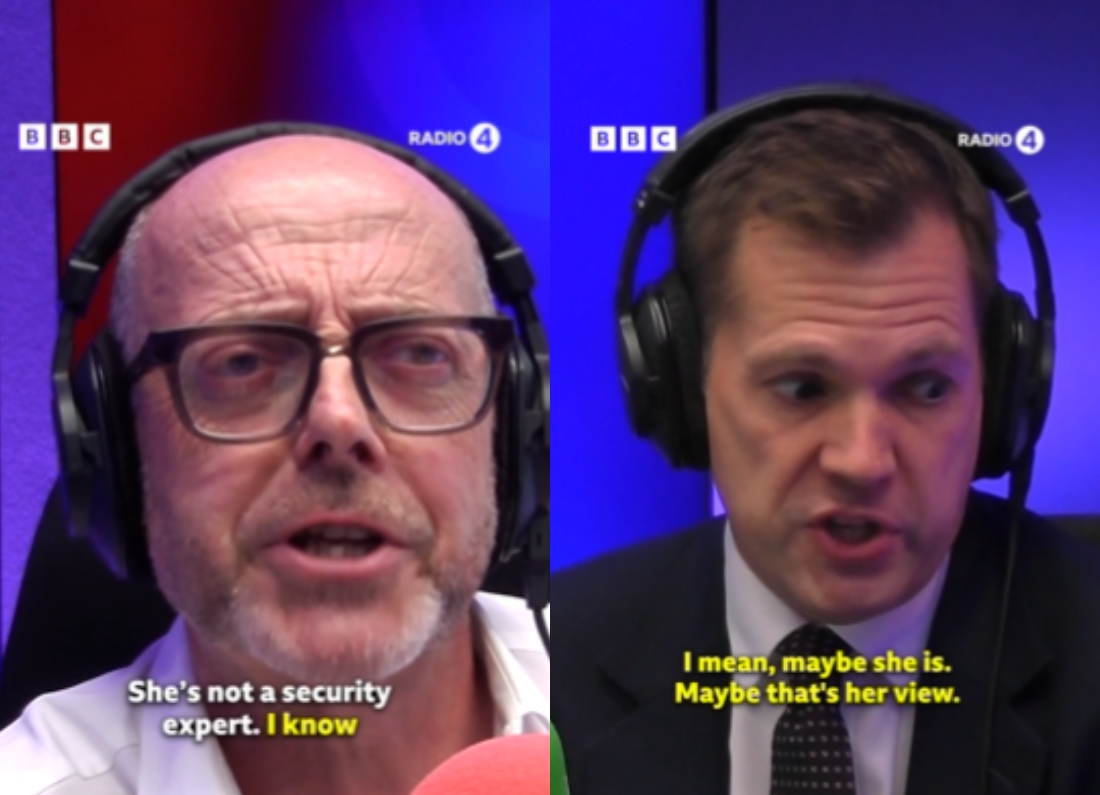
Nick Robinson challenged Robert Jenrick live on Radio 4 after the Reform UK MP accused the government of failing to protect Nigel Farage because of his political views.
The exchange came after it emerged that Farage had rejected a taxpayer-funded protection package last year which reportedly included a bodyguard, a car and a trained driver. The package was said to be similar to the protection offered to Conservative leader Kemi Badenoch.
Reform has argued that the offer was not enough to match the threat Farage faces. But the detail has complicated the party’s public claim that its MPs have been abandoned by the authorities.
That point was picked up directly by Mail columnist Dan Hodges, who wrote on X: “Think it’s worth repeating. Zia Yusuf claimed no state support was being offered to Reform MPs for protection. In reality, Nigel Farage was offered a car, a trained driver, a bodyguard, and security on a similar level to that offered Kemi Badenoch. That’s quite the deception.” The post had been viewed nearly 50,000 times by Tuesday morning.
The row after Ann Widdecombe’s death
The security row has intensified following the death of Ann Widdecombe, the former Conservative minister who later became a Reform spokeswoman. A 28-year-old man has been arrested on suspicion of murder, and counter-terror police are now leading the investigation.
Reform figures have used Widdecombe’s death to argue that the party’s MPs and senior figures are not being properly protected. Farage is now expected to meet the Royal and VIP Executive Committee, known as Ravec, which assesses protection arrangements for high-profile public figures.
But the argument has already become tangled in conflicting claims from Reform’s own side. Zia Yusuf, the party’s home affairs spokesman, said no state support was being offered to Reform MPs. That claim, and the tone of several of Yusuf’s other recent public interventions, is now under scrutiny because Farage was reportedly offered a significant protection package and turned it down.
What Jenrick claimed
On BBC Radio 4’s Today programme, Jenrick said Farage had initially been given a “comprehensive plan” after becoming an MP in 2024. He claimed that protection was later downgraded. “I don’t know why, maybe that will be explained to Nigel when he meets the committee,” Jenrick said. “But that feels to me to have been very unwise, to say the least.”
Jenrick said Farage was “under great threat” and accused the authorities and parts of the media of being too casual about his safety. He also complained that photographs had been published which made it easy to identify where Farage’s daughter lived and where his homes were.
Robinson pushed back immediately. “Nigel Farage posed in front of his own homes for the cameras repeatedly,” he said.
Jenrick then argued that Reform politicians face particular danger because they raise issues other politicians avoid. “If you talk about Islamist extremism, as I do and Nigel Farage has done for many years, you are likely to be in considerably more danger than those who don’t,” he said.
Robinson rejected that claim. “You can’t say that, Mr Jenrick, there’s no evidence for that at all,” he said. “There’s a threat from the far right in this country. Ask Diane Abbott, if she was in that seat, ask the family of Jo Cox. There are people on all sides of politics who have become a target.”
That was the most important part of the interview. Robinson was not denying that Farage faces threats. He was challenging the claim that Reform politicians are uniquely exposed because of their views, and that the state has therefore singled them out for neglect.
The £5m question returns
Robinson then moved the conversation to the issue Reform would rather not talk about: Farage’s finances. The Reform leader is facing scrutiny over a £5m gift from a crypto billionaire, as well as questions about other support he has received. Farage has triggered a by-election in Clacton, saying voters should judge him rather than the “liberal establishment”.
Robinson suggested Reform was now using the security row to change the national conversation. He told Jenrick: “In the last few minutes, you have attacked the media, you’ve attacked the police, you’ve attacked the government, you’ve attacked the Speaker, you’ve attacked the establishment who apparently want someone dead in the Reform party.”
He then put the central accusation directly: that Reform was trying to shift attention away from Farage’s £5m gift and frame legitimate scrutiny as persecution. This echoes the exact same defence Farage himself has offered elsewhere, describing scrutiny of his finances as being “treated like a war criminal.”
Jenrick accused Robinson of reading from “a pre-scripted final question”, which Robinson denied angrily.
Why the Hodges tweet matters
Hodges’s intervention matters because it cuts through the broad emotional claim being made by Reform.
If the argument is that Farage was offered protection but believed it was insufficient, that is one thing. That can be debated. Security threats are serious, and any protection package should match the risk.
But if the public claim is that no state support was being offered at all, while Farage had in fact been offered a bodyguard, car, trained driver and security comparable to the Conservative leader’s, then the story changes.
That is why Hodges called it “quite the deception”. It goes directly to Reform’s wider problem in this row. The party is trying to present Farage as abandoned by the state, but the known details suggest a more complicated picture.
The awkward gap in Reform’s story
There is a legitimate debate about the safety of politicians. MPs have faced rising abuse and threats in recent years, and the murders of Jo Cox and Sir David Amess remain a permanent warning about the risks of public life.
But there is also a difference between saying security arrangements were not good enough and saying the state offered nothing.
That distinction is now at the centre of the story. Jenrick’s claim is that Farage was failed because the government does not like Reform’s views. Robinson pressed him on the evidence for that. Hodges’s tweet then sharpened the obvious question: why did Reform’s public message leave out the fact that Farage had reportedly been offered a serious protection package?
For Reform, the politics of this are difficult. The party wants the focus to be on security. Its critics say it is using security to escape scrutiny over money.
Robinson’s interview forced those two stories together. And once the rejected protection package is included, Reform’s claim of abandonment becomes much harder to sell.





Leave a Reply