


Let me ask you a simple question. If a political party was polling joint first nationally – level with both the Conservatives and Reform UK – had more members than the Conservative Party, had just won its first parliamentary by-election in history in a result described as historic, led among all voters under 65, and beat its main rival by 15 points in a direct head-to-head according to polling, would you say that party was a serious force in British politics?
Of course you would. Anyone would.
Now let me tell you which party that is. It is the Green Party. And now let me tell you something else: Zack Polanski, their leader, gets no hardy any media attention. He was excluded from the major pre-Gorton by-election debates. The Greens receive a fraction of the broadcast coverage given to Reform, Labour and the Conservatives. And when the Greens are discussed in major media outlets, the framing is often still one of curiosity, novelty or pleasant surprise – a small party doing unexpectedly well, rather than what the evidence says they actually are: one of Britain’s major political parties.
Something has gone badly wrong with how this country’s media covers politics. And the Green Party is where that failure is most visible.
The numbers they are not telling you
Start with the polling, because the numbers are stark and largely unreported in their full significance.
In the latest Lord Ashcroft poll of more than 5,000 people, conducted between 26 and 30 March 2026, the Green Party was on 21% of the vote – equal first with both Reform UK and the Conservatives, with Labour trailing badly on 17%. It was the first time in the party’s history that it had led or tied in a major national poll.
But that is just the headline figure. The detail underneath is more extraordinary. YouGov data shows that among voters under 65 – the vast majority of the adult population – the Greens lead outright. Their membership has passed 220,000, having tripled since Zack Polanski became leader in September 2025. That makes them larger in membership terms than both the Conservative Party and the Liberal Democrats. The Young Greens have 40,000 members – the largest youth wing of any political party in Europe.
Then there is the tactical voting data. YouGov asked respondents what they would do if only two parties could win in their constituency. In a straight head-to-head between the Greens and Reform UK, 42% said they would vote Green and 27% would vote Reform. That is not a marginal lead – it is a 15-point margin, and it dramatically outperforms the Greens’ headline polling numbers. It suggests that a huge pool of latent Green support is being suppressed by the assumption that the Greens cannot win – an assumption that is rapidly being proven false.
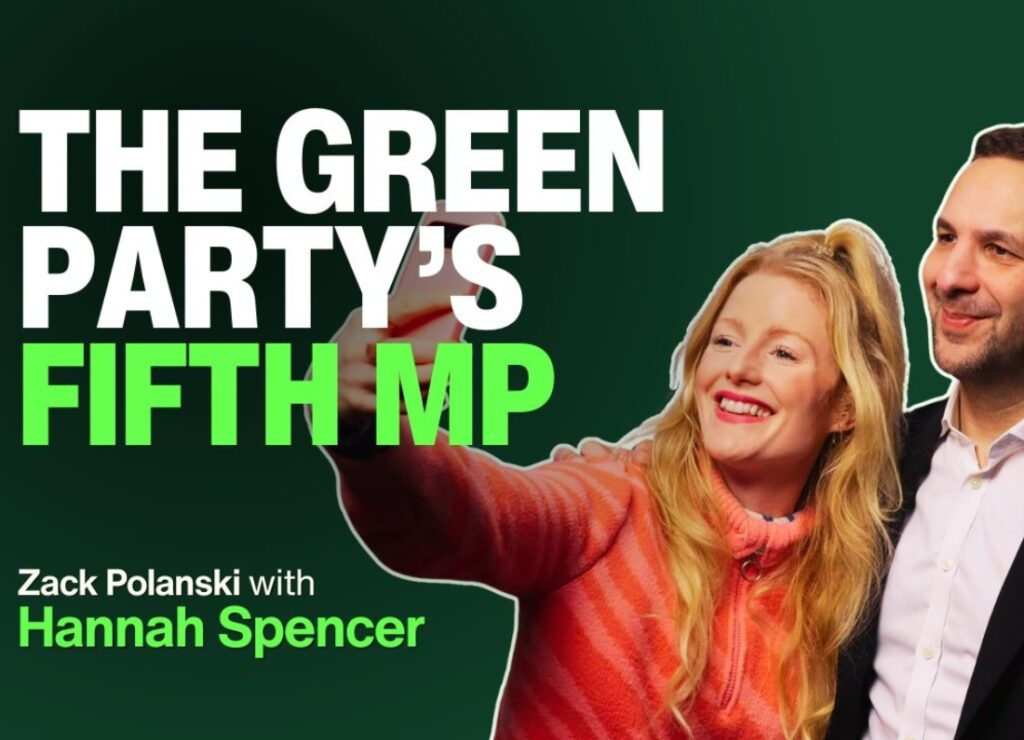
And then there is Gorton and Denton. On 26 February 2026, Hannah Spencer won the parliamentary by-election for the seat with 41% of the vote – a majority of more than 4,000 – in a result described by every serious election analyst as genuinely historic. The Greens had never won more than 10% of the vote in a parliamentary by-election before. They won it in Manchester. Labour, the party whose seat it was, finished third.
More recently, the Greens took a Kent County Council seat directly from Reform in Cliftonville – in the county Farage promised would be his shop window – leaving Reform just six seats from losing control of their flagship council entirely.
What the media is doing instead
Given all of this, you might expect the Green Party to be receiving significant, sustained coverage in Britain’s national media. Analysis of their policies. Interviews with their leader. Serious examination of whether they could form part of a future government. The kind of coverage that Reform UK has been receiving, relentlessly, for the past two years.
That is not what is happening.
Instead, the media landscape looks roughly like this. Reform UK stories dominate the political agenda – every Farage stunt, every controversial candidate, every polling number, every trip to the Maldives gets extensive coverage. Labour gets the coverage due to the governing party. The Conservatives get coverage as official opposition. And the Greens get occasional, slightly surprised takes about how well they are doing – as though the reader is expected to be as shocked as the journalist.
Polanski, whose personal approval rating of -8 makes him the most popular opposition leader in the country (compared to Farage’s -16, Badenoch’s -14 and Starmer’s staggering -44), gets no regular media slot. He is not routinely included in the major political panels that dominate broadcast debate. When the Greens are mentioned in national newspapers, it is often in the context of their effect on Labour’s vote share rather than as an independent political force with its own identity and programme.
The broadcaster argument – that coverage reflects audience interest and political salience – does not stand up when the Greens are polling joint first nationally. The “can’t win” argument – that they deserve less coverage because they are unlikely to win seats under first past the post – is circular and self-fulfilling: voters who don’t know the Greens are polling first are less likely to consider voting for them, which suppresses their vote, which is then used to justify the low coverage.
This is how the media maintains the political status quo – not necessarily by design, but by inertia, assumption and the weight of decades of two-party framing that simply has not caught up with where the country is.
Who is Zack Polanski?
Part of the problem may be that significant numbers of people still do not know who Zack Polanski is – a fact confirmed by polling that showed around 44% of the general public were unsure whether he was doing well or not as leader, largely because they had not seen enough of him to form a view.
He was born in east London to a working-class Jewish family. He became a vegan activist and actor. He was elected deputy leader of the Green Party under Caroline Lucas and led the London Assembly Green group before standing for and winning the leadership in September 2025, defeating the more cautious establishment candidate.
His political identity is what he calls “eco-populism” – a deliberate attempt to combine the Greens’ environmental platform with an unapologetically left-wing economic programme. Wealth taxes, windfall taxes, a £15 minimum wage, rent controls, public ownership of energy. These are not policies that poll narrowly or with specific demographics. The Lord Ashcroft survey found huge majorities in favour of a wealth tax and higher taxes on energy companies – exactly the territory Polanski has occupied.
His leadership has been characterised by a directness that cuts through in a way few politicians currently manage. He calls it “genocide” in Gaza when other party leaders reach for careful diplomatic language. He told voters that Starmer’s government is “not being entirely truthful” about Britain’s involvement in the Iran war. He said the May elections are “a straight-up battle between hope and hate.” He means what he says, and people can tell.
His approval rating being -8 in an era when every other significant party leader is deeply negative is remarkable context. Starmer is -44. Farage is -16. Badenoch is -14. Polanski is -8 – meaning he is either liked or disliked by roughly equal numbers, making him effectively the least unpopular political leader in the country. That is not nothing. That is, in fact, a major political asset in a political era defined by public contempt for politicians.
Why this matters
The media’s underreporting of the Green Party’s rise matters for two related reasons.
The first is democratic. We live in a democracy. The job of a free press is to accurately inform citizens about the political choices available to them. When a party is polling joint first nationally – level with the parties that receive the bulk of broadcast and print coverage – and that party is being systematically underreported, voters are being denied information relevant to their political choices. That is a failure of the press’s democratic function.
The second reason is practical and about the shape of the country’s political future. The Green Party’s rise is not a blip. It is not a protest vote that will dissolve when people are forced to choose. The YouGov tactical voting data shows that even when people are asked to choose between only two parties, Green support does not collapse – it surges to 42% against Reform. The membership figures show genuine, invested commitment rather than passive sympathy. The Gorton and Denton result and the Cliftonville by-election victory show the party can win in places it has never won before.
Electoral Calculus modelling found that a small increase in Green support, combined with a small fall in Labour support, would put the Greens ahead of Labour in parliamentary strength. The Greens winning more seats than the official opposition of the largest democracy in Europe would be genuinely historic – the kind of realignment that happens once in a generation.
And yet you would not know any of this from the coverage. You would know, in forensic detail, about every twist and turn of the Reform UK story. You would know what Lee Anderson thinks about welfare reform. You would know the precise choreography of Farage’s visit to a Wigan doorstep with a novelty cheque. You would know all of this because the media has decided – consciously or not – that Reform is the interesting story and the Greens are the footnote.
A note on what the Greens need to do
This is not entirely a media problem. The Greens have work to do too. One persistent criticism – voiced even by sympathetic observers – is that under Polanski’s eco-populism framing, climate and environment have been pushed to second place behind economic messaging. For a party founded on environmentalism and whose name is literally “Green,” that is a tension worth resolving. The Iran war energy crisis and the solar record-breaking spring of 2026 have demonstrated that the energy transition argument is both morally right and practically compelling – the Greens should be making it more loudly, not more quietly.
The party also faces the structural challenge of first past the post, which will suppress its seat count far below what its vote share would justify under any proportional system. The Greens support proportional representation, as they should – it is the only system under which their actual level of public support would be reflected in parliamentary power.
But the media challenge is real and should be named. A party polling joint first, with 220,000 members, leading among voters under 65, winning historic by-elections and beating its main rival by 15 points in a head-to-head deserves to be covered as what it is.
Not as a pleasant surprise. Not as a curiosity. Not as a footnote to the Reform story.
As one of the defining forces in British politics today.
The media will catch up eventually. It always does. But by then, the Greens will have been doing this for months without the coverage they deserve. And in a democracy, that is the voters’ loss as much as the party’s.







Leave a Reply