

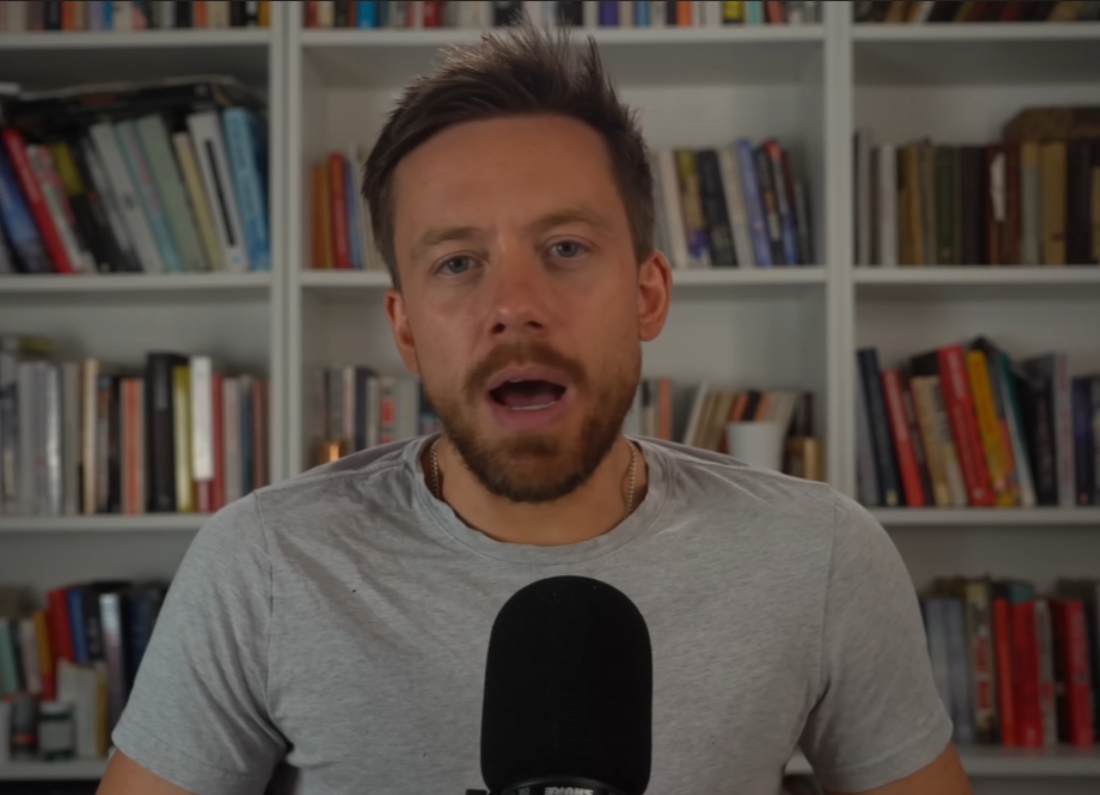
Owen Jones has published a YouTube video asking whether Britain is headed for dictatorship – and making the specific argument that British exceptionalism, the idea that democracy is somehow culturally embedded here in a way that makes tyranny impossible, is not a protection but a complacency. His central claim is that Britain’s constitutional structure – parliamentary sovereignty, no codified constitution, no federal courts, no separation of powers – makes it significantly easier to establish authoritarianism here than it was in the United States. Reform UK’s published programme, he argues, is a detailed blueprint for doing exactly that.
The video opens by anticipating the obvious reaction: that raising the question of dictatorship in Britain is hysteria, that this is Britain, that democracy has prevailed here for over a century, that we’ve had no absolute monarchy or tyranny since the 17th century. Jones says he is not the boy who cried wolf. He sets out to make the case carefully.
American exceptionalism – and what happened to it
The starting point is the US. American exceptionalism held that someone like Donald Trump could never become president. He became president twice. The V-Dem Institute at Gothenburg University, which produces the annual democracy report, has stated that “the speed with which American democracy is currently dismantled is unprecedented in modern history,” and that the pace is “comparable to some coup d’état.”
Jones catalogues what Trump has done: concentrated power in the executive while bypassing Congress; politicised the federal bureaucracy to serve ideological ends; weaponised the justice system against opponents; turned ICE into what he describes as an out-of-control arm of the state that has killed migrants and US citizens; deployed the National Guard to opposition cities; attacked judicial independence; had lawful permanent residents arrested for pro-Palestinian views; slashed university funding and targeted institutions over Palestine and minority rights; hobbled the media through lawsuits, broadcast licence threats and journalist access blocks.
And then there is the media ownership dimension. Pro-Trump businessman Larry Ellison and his son have bought CBS News, whose editorial position has shifted in Trump’s favour. They are on course to take over CNN. TikTok, demonised as pro-Palestine, was taken over by a consortium including the Ellisons.
This all happened, Jones argues, in a country with a codified constitution, a First Amendment, a federal court system, 50 state governments with constitutionally protected powers and a two-chamber legislature both separately elected.
Why Britain is more vulnerable
Jones’ central argument is counterintuitive but specific. Britain has none of those structural protections. No codified constitution. No First Amendment-style free speech protections. No federal courts. No state governments. Devolution exists but its powers are gifted by Westminster and can be removed by Westminster. Britain is, Jones argues, one of the most centralised states in the Western world.
The operational consequence is what political scientists call parliamentary sovereignty – what Lord Hailsham famously called in the 1970s an “elective dictatorship.” Win a majority of seats in the House of Commons and you can do, in practice, almost whatever you want. Under first-past-the-post you can win a small minority of the national vote and win everything. Labour in 2024 got 34.7% of the vote – just over a third – and won two-thirds of the seats.
The House of Lords exists. But a government that wants to neutralise it can. The Parliament Acts allow a government to eventually bypass the Lords entirely. Reform’s own manifesto pledges to replace the Lords with what it calls “a much smaller, more democratic second chamber.” Jones notes that how this chamber would be constituted is left deliberately undefined – it says “structure to be debated.” It does not say elected.
What Reform is actually proposing
Jones then goes through Reform’s programme in detail, argument by argument.
Leave the ECHR and repeal the Human Rights Act. This strips individuals of their primary legal protections against the state. As we reported in our Stefanovic Reform policies piece, the ECHR is the reason the Hillsborough families could demand justice, the reason victims of abuse can seek safety and the reason disabled people are treated with dignity. Peter Stefanovic asked whether you would trust a party that wants to scrap the Equality Act and legalise fire and rehire with designing your replacement rights. Jones asks whether you would trust a party that calls rival politicians “traitors” with that power.
Create a British ICE. A mass deportation force modelled on the US Immigration and Customs Enforcement, which Trump has already used to detain lawful permanent residents and US citizens. Zia Yusuf has stated that Reform’s legislation will mean “lawyers and judges will be powerless to stop any of it.” His characterisation of lawyers as “degenerate” is, Jones notes, “the language you expect from fascists.”
Politicise the civil service. Reform’s manifesto commits to replacing senior civil servants with “successful professionals from the private sector” who would be political appointees. Ministers would be given the power to sack civil servants directly. The civil service, which is supposed to be strictly independent of political control, would become an instrument of the government.
Take direct powers over the police and declare a war on activist judges. Jones identifies this as the removal of institutional independence from the two pillars of law enforcement.
Scrap the Equality Act. As we reported in our Stefanovic piece, this would effectively legalise discrimination against women, disabled people and gay workers. Jones frames it in the context of Reform’s declared hostility to legal protections for minorities.
Ban face coverings in public. Ban mass Muslim prayers near historic sites. Christian and Jewish prayers are not mentioned. Jones: “We are all very naive if we think that’s as far as the state-backed Islamophobia a Reform UK government will go.”
Threaten universities. Yusuf has threatened to defund universities that don’t platform Reform MPs. Reform’s 2024 manifesto pledges to cut funding to universities that “undermine free speech” – a phrase Jones describes as “a euphemism for institutions refusing to submit to hard-right politics.”
Roll back voting rights. Reform has committed to restricting postal voting and removing voting rights from Commonwealth citizens. After the Gorton and Denton by-election, Reform claimed – without evidence – that they had lost due to “sectarian voting and cheating.” The police found no evidence of fraud. Jones: “If they’re going to make up lies about the electoral system, they will use that to justify policies to restrict people from voting.”
Zia Yusuf’s tweet – and what “traitors” means
Jones focuses on a specific tweet by Yusuf: “Recent events demonstrate why I view the Tory and Labour politicians who created the burning injustice of modern Britain as traitors to their country. A reckoning is coming.”
The tweet doesn’t define “recent events,” “burning injustice” or “reckoning.” Jones’s analysis is precise. “Describing rival opposing politicians as traitors to their country – well, let’s put it this way. Those deemed traitors to their country do not historically speaking fare well. If you’re saying they’re traitors to their country, you’re saying they’re going to get a reckoning. What does that mean?”
As we reported in our Zia Yusuf and Laura Kuenssberg piece, Yusuf also told Kuenssberg that Reform’s deportation legislation will mean lawyers and judges are “powerless.” The language around the judiciary, lawyers and political opponents builds a consistent picture of a party that views legal and institutional checks not as legitimate constraints but as obstacles to be removed.
The cordon sanitaire – and why it’s gone
Jones’s broader argument is about the collapse of what he calls the post-World War II cordon sanitaire – the consensus that the hard right should be treated as politically illegitimate, that there is a line you can go to but no further. That consensus, he argues, has collapsed across the Western world. The far right has been legitimised, is in government in some countries, and has either replaced or taken over the centre right elsewhere.
The consequence is that the institutional resistance to Reform’s programme, if it were to gain power, should not be taken for granted. The right-wing press – the Sun, Daily Mail, Telegraph – would not resist it. The BBC is vulnerable: the government controls its funding settlement, renews its royal charter and influences senior appointments. “Neutralised with ease,” Jones says.
He is careful to say he is not predicting this outcome. He is describing the conditions that would make it possible. The structural protections that American democracy had – and which Trump has still not fully dismantled despite unprecedented speed – Britain doesn’t have. The checks that a Reform government would face are weaker. The authoritarian precedents – anti-protest laws, the prescribing of Palestine Action as a terrorist organisation equivalent to ISIS and al-Qaeda, the banning of Piker and Uygur – already exist and can be built on.
“We’re not talking about right-wing Tories of the sort we’ve endured,” Jones says at the end. “We’re talking about a very different brand of politics and they are preparing for power and they have an opportunity.”
You can watch the video below:




Leave a Reply