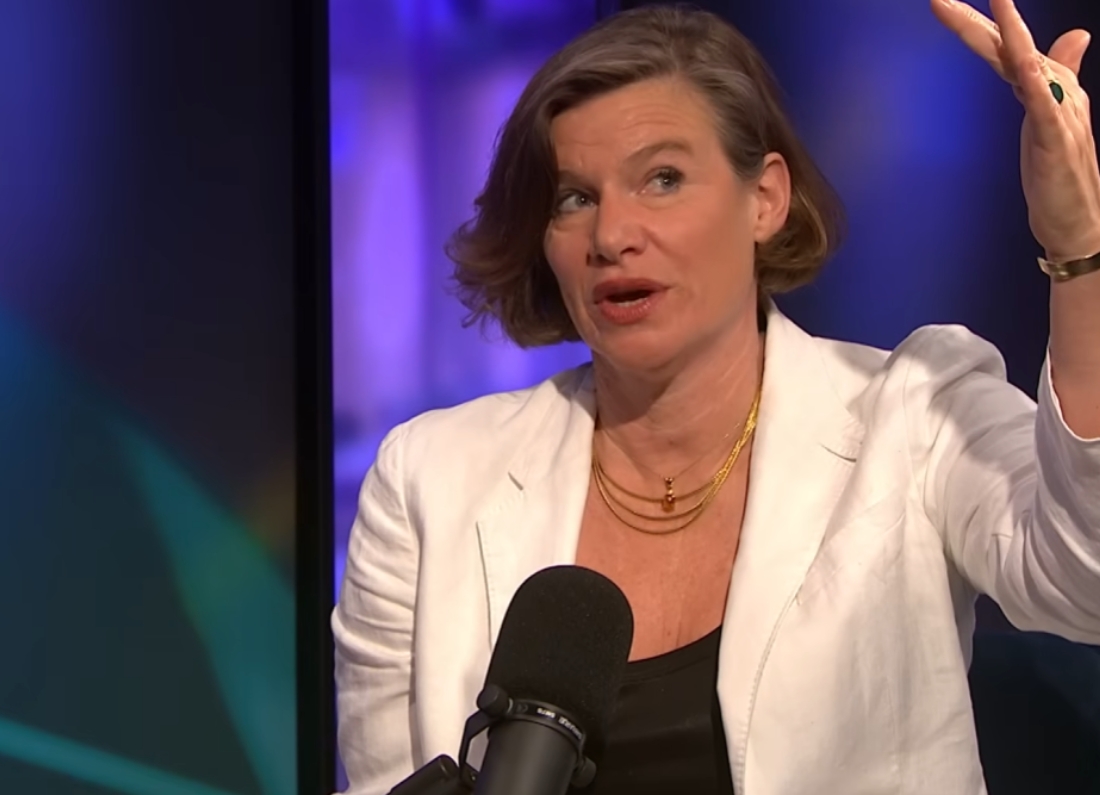
Mariana Mazzucato, one of the world’s most influential economists and the academic whose work shaped Labour’s original pitch for power, has gone viral for a Channel 4 News interview in which she called what Farage and Boris Johnson did on Brexit “a crime,” said the UK has underinvested by £500 billion compared to OECD averages over the last two decades, and said that both men have still not been held accountable. She also had things to say about Palantir, Spain’s energy bills, Andy Burnham and what happens to public money when it is war versus welfare.
The crime of Brexit
The specific passage that has driven the clip’s virality is Mazzucato’s language on accountability. “I do think that it is a crime – and I’ll use that very strong word – what both Farage and Boris Johnson did, which was to lie and lie again, and are still not been held accountable for such a problematic policy.”
She is careful to separate this from condescension toward Leave voters. “I’m not telling people they’re stupid. I do think we have to stop thinking that people somehow have just been brainwashed.” Her argument is that voters made a choice in a referendum in which they were given false information by people who have faced no consequences for providing it.
On the economic consequences she is blunt: “Just look at the data. They left. Businesses left. So now because they left, because our market is so much smaller – because what drives business investment are the expectations of future market and technological opportunities – what was Brexit but a massive reduction in our market size?”
The specific numbers she cites: the UK is 27th in the OECD in terms of investment as a share of GDP. Had the UK invested at the OECD average over the last two decades, it would have invested £500 billion more. Both the public and private sectors have failed to invest – and without bold public investment that creates expectations of where future opportunities lie, private investment does not follow.
Where is the money – unless it’s war?
One of the most resonant arguments in the interview is Mazzucato’s observation about how governments discuss money. She returns to it multiple times.
“During war, no one says there’s no money because they know that the money can be created. Had we invested the average of OECD countries, we would have invested 500 billion pounds more in the last two decades.”
“Unless it’s war. Let’s just call stuff out, right? During war, no one says there’s no money. Why is that? Because they know that the money can be created in a global north country, especially one that has its own sovereign currency. You can create money.”
Her critique of Labour is that it began with the negatives – the winter fuel payment, disability allowance cuts – rather than the positives. “Beginning with the negatives instead of the positives and the few positives like the net zero mission not really kind of backing it and saying that’s what will catalyze growth. It’s a false trade-off. It’s not either we do green or we do growth.”
Spain and the energy lesson Britain hasn’t learned
Mazzucato uses Spain as a direct comparison to the UK’s energy response – one that is increasingly relevant given US tariffs and global supply chain disruptions.
Spain held course on renewables rather than subsidising consumer bills through public money. Instead, it taxed excess profits in the energy sector to prevent prices from spiralling, capped prices based on competitive renewable energy prices rather than gas, and did not allow energy companies to benefit from the crisis at public expense.
The result: Spain now has electricity bills 40% cheaper than the UK’s.
“We have to prevent excess profits,” she says, “exactly what NASA said would not help us get to the moon.” The NHS data contract she names specifically: “If you have problematic contracts like just opening up the NHS data to Palantir in the name of being business-friendly – if we have different types of deals for the private sector because we’re worried about the private investment that left after Brexit, which then causes a lack of transparency – that’s not the way I think to structure a progressive economy.” As we reported in our Palantir and Khan piece, Sadiq Khan blocked Palantir’s Metropolitan Police AI contract for procurement rule breaches – a decision Mazzucato’s framework would endorse.
On Andy Burnham and the Labour leadership
Mazzucato is careful not to endorse a candidate. But she is not neutral.
“I did actually work with Andy Burnham in Manchester on some Manchester missions around sustainable transport. The Good Growth Commission. We actually worked on it together four or five years ago. We saw each other a couple of weeks ago in Madrid through a wonderful gathering of mayors globally and he came up to me and said how much he had appreciated the work.”
On Burnham’s fit with her framework: “I do have a lot of time for Andy Burnham.” On Starmer: “I do think Kier Starmer, if he could just get some more courage, strategy, and vision and have his government back him, there’s still time to do it right.” She does not suggest those two things are equally likely.
Her broader argument is that the question is not which individual leads but whether the programme is mission-oriented, goal-driven, genuinely co-created with communities and backed by strategic public investment. “The question is can any of these candidates come in and catalyze business investment in an investment-starved country where both public and private have not done their job.”
She adds something that directly connects to the byelection on 18 June: “I would love to see the Green Party and the Labour Party come together to fight Reform, which I think is an extremely problematic agenda.” As we reported in our Burnham land value tax and campaign launch piece, the Greens are not standing in Makerfield.
The common good economy – and the compass
Mazzucato’s new book, The Common Good Economy, argues that both left and right have become trapped in a model that treats the public interest as an afterthought rather than the central purpose of economic policy. She proposes what she calls a “common good compass” – purpose, co-creation, sharing knowledge, sharing rewards, and transparency and accountability.
The critique of how the UK has governed public-private partnerships is sharp. “Biologists are more rigorous than economists. When they talk about ecosystems they will actually differentiate a parasitic predatory ecosystem versus a mutualistic symbiotic ecosystem based on reciprocity. They have mathematical equations for this. So if we want to talk about goals and everyone talks about goals, why is it that we’re not delivering?”
The answer she gives is that economic theory and practice is not built around goals but around fixing what economists call market failures after the fact – which costs more than getting it right at the start. She cites Nick Stern’s climate report: the cost of inaction is higher than the cost of action. “It costs less to educate a child, to invest in youth centers, community centers, mental health, than to imprison them. Do we do that? No.”
Her dream vision for the common good economy, offered at the interview’s close, is modest and specific: “The youth centers, community centers, public libraries, public pools. In terms of the accessibility. Those – we have to reinvent the welfare system. What does it mean for a progressive government to put that as priority – as an economic agenda, as an innovation agenda? Allow everyone to flourish, invest in their ability to be creative and to flourish. That’s a common good economy.”
You can watch the full video below: