

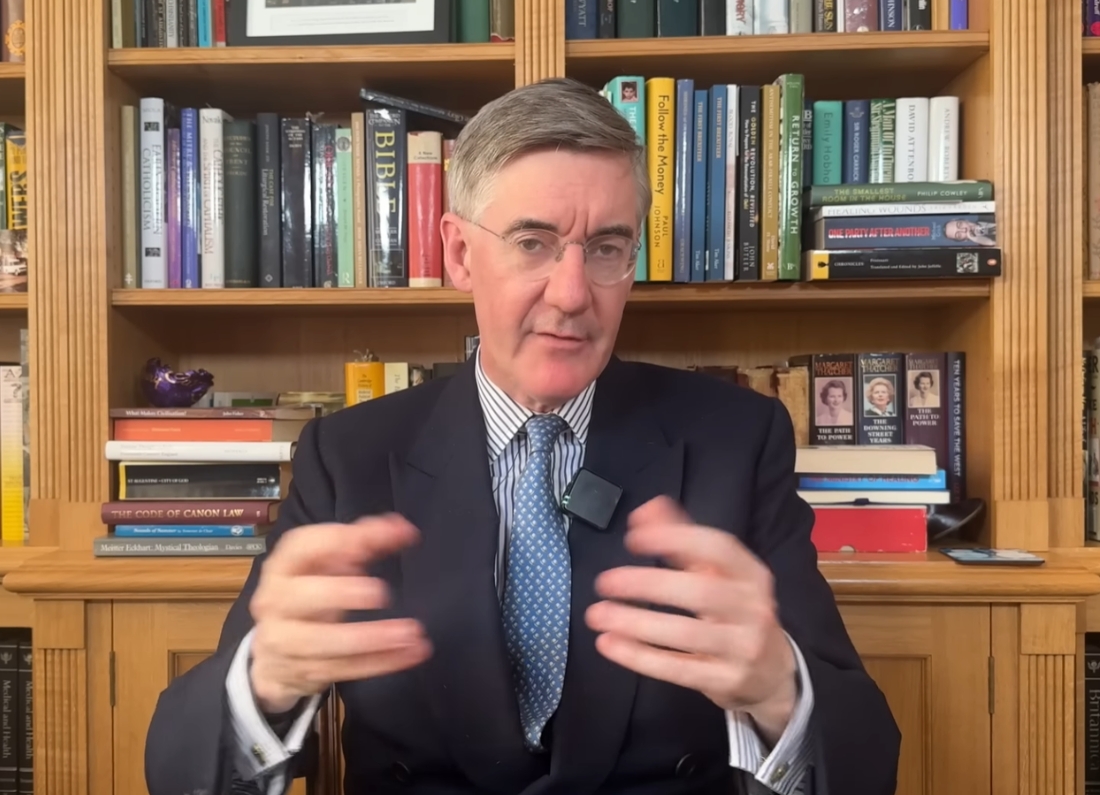
We cross now to Jacob Rees-Mogg, the former Minister for Brexit Opportunities, a job title that aged about as well as a lettuce in direct sunlight.
Rees-Mogg, who served in that role in Boris Johnson’s government from February to September 2022, decided to offer one of those grand Brexit prophecies that sounds less like analysis and more like something written on parchment with a quill.
Responding to a story about the EU budget, he wrote: “In a generation there will be no EU to rejoin.”
Right then.
The problem with the prediction
This is the same European Union that still has 27 member states, nine candidate countries as of early 2026, and a queue of countries trying to get in rather than out. Albania, Bosnia and Herzegovina, Georgia, Moldova, Montenegro, North Macedonia, Serbia, Turkey and Ukraine are all listed as candidate countries by the European Parliament’s research service.
It is also, awkwardly for Rees-Mogg, not where British public opinion appears to be heading. Survation’s mega poll found 63% would now vote to rejoin the EU against 37% who would stay out, a 26-point margin representing a 30-point swing from 2016. A separate YouGov poll found two-thirds of Britons believe Brexit has made every issue they care about worse. YouGov’s May polling specifically found 55% support for rejoining, against 34% opposed, while its June tenth-anniversary polling found 57% of Britons now believe the UK was wrong to vote Leave.
So yes, apart from the EU still existing, more countries wanting to join it, and more Britons wanting to rejoin it, a flawless prediction.
The economics haven’t helped his case either
The intervention comes after years of increasingly grim Brexit economics. The Office for Budget Responsibility has repeatedly worked on the assumption that Brexit will reduce long-run UK productivity by around 4% relative to remaining in the EU. The Centre for European Reform has separately found Brexit has cut trade across almost every sector of the UK economy, with agrifood exports down 29% and travel exports down 39%.
Rees-Mogg has never been a man to let events get between him and a forecast. This is the former Commons leader whose government’s prorogation of Parliament was ruled unlawful by the Supreme Court in 2019, after Boris Johnson’s administration attempted to suspend Parliament during the Brexit crisis, a legal defeat that has resurfaced repeatedly in recent commentary on the Conservative Party’s record on constitutional stability, including in response to Kemi Badenoch’s recent warning of a Burnham “summer of chaos.”
The reaction
If Rees-Mogg was trying to reassure himself, the internet was not in the mood to join in.
Chris Bryant wrote: “Utter tosh. I remember people making all sorts of false claims about Brexit (including that we would remain in the single market) and arguing that others would follow us. But what actually happened? More want to join.”
Mike Galsworthy said: “It almost as if he is in deep wishful thinking that the UK won’t have the choice…”
John O’Brennan added: “Yep, these idiots are STILL doing this cabaret act. Even after losing up to 8% of GDP and 12% of inward investment.”
Higgins Cartoons went full letter-to-the-manor-house: “Dear Jacob Rees-Mogg, How nice to hear from you, still making pronouncements I see. I fear I thought you had passed to a better place after you were made ‘Minister for Brexit Opportunities’. I heard nothing from you in that post? Tell me of the unicorn infested sunlit uplands.”
Stephen Colvin wrote: “Oh god. Sometimes I’m embarrassed by some brexiteers. They’ve been saying this for ages.” Chris Portis kept it simple: “Nanny, he’s on the internet again.” Evert te Winkel said: “There have been a lot of stupid British politicians, but this one takes the cake.”
Dcms1000 asked the obvious follow-up: “Then where will you move your companies to avoid tax you haunted hatstand?” And Clive Wismayer wrote: “Does Jacob want to see a return to 27 currencies, competitive devaluation, internal customs barriers and, er, war? Continental Europeans don’t hate each other. It’s only the English who do that.”
Not exactly a new prediction
The funny thing is, Rees-Mogg’s forecast is not even original. Eurosceptics have been declaring the EU days from collapse since roughly the invention of colour television. Every eurozone crisis, migration crisis, budget row or French farmer with a tractor gets treated as the final death rattle of Brussels. And yet somehow the thing keeps existing.
Lord Matthew Elliott, the Vote Leave chief executive, faced similar difficulty defending the Brexit legacy on its tenth anniversary, struggling to reconcile his own book’s account of NHS funding with the £350m bus claim when directly challenged. Rees-Mogg’s intervention fits a broader pattern of senior Brexit-era figures continuing to insist the project has succeeded, or is about to be vindicated, even as the polling and economic data move further in the opposite direction.
The UK, meanwhile, left, discovered that sovereignty does not unload lorries, that borders mean border checks, that “taking back control” did not magically make the country richer, and that being outside the room does not make the room disappear.
Rees-Mogg may be right about one thing: in a generation there may well be no EU to rejoin. Not because the EU has vanished. But because by then, the terms for Britain getting back in may look very different indeed.










Leave a Reply