


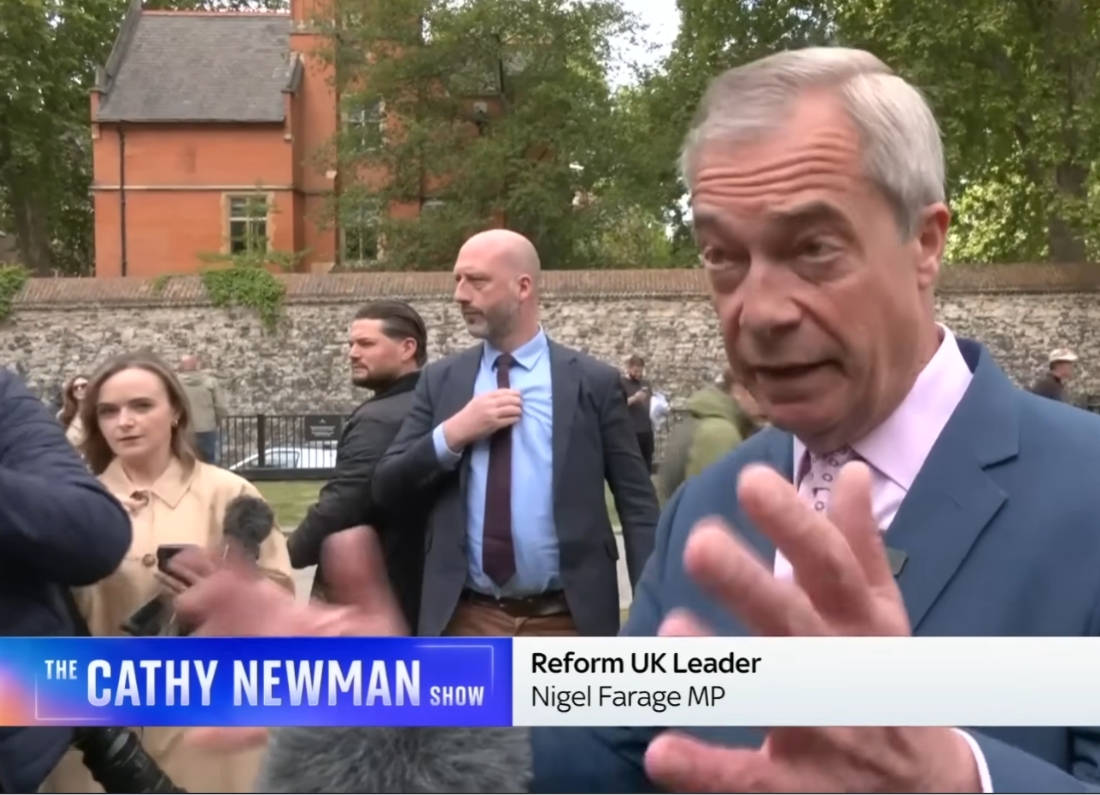
There is a pub in every town in England where Nigel Farage would be warmly received. He would pull up a stool, order a pint, light a cigarett outsidee and tell anyone who listened that the country had been stolen – by the establishment, by the banks, by the liberal elite, by the people who went to the right schools and ran things for themselves while the rest of us were left behind. And the people in that pub would nod. Because they are not wrong to feel left behind. They have been left behind. The question is who is actually doing the leaving.
Because here is what Farage does not mention at the bar. His party’s biggest financial backer lives in Thailand. Its second biggest donor pleaded guilty to federal financial crimes in America and was subsequently pardoned by Donald Trump. And Farage himself has personally invested in a Bitcoin company that would be directly worth millions to him if his own party’s policies were ever implemented.
The “man of the people” is, in fact, a man of very specific people. And they are not the people in the pub.
The money behind the movement
Let us start with the numbers, because they are extraordinary. Christopher Harborne, a Thailand-based aviation and cryptocurrency investor who goes by the name Chakrit Sakunkrit in Thailand, has donated more than £12 million to Reform UK – making him the single largest donor in the history of British politics. He is the source of approximately two-thirds of all money Reform has ever received.
Harborne made his fortune in aviation fuel before becoming a major investor in Tether, the cryptocurrency stablecoin that has effectively become the dollar of the crypto world. Tether generates profits comparable to Goldman Sachs. Harborne also holds stakes in crypto exchange Bitfinex. He is not a struggling working-class voter who wants his country back. He is a reclusive billionaire operating from Southeast Asia who has chosen to channel enormous financial resources into reshaping British politics.
Then there is Ben Delo. The 42-year-old co-founder of BitMEX – one of the world’s largest cryptocurrency derivatives exchanges – is described as Britain’s youngest self-made billionaire. He donated £4 million to Reform UK earlier this year, before the government introduced a £100,000 cap on donations from British citizens living abroad. When the cap came in, Delo did not stop. He announced he was moving back to the United Kingdom from Hong Kong specifically to circumvent it. He intends to donate millions more to help Farage “build a war chest.”

Delo’s legal history is worth pausing on. In 2022, he pleaded guilty in the United States to violating the Bank Secrecy Act – specifically, wilfully failing to implement anti-money laundering controls at BitMEX. He was fined $10 million and received 30 months of probation. Last year, Donald Trump pardoned him.
A man pardoned by Trump after pleading guilty to financial crimes is now relocating to Britain specifically to fund the party most aligned with Trump’s political model. Farage described Delo as “a true patriot.” Reform called him “a builder, visionary and problem-solver.” It did not call him a convicted financier. It did not mention the guilty plea, the fine or the pardon.
The conflict of interest nobody is talking about
The Harborne and Delo money would be concerning enough on its own. But Farage’s own personal financial situation raises questions that go beyond donor relationships.
In March, Farage announced a personal investment of £215,000 in Stack BTC – a Bitcoin treasury company chaired by former Chancellor Kwasi Kwarteng. Stack BTC is what is known as a “Bitcoin treasury company”: it exists primarily to buy and hold cryptocurrency. Its business model depends on investors believing that the company’s share price will rise as Bitcoin rises. Farage’s bonus in the company is triggered if Stack hits a market valuation of £100 million. At the point of his investment announcement, the share price quadrupled. On paper, Farage made more in a single day than many of his Clacton constituents earn in a decade.
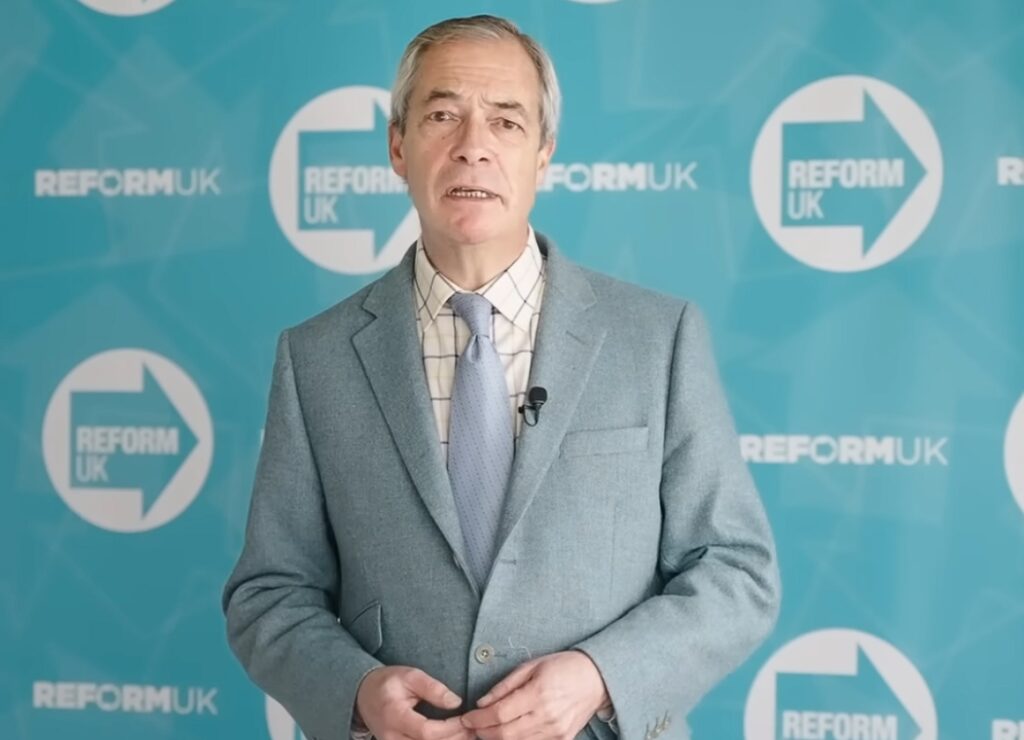
Now consider what Farage is simultaneously promising as political policy. He wants to cut capital gains tax on cryptocurrency from 24% to 10%. He wants the Bank of England to hold Bitcoin as a national reserve asset. He wants a sovereign wealth fund built from crypto assets. He has told a crypto conference in Las Vegas: “When it comes to your industry, I am your champion.”
The man advocating for policies that would directly benefit his own investment portfolio is the same man presenting himself as the outsider fighting the rigged system. The conflict of interest is not subtle. It is structural and deliberate.
Fraser Nelson, in a forensic essay for the Sunday Times, called this “illiberal conservatism” – a model associated with Viktor Orban in Hungary and Silvio Berlusconi in Italy, in which politicians do not merely set market rules but actively pick winners and punish those who resist. Under this model, it is not a free market but a managed one where advantage flows through proximity to power. Orban’s childhood friend from school is now the richest man in Hungary. Berlusconi ran Italy while owning its media. Farage is proposing to govern Britain while personally invested in the industry he is promising to deregulate and reward.
The Electoral Commission’s blind spot
There is a further dimension to this that has received insufficient scrutiny. Byline Times reported that Reform UK has not shared any of its cryptocurrency wallet addresses with the Electoral Commission – the body responsible for monitoring political finance. Without those wallet addresses, the Commission cannot independently verify where Reform’s crypto donations are coming from or who is behind them.
A spokesperson for the Commission told Byline Times: “Reform has not shared any crypto wallet address with us. We routinely request a variety of information from parties to ensure they are fulfilling their legal responsibilities.” In other words, the watchdog has asked. Reform has not answered.
The government has since announced a moratorium on cryptocurrency donations to political parties, citing concerns that digital assets could be used to obscure the origin of political funding. The moratorium came too late to catch the donations already made.
The pint glass and the private jet
Let us return to the pub. Farage’s entire political identity is built on a performance. The pint. The cigarette. The rolled sleeves. The accent that drifts, chameleon-like, between the public school he attended and the working men’s clubs he visits. The claim to speak for people who have been ignored, overlooked and left behind by a metropolitan establishment that does not understand them.
There is genuine grievance behind that performance. Deindustrialisation, wage stagnation, housing unaffordability, NHS decay, the broken promise of prosperity that came after the financial crash – these are real. The anger they produce is real. The feeling that nobody in power gives a damn about ordinary people is, in many cases, accurate.
But the answer to a rigged system run by the wealthy for the wealthy is not a different version of the same thing. When Farage flew to the Maldives on a private jet linked to his billionaire donor, spent two days failing to reach the Chagos Islands and flew home, he declared it a “humanitarian mission.” It cost, by his own declaration, £25,000 – a figure Labour calculated bore no relation to the actual market rate of an 11,000-mile round trip on a £45 million aircraft.
When his party’s flagship Kent County Council raised council tax by 3.99% after promising to cut it – after the DOGE efficiency unit found nothing to cut – the people who had voted for change found themselves paying more. When the free energy bills prize draw was won by “staunch branch members” of the local Reform party, not by struggling households, the curtain slipped.
The Farage mirage is not a new phenomenon in British politics. Populist leaders have always dressed up the interests of the powerful in the language of the people. What makes this iteration different is the scale of the financial flows involved, the opacity of the crypto funding, and the brazenness of the conflict of interest between Farage’s personal investments and his policy platform.
Neil Kinnock called it a “posh boys club” that has “no design, no practical plan.” He is right. But it is something more specific than that. It is a crypto industry lobbying operation dressed as a revolution – bankrolled by billionaires who stand to profit enormously from the deregulation it promises, fronted by a man who has spent 30 years perfecting the art of sounding angry while serving the interests of people who are never angry because the system works very well for them.
![Neil Kinnock A Labour Rebel's Path To Power [YouTube]](https://thedailybritain.co.uk/wp-content/uploads/2026/04/Neil-Kinnock-A-Labour-Rebels-Path-To-Power-1024x740.jpg)
The people in the pub deserve better than that. They deserve politicians whose financial interests are aligned with theirs – not with those of a reclusive Thai-based Bitcoin billionaire and a man pardoned by Donald Trump for financial crimes.
That is not what Reform UK is offering them. It never was.













Leave a Reply