

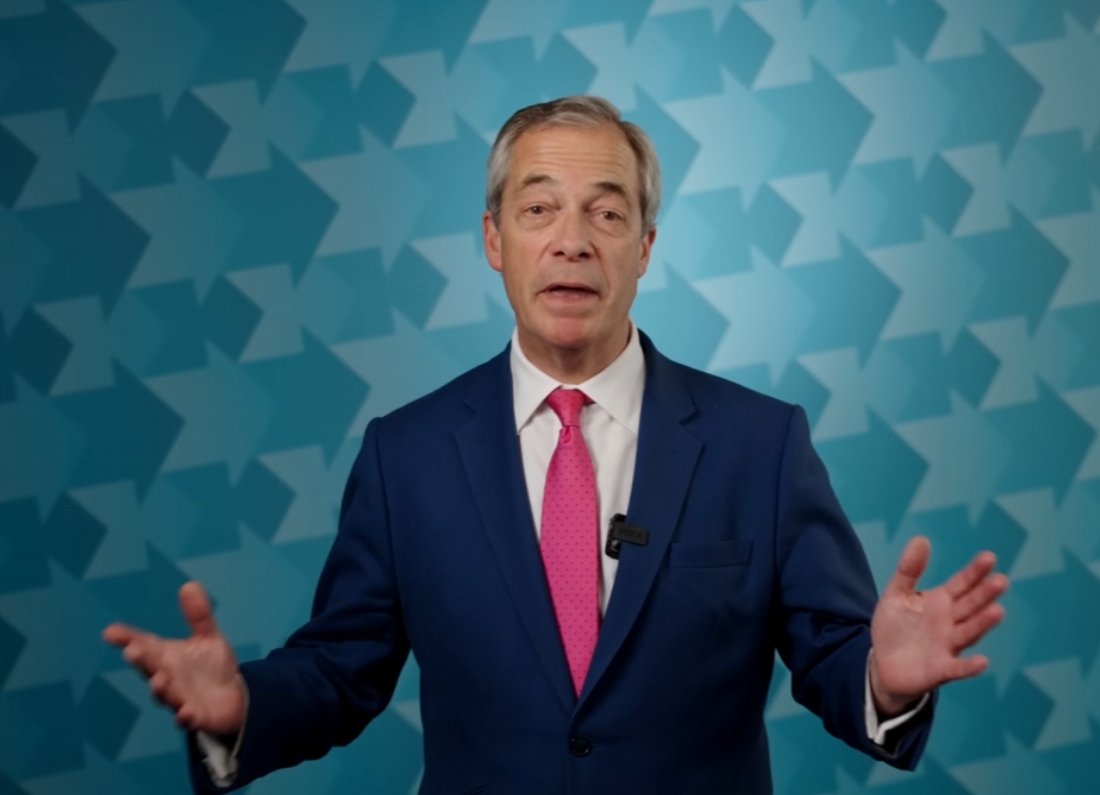
Reform UK’s support has dropped to its lowest level in more than a year, according to new polling, as the party faces a mounting pile of scandals across Scotland, Wales and England in the weeks before crucial elections – while former Labour leader Lord Neil Kinnock has delivered a blistering assessment of Farage’s party as a “posh boys club” with “no design, no practical plan.”
The twin developments represent a significant moment for a party that has spent the best part of a year projecting an image of unstoppable momentum. With May 7 local elections in England and May 7 Scottish Parliament elections both now just weeks away, the question of whether Reform’s surge has peaked – or whether the current wobble is a temporary blip – has become one of the defining questions of British politics.
The polling picture in Scotland
A Norstat survey for the Sunday Times showed Reform‘s support in Scotland plummeting since February, down four points to 15% in both constituencies and the regional list – the lowest level the party has recorded in any Norstat poll since January 2025.
Professor Sir John Curtice of Strathclyde University, Britain’s most respected polling analyst, said the drop was “bad news” for the SNP, paradoxically – because it could encourage tactical voting against John Swinney’s party. “Support for Reform is down by four points on both ballots and is lower than in any Norstat poll since January 2025,” Curtice said. “It must be concerned that the tide of support it has been enjoying has receded just weeks before it has the opportunity to turn polling numbers into electoral success.”
He identified two specific factors behind the decline in Scotland. The Iran war has reframed the politics of populism in ways that work against Reform: “Following the US bombing of Iran, Nigel Farage’s close association with the US president may now be a disadvantage. Even those who voted Reform in Scotland in 2024 now give Donald Trump a negative net rating.” He also pointed to the party’s Scottish leader: “Meanwhile, the party’s Scottish leader, Malcolm Offord, is not proving an electoral asset.”
That is a considerable understatement. Lord Offord has been dogged throughout the campaign by a racist and homophobic joke he told at a rugby club dinner in 2018. Within 24 hours of Reform naming its Scottish candidates last month, one had already been suspended after it emerged he had been banned as a company director for seven years after diverting thousands of pounds from a taxpayer-funded Covid loan into his personal account. Multiple other candidates have faced scrutiny for past social media posts expressing bigoted and hateful views.
The projected seat outcomes from the Norstat figures suggest the scale of the challenge Reform faces in translating Scottish votes into Holyrood representation. The party’s 15% vote share would yield around 16 MSPs under the proportional regional list system – a significant presence in the chamber, but well below the position of official opposition that some in Reform had hoped for.
The picture across Britain
Scotland is not an isolated case. Two new polls published on the same weekend suggest the momentum Reform has enjoyed over the last year is stalling across the UK. The Lord Ashcroft poll for the Mail on Sunday put Reform on 21% – level with both the Conservatives and the Greens – having lost its outright national lead for the first time in more than a year.
That Lord Ashcroft finding is itself historic: the Greens drew level with Reform in a national poll for the first time ever – a development that, combined with the Scottish data, paints a picture of a party whose advance has hit genuine resistance across the United Kingdom.
In Wales, where Senedd elections also take place on 7 May, Reform has faced its own candidate controversies. Multiple candidates have been exposed for sharing bigoted and hateful views on social media. A third candidate quit the party after being selected, citing serious concerns about the vetting process and a lack of genuine concern for local issues. Defections from the party have also been reported.
In England, the accumulation of controversies has been relentless: the Kent County Council “horror show,” the Grenfell housing scandal, the failed Maldives trip, the Dolge efficiency unit finding no waste, the paper candidate cold calling, and a housing spokesperson whose comments about Grenfell drew calls for his sacking from across the political spectrum.
Neil Kinnock: ‘a posh boys club’
Into this context stepped Lord Neil Kinnock – the former Labour leader who fought and lost two general elections against Margaret Thatcher, and who has spent decades watching British populism from close quarters.
![Neil Kinnock A Labour Rebel's Path To Power [YouTube]](https://thedailybritain.co.uk/wp-content/uploads/2026/04/Neil-Kinnock-A-Labour-Rebels-Path-To-Power-1024x740.jpg)
Kinnock’s assessment of Reform was unsparing. Speaking to Nation.Cymru, he rejected the party’s claim to represent overlooked and forgotten communities, saying: “Of course it’s not. It’s the opposite. It’s a posh boys’ club. They don’t give a damn about the real wellbeing of the communities of Wales.”
He argued that Reform’s entire political proposition rests on emotion rather than substance: “The only argument going for them is grievance and resentment. You can’t represent people on that basis.”
On the absence of any coherent policy platform, he was equally direct: “You’ve only got a shout. There’s no design, no practical plan.” He pointed to what he described as “falsehoods like the economic bounty that was supposed to come from Brexit, which has proved to be a Farage mirage” – a phrase that cuts to the heart of Reform’s credibility problem.
Kinnock’s wider argument was that populism’s fundamental weakness is its inability to move from opposition to governance. Grievance, he suggested, is a powerful electoral tool but a useless governing one. The Kent County Council evidence – DOGE found no waste, taxes went up, councillors quit, services unchanged – appears to validate that critique in practice.
The ‘Farage mirage’ problem
The phrase “Farage mirage” is worth dwelling on. It echoes the critique now being made from multiple directions: that Reform has built its appeal on promises it cannot keep, in the same way that Brexit promised economic bounties that never materialised.
Farage promised that Kent County Council would be a “shop window” for how Reform would govern. One year on, the window displays chaos and broken promises. He promised to reach the Chagos Islands on a humanitarian mission. He flew to the Maldives, stood on a dock, and flew home. He promised DOGE would find waste “off the charts.” His own councillors admitted they found nothing. He promised to cut council tax in Kent. The council raised it by 3.99%.
The gap between the promise and the delivery – between the noise and the outcome – is precisely what Kinnock’s critique identifies. And with Scotland, Wales and English local councils all voting on 7 May, the question of whether voters have noticed that gap may be about to receive its most definitive answer yet.
What happens next
The Norstat data and the Ashcroft poll together suggest that the weeks between now and 7 May will be more competitive than many expected when the year began. Reform entered 2026 as a seemingly irresistible force. It now finds itself in a three-way tie in England with the Conservatives and Greens, falling in Scotland, facing candidate scandals in Wales, and being characterised by one of the most experienced figures in British political history as a party of slogans, grievances and empty promises.
Whether that characterisation sticks will depend partly on events – the Iran war, energy bills, and the NHS dispute could all shift the terrain – and partly on whether the Greens, Labour and the Liberal Democrats can persuade anti-Reform voters to consolidate effectively. The YouGov tactical voting data suggests that when voters are offered a straight choice between the Greens and Reform, the Greens win by 15 points. The local elections will test whether that latent preference can be mobilised in practice.
The momentum that made Reform look unstoppable six months ago has, for the first time, visibly stalled. What happens when the votes are counted on 7 May will determine whether this is a brief wobble or the beginning of the end of the Farage surge.
You may also like: Reform UK caught cold calling strangers to stand as paper candidates in May local elections





Leave a Reply