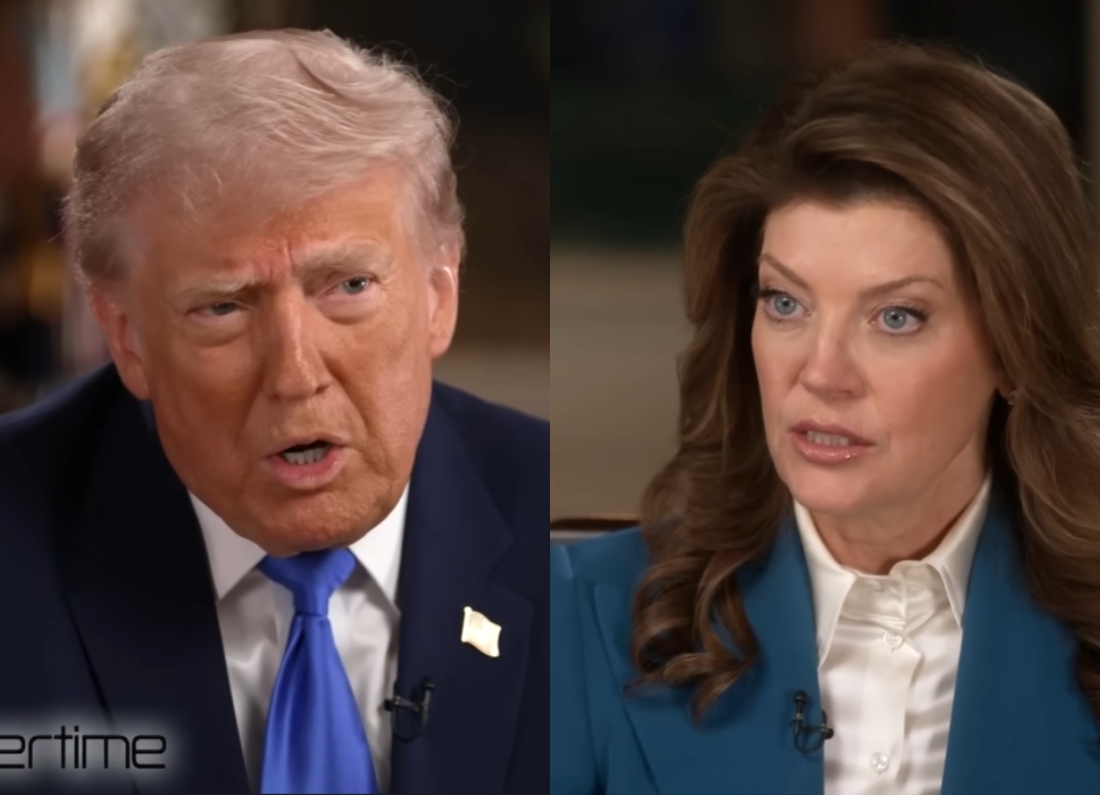
Donald Trump called veteran CBS journalist Norah O’Donnell “disgraceful” and declared “I’m not a rapist, I didn’t rape anybody” in a live television interview that began as an account of Saturday’s assassination attempt and rapidly descended into one of the most confrontational moments between a sitting US president and a network journalist in recent memory.
The 60 Minutes interview, broadcast on Sunday night, was supposed to give Trump the opportunity to address the nation following the attempted attack at the White House Correspondents’ Dinner – the annual gathering of Washington’s press corps, administration officials and celebrities at the Washington Hilton. Instead it became a television event in its own right, as a composed opening from Trump gave way to an extended and furious confrontation with O’Donnell over what it was and was not appropriate to broadcast to the American public.
How the interview started
Trump opened in relatively measured terms. Asked how worried he had been during the incident, he told O’Donnell: “I wasn’t worried. I understand life. We live in a crazy world.”
He said he had not made life easy for his Secret Service detail in the initial moments: “I wanted to see what was going on, and I wasn’t making it that easy for them. By that time, we started to realise maybe it was a bad problem, and different than what would be normal noise from a ballroom.”
He described agents repeatedly asking him and the first lady to get to the floor. “I started walking and they said, ‘Please go down, please go down on the floor.’ So I went down and the first lady went down also.”
He was notably tender when O’Donnell raised Melania’s visible distress in footage from the ballroom. “I saw the scene. They played it for me and, you know, pretty good closeup. And she looked very upset about what just took place, you know? Why not?” He added: “I’ve been through this before a couple of times. And she has not to this extent.”
The moment it exploded
The interview changed atmosphere entirely when O’Donnell moved to the gunman’s manifesto – a 1,100-word document that Cole Tomas Allen, 31, had sent to his family members approximately ten minutes before charging the hotel’s security checkpoint armed with a shotgun, a handgun and multiple knives.
O’Donnell told Trump: “The so-called manifesto is a stunning thing to read, Mr. President. He appears to reference a motive in it. He writes this quote, ‘Administration officials, they are targets.’ And he also wrote this: ‘I am no longer willing to permit a pedophile, rapist, and traitor to coat my hands with his crimes.’ What’s your reaction to that?”
Trump’s response was immediate and furious: “I was waiting for you to read that because I knew you would, because you’re horrible people. Horrible people. Yeah, he did write that. I’m not a rapist. I didn’t rape anybody.”
When O’Donnell asked whether he believed the gunman was referring to him, Trump continued: “I’m not a pedophile. Excuse me. Excuse me. I’m not a pedophile. You read that crap from some sick person? I got associated with stuff that has nothing to do with me. I was totally exonerated. Your friends on the other side of the plate are the ones that were involved with, let’s say, Epstein or other things.”
“You shouldn’t be reading that on 60 Minutes. You’re a disgrace. But go ahead. Let’s finish the interview,” he said, then added: “You’re disgraceful.”
O’Donnell pushed back, noting she was quoting the alleged gunman’s words as part of establishing motive. Trump was unmoved.
The security question
The interview also touched on a subject that has caused significant discomfort in Washington since the attack – the apparent security failures that allowed Allen to check into the Washington Hilton the day before the event, assemble a disassembled shotgun in his hotel room, and reach the security checkpoint outside the ballroom.
O’Donnell noted that Allen’s own manifesto had commented on the lax security, writing: “What the hell is the Secret Service doing? I expected security cameras at every bend, bugged hotel rooms, armed agents every ten feet, metal detectors out the wazoo. What I got is nothing.”
Trump’s response was characteristically dismissive: “Well, he was pretty incompetent too, because he got caught.”
The question of how Allen was able to bring disassembled firearms into the hotel undetected is likely to be the subject of a formal review. This was, by the acting attorney general’s own account, a politically motivated attack on the US president and his cabinet, carried out in a building that was supposed to have been secured.
Trump on the press – and wanting the dinner back
Despite the confrontational tone of the 60 Minutes interview, Trump said he did not want the White House Correspondents’ Association to cancel the annual dinner as a result of Saturday’s attack.
“I don’t want to see it be cancelled. I think it’s really bad for a crazy person to be able to cancel something like this,” he said, adding with characteristic ambiguity: “It’s not that I want to go. I’m very busy. I don’t need that.”
He was also noncommittal about whether Saturday’s events would change his relationship with the mainstream media. “For whatever reason, we disagree on a lot of subjects. We talk about crime. I’m very strong on crime. It seems like the press isn’t. It’s not so much the press. It’s the press plus the Democrats because they’re almost one and the same.”
The wider reaction
The 60 Minutes confrontation has reignited a debate that has run throughout Trump’s political career – about the appropriate boundaries between a free press and a president who believes certain information should not be made public.
O’Donnell’s defenders argue that reading from the manifesto of a man who just tried to kill the president and his cabinet is basic journalism. The manifesto directly establishes motive, and motive is central to any criminal case and any public understanding of what happened. Withholding it because it contains allegations Trump finds uncomfortable would be a form of self-censorship.
Trump’s supporters argue that broadcasting unverified allegations from a deranged gunman’s manifesto – allegations that happen to echo some of the most damaging claims made against the president – is something different from establishing motive, and that O’Donnell knew exactly what she was doing when she framed the question the way she did.
What is not in dispute is that a 31-year-old Caltech-educated engineer from California travelled across the country by train, checked into the hotel where the president was dining, and attempted to kill him and his cabinet. The dinner has been cancelled. The investigation continues. Allen is not cooperating with investigators and faces charges of using a firearm during a crime of violence and assault on a federal officer, with more charges expected.
And the first major television interview Trump gave about the attempt on his life turned into a row about journalism ethics that is likely to generate more headlines than the investigation itself.
You can watch it in full below:
You may also like: American millionaire trophy hunter trampled to death by elephants while hunting in Gabon rainforest