Donald Trump has extended the Iran ceasefire in a dramatic about-turn, hours after telling reporters he “expected to be bombing” – but Tehran has dismissed the extension as a tactical ploy and warned it is preparing to “reveal new cards on the battlefield,” leaving the fragile peace more precarious than ever.
The extraordinary reversal came after a day of whiplash diplomacy. Trump had spent Tuesday morning ramping up bellicose rhetoric, telling CNBC the US military was “raring to go” and that he did not want to extend the ceasefire. By the afternoon, he had posted the extension on Truth Social.
“Based on the fact that the Government of Iran is seriously fractured, not unexpectedly so and, upon the request of Field Marshal Asim Munir, and Prime Minister Shehbaz Sharif, of Pakistan, we have been asked to hold our Attack on the Country of Iran until such time as their leaders and representatives can come up with a unified proposal,” Trump wrote.
“I have therefore directed our Military to continue the Blockade and, in all other respects, remain ready and able, and will therefore extend the Ceasefire until such time as their proposal is submitted, and discussions are concluded, one way or the other.”
Iran’s response: ‘A ploy to buy time’
The extension drew an immediate and hostile response from Iran’s side. Mohammad Bagher Ghalibaf – the speaker of Iran’s parliament and its lead negotiator in recent talks – and his personal adviser dismissed it as tactical rather than genuine.
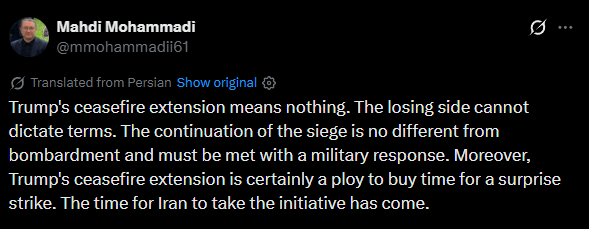
“A ploy to buy time for a surprise strike,” Mahdi Mohammadi wrote on social media. “The time for Iran to take the initiative has come. The losing side cannot dictate terms. The continuation of the siege must be met with a military response.”
Ghalibaf himself had already made clear that Iran would not come to the table while facing military pressure. “We do not accept negotiations under the shadow of threats,” he wrote, accusing Trump of seeking to turn the negotiating table into “a table of surrender.”
Iranian state television broadcast a statement confirming that “no delegation from Iran has visited Islamabad so far” – directly contradicting Trump’s suggestion that talks were imminent.
What caused the U-turn
Senior figures in the Islamic Revolutionary Guard Corps – who have consolidated their hold on power following the deaths of more pragmatic leaders in the initial US-Israeli strikes – were reportedly infuriated by Trump’s social media posts on Friday, in which he all but proclaimed American victory while depicting Iran as surrendering on its nuclear programme. That Iranian fury led to the Strait of Hormuz being closed again, just one day after Foreign Minister Abbas Araghchi had declared it open.
Trump’s decision to extend the ceasefire appears to have been driven by Pakistani mediation. Prime Minister Shehbaz Sharif – who has acted as the principal broker throughout – thanked Trump and posted that “Pakistan shall continue its earnest efforts for a negotiated settlement of the conflict.” Security has been tightened across Islamabad, with thousands of personnel deployed and government buildings, schools and colleges shut down ahead of anticipated second-round talks.
“If they don’t come to Islamabad, or the second round does not take place, it will be an embarrassing situation for Pakistan as well,” political analyst Nusrat Javed said.
The blockade continues – and escalates
Despite the ceasefire extension, the US maintained and intensified its naval pressure on Iran. Treasury Secretary Scott Bessent warned that Iran’s oil storage at Kharg Island – its key crude oil export facility – would reach capacity within days, forcing its oil wells to shut down. “In a matter of days, Kharg Island storage will be full and the fragile Iranian oil wells will be shut in,” he posted.
US forces on Tuesday boarded a second vessel – an oil tanker previously under sanctions for smuggling Iranian crude oil in Asia, intercepted in the Indian Ocean between Sri Lanka and Indonesia. This followed Sunday’s seizure of the Iranian cargo ship Touska in the Gulf of Oman.
Iran’s foreign ministry spokesperson described both ship seizures as “piracy at sea and state terrorism” and questioned whether Washington was negotiating in good faith.
The global stakes
The head of the International Energy Agency, Fatih Birol, has described the combined impact of the Iran conflict on oil – alongside Russia’s war on Ukraine’s effect on gas supplies – as “the biggest crisis in history” in global energy markets. The cumulative effect of the Strait’s closure has already exceeded half a billion barrels of lost oil production, and experts warn that even an imminent deal would not immediately restore prices.
UK Foreign Secretary Yvette Cooper, who has been in talks with counterparts about safeguarding the strait, described it as “a critical diplomatic moment” in the crisis. Britain and France are co-hosting an international conference on restoring Hormuz navigation and have been building a multinational coalition to reopen the waterway peacefully once the war ends.
The fundamental sticking points
The issues that derailed the first round of talks in Islamabad remain unresolved: Iran’s nuclear enrichment programme, its support for regional proxy forces including Hezbollah, and the Strait of Hormuz itself. Iran has demanded the blockade end before talks resume. Trump has insisted the blockade will continue regardless.
Trump told CNBC on Tuesday that Iran has “no choice” and claimed he had effectively achieved regime change. “We’ve taken out their navy, we’ve taken out their air force, we’ve taken out their leaders,” he said. “And I think we’re in a very strong negotiating position.”
Many analysts dispute that framing. Far from producing a more pliable Iranian government, experts say the conflict has strengthened the IRGC’s grip on power at the expense of more pragmatic figures, making a deal harder rather than easier to reach. The ceasefire extension buys time. Whether Iran uses that time to come to the table or to “reveal new cards on the battlefield” – as Mohammadi warned – may determine whether the world’s worst energy crisis in history gets significantly worse.
You may also like: The Onion acquires Infowars after 17 months of legal battles – and plans to relaunch it as a parody of itself