

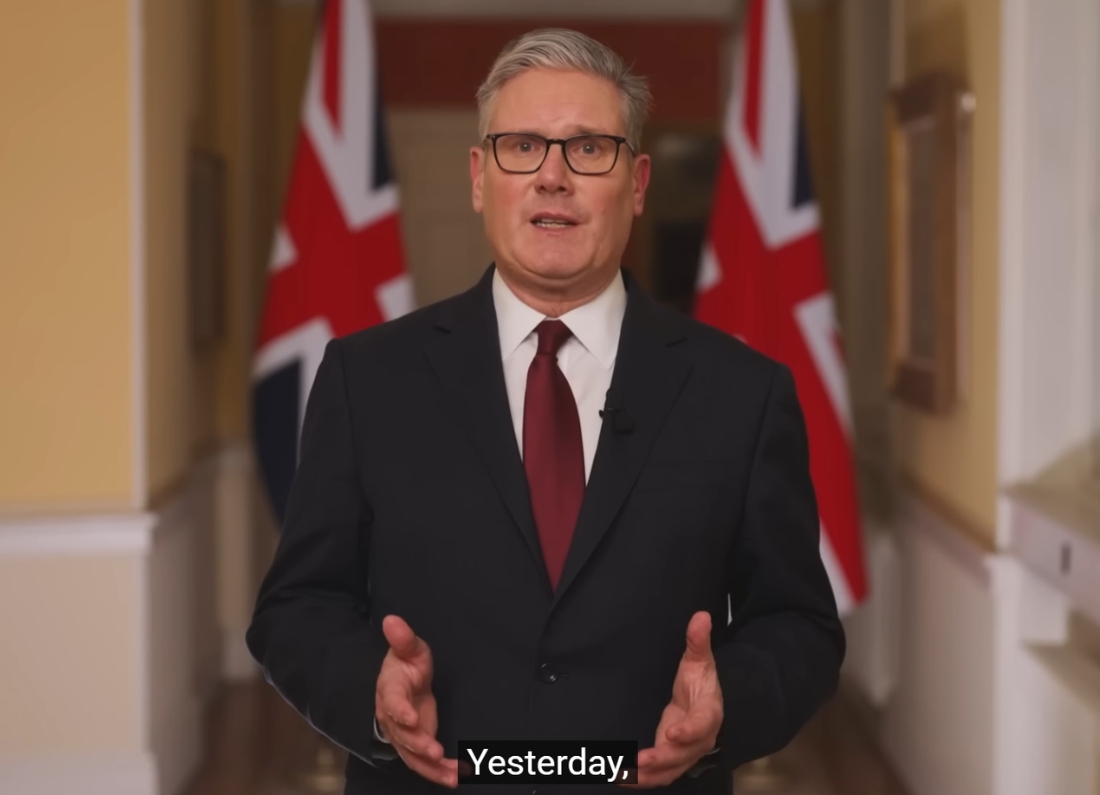
Keir Starmer has opened Labour’s 2026 local election campaign by going on the offensive over the Iran conflict, branding his political rivals “utterly reckless” for pushing Britain towards joining Donald Trump’s military campaign against Tehran.
Speaking at a campaign launch event in the West Midlands on Monday, the Prime Minister sought to reframe what has been a difficult period for his government – using his handling of the Iran war as evidence of sound leadership and responsible decision-making, in contrast to what he described as the dangerous impulsiveness of the Conservatives and Reform UK.
With voters heading to the polls on 7 May for local elections across England, and national elections in Scotland and Wales, Starmer is betting that a message of stability, fairness and measured judgement will cut through – even as his party faces some of the bleakest polling numbers of his premiership.
Iran takes centre stage
The most striking element of Monday’s launch was Starmer’s decision to place the Iran conflict so prominently at the heart of Labour’s campaign message. Last month, the United States launched pre-emptive strikes on Iran, and Washington subsequently requested full access to UK military bases to support that offensive operation. Starmer rejected the request.
He did, however, later agree to allow limited access for defensive and targeted strikes, in a careful attempt to maintain the UK’s alliance with the US without committing British forces to open warfare. It is a distinction the Prime Minister is now drawing loudly and repeatedly.
“We will protect our forces, our people, our allies in the region,” Starmer is expected to say. “But I made the decision that it is not in our national interest to commit British forces to a war, without a clear legal basis and a clear plan – and I stand by that.”
He then turned his fire on the opposition: “It’s a question of judgement. Do not forget that the Tories and Reform would have rushed us into this. With no thought of the consequences, including for the cost of living. Utterly reckless.”
Both the Conservatives and Reform UK had initially suggested Starmer should have granted Trump full access to British bases for the pre-emptive strikes – a position Starmer is now actively using as a political weapon against them.
“Stand together” in a volatile world
Beyond the Iran question, Starmer used the West Midlands launch to set out the broader theme of Labour’s campaign: unity in the face of global uncertainty. Flanked by Deputy Leader Lucy Powell and senior Cabinet ministers, the Prime Minister urged the country to “stand together” as conflicts in both Ukraine and Iran continue to reshape the international landscape.
“Because, in the context of everything that is happening in the world, those values – that fairness we stand for – it’s never been more important,” he is expected to tell supporters. “That is the thing about the volatile world we live in now. It tests, not just our security, our strength on the world stage. It also tests our fairness at home. Our unity.”
The campaign is operating under the slogan “Pride in Britain” – language designed to plant Labour firmly on patriotic ground, and to challenge the perception that national pride is the exclusive territory of Reform UK and the political right.
Starmer vowed the party would continue “to fight to earn every vote” and “fight for the country we are building together, a Britain built for all” – a line that will likely feature heavily in campaign materials over the coming weeks.
The Cabinet is also set to play an active role in the weeks ahead, with almost 30 visits planned across the country over the next week alone as Labour attempts to make its presence felt in every corner of England, Scotland and Wales.
The Iran war’s impact on energy prices
The conflict in Iran is not just a foreign policy issue – it is already having a direct impact on British household finances, and Starmer will need to navigate that carefully.
Iranian forces have been effectively blockading the Strait of Hormuz, one of the world’s most critical shipping lanes, by targeting oil tankers attempting to pass through. The resulting disruption has pushed global oil and gas prices higher, adding pressure to an energy market that was only just beginning to ease.
Energy bills are set to fall to £1,717 per year from next week, as Ofgem’s new price cap for April to June comes into effect – and Starmer is expected to credit Labour’s management of the economy for that improvement.
However, there are real concerns about what comes next. Wholesale gas and oil prices, driven upward by the Strait of Hormuz disruptions, could push the cap back up for the July to September quarter. It is a vulnerability that opposition parties will be quick to exploit if summer bills rise again, and one that somewhat complicates Labour’s attempt to claim economic credit for falling energy costs.
A party under pressure
The local elections on 7 May represent the most significant electoral test of Starmer’s premiership. It is the first major nationwide ballot since Labour’s landslide general election victory in 2024 – and the contrast between then and now could hardly be more stark.
The party has slumped dramatically in the polls over the past two years. In last month’s Gorton and Denton by-election, Labour did not just lose – it finished third, behind both Reform UK and the Greens. The Green candidate won the seat with a majority of over 4,000 votes, in what was described as the first ever parliamentary by-election victory for the party.
More than 5,000 council seats are up for grabs on 7 May, across 136 English local authorities. Labour is defending more than 2,500 of those seats – meaning the scale of potential losses is considerable. In Wales, polling from YouGov suggests the party could be pushed out of government for the first time since devolution began in 1999, with Plaid Cymru projected to emerge as the largest party.
Pollster Lord Robert Hayward has warned Labour faces a “very substantial” threat, describing recent council by-election results as “absolutely horrendous.” There is also speculation that a catastrophic May result could embolden those within the party who have been quietly discussing a leadership change.
What the opposition is saying
Rival parties have not held back in setting out their alternative pitch to voters.
Conservative Party chairman Kevin Hollinrake dismissed Labour’s record, saying: “Under Labour, Britain isn’t working. Rachel Reeves has stifled growth with her tax hikes and economic incompetence. Keir Starmer is too distracted by threats from within his own party to focus on his job.”
Tory leader Kemi Badenoch, who launched her party’s own local election campaign earlier this month, claimed the Conservatives are “coming back” and pledged to fight in every part of the country.
Nigel Farage, meanwhile, told Reform supporters the May 7 elections are “a referendum on our entire political class” – a framing that positions his party not just as an opposition to Labour, but as a rejection of the entire political establishment.
What happens next
Whether Starmer’s gamble on the Iran narrative pays off remains to be seen. It is a bold choice to lead a local election campaign with a foreign policy argument – but with the conflict reshaping global energy markets and dominating the news cycle, it may be the most visible terrain on which Labour can make a credible claim to competent leadership.
The coming weeks will reveal whether voters credit the government for keeping Britain out of a costly foreign war, or whether deeper frustrations over the cost of living, public services and falling living standards override that message entirely.
Polling stations open at 7am on Thursday 7 May 2026.
You may also like: The vetting headache: Why Reform UK is clashing with the BBC over candidate scandals




Leave a Reply