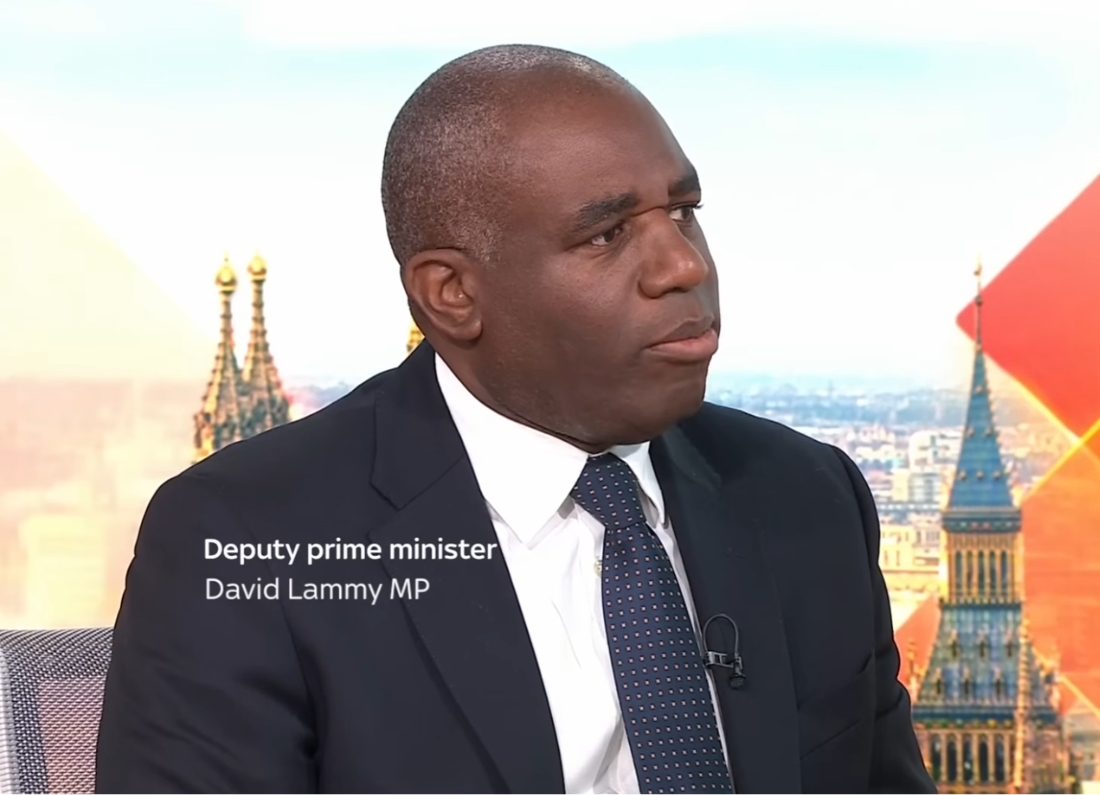
David Lammy refused five separate times on Sky News to say whether the United Kingdom should rejoin the European Union, as Labour’s long-suppressed Brexit divisions burst back into the open – with Wes Streeting calling Brexit a “catastrophic mistake” that should be reversed, a Labour backbencher calling the reopening of the debate “absolutely brainless,” and Andy Burnham trying to avoid the subject entirely in a Makerfield constituency where most people voted Leave.
The exchange with Sky News presenter Sophy Ridge became one of the most uncomfortable political moments of the week for the government, as the deputy prime minister twisted through five attempts to deflect a question that anyone watching knew he wanted to answer but politically could not.
The five refusals
Ridge asked Lammy whether the UK should rejoin the EU.
Attempt one: “I am really proud to have been the first foreign secretary to be back around the EU table last year.”
Attempt two: “We set red lines in the manifesto.”
Attempt three: “I’m not going to make a commitment about the next election manifesto process.”
Attempt four – after Ridge clarified she was not asking about the manifesto but about his personal view: “Me, David Lammy the deputy prime minister, am committed to collective responsibility.”
Attempt five – after Ridge said “Tell us what you really think, go on”: “I am in government delivering for the British people.”
Five attempts. Zero answers. The word “rejoin” was not uttered by Lammy in any of his five responses.
The political logic is obvious: Lammy as a private citizen and politician before government has been consistently, enthusiastically pro-European. As a cabinet minister, saying what he actually thinks about Brexit runs directly into Burnham’s Makerfield byelection problem and Labour’s broader difficulty with the Leave-voting working-class communities whose support it desperately needs to win back from Reform.
Why this week – what Streeting did
The Brexit debate did not reignite by accident. It was reignited by Wes Streeting, who resigned from the cabinet earlier this week in what we reported in our full coverage of his resignation and ferocious attack on Starmer.
In interviews following his resignation, Streeting described Brexit as “a catastrophic mistake” and said the UK should rejoin the EU. The statement was not a slip – it was a deliberate positioning choice by a leadership candidate who is calculating that a pro-rejoin stance plays well with Labour members even if it plays badly with Leave voters.
The calculation may be correct on the membership side. As we reported in our piece on the Labour leadership field, Labour’s membership is predominantly Remain-voting and pro-European. A rejoin commitment differentiates Streeting from Burnham on a question where the membership’s preferences and the electorate’s preferences diverge sharply.
The Burnham problem
Streeting’s intervention placed Andy Burnham in a specific and immediate difficulty. Burnham told last year’s Labour conference that he wanted to see the UK back in the EU in his lifetime. As we reported in our Makerfield byelection analysis, he is now seeking to be the Labour candidate in a constituency where the majority voted Leave – and where Reform won 50.4% of the vote in last week’s local elections.
Burnham has been trying to avoid discussing Brexit during the Makerfield campaign. Streeting’s “catastrophic mistake” intervention made that avoidance considerably harder to maintain.
As we reported in our full Burnham platform piece, Burnham’s pitch to Makerfield is built on renationalisation, reindustrialisation and a direct attack on Reform as the “arch-Thatcherites” who created the communities’ problems in the first place. It is not built on relitigating 2016. Streeting has now forced the question back onto every doorstep Burnham will visit.
‘Absolutely brainless’
The sharpest response came not from a Conservative or a Reform MP but from within Labour’s own parliamentary party. Jonathan Hinder, the MP for Pendle and Clitheroe – a northern constituency with significant Leave-voting communities – was direct to the point of bluntness on Radio 4’s Today programme.
“To suggest that the solution now is for us to reopen the Brexit debate is just staggering and the Labour Party is in an existential crisis, it really is, and the idea that we can reconnect to our working class base by reopening this debate is just a staggering level of out of touch,” Hinder said.
He added: “The priority of the British people right now is not to reopen this debate… and we’re doing that again. It’s just absolutely brainless.”
Hinder’s intervention reflects a specific anxiety within Labour’s northern and midlands contingent: that the party’s response to losing working-class communities to Reform is to double down on the positions – metropolitan, pro-European, socially progressive – that those communities have already rejected once. As we reported in our analysis of why Labour keeps losing these voters, the fundamental tension between Labour’s membership base and its electoral coalition has never been resolved and is now being re-exposed by the leadership contest.
What Starmer’s Monday speech said
The Brexit dimension of this week’s controversy is directly connected to Starmer’s make-or-break speech last Monday, which we covered in full in our EU reset and Monday address piece. Starmer explicitly framed rebuilding the EU relationship as Labour’s defining mission, pledging a youth mobility scheme and describing the June EU summit as a “big leap forward.”
The space between “put Britain at the heart of Europe” and “UK should rejoin the EU” is politically crucial. Starmer has been trying to occupy the first position while avoiding the second. Streeting’s intervention collapsed that space in a single interview, forcing every Labour figure to be asked whether “heart of Europe” means they want full membership.
Lammy’s five non-answers are the result. He thinks what he thinks. He cannot say what he thinks. The gap between those two positions is, for voters who already believe politicians never tell the truth, precisely the problem.
What the OBR says – and why it matters here
As we reported in our piece on the EU rejoin question as a generic political debate, the economic case for EU realignment has strengthened significantly since the referendum. The OBR says Brexit costs 4% of long-run productivity. Net migration hit 944,000 after Brexit – the opposite of what was promised. The economy is 6-8% smaller than pre-Brexit projections. 63% of Britons say they would now vote to rejoin.
Hinder’s “brainless” argument is not about the economics. It is about the politics. The voters Labour is losing to Reform are not primarily making economic calculations about GDP. They are making cultural and identity calculations about sovereignty, community and being heard. Reopening Brexit as a debate, in Hinder’s analysis, signals precisely the opposite of being heard.
Both things can be simultaneously true: the economic argument for EU membership is strong and the political argument for raising it now is catastrophically weak. The Labour leadership contest has just made it impossible to hold those two truths separately.