


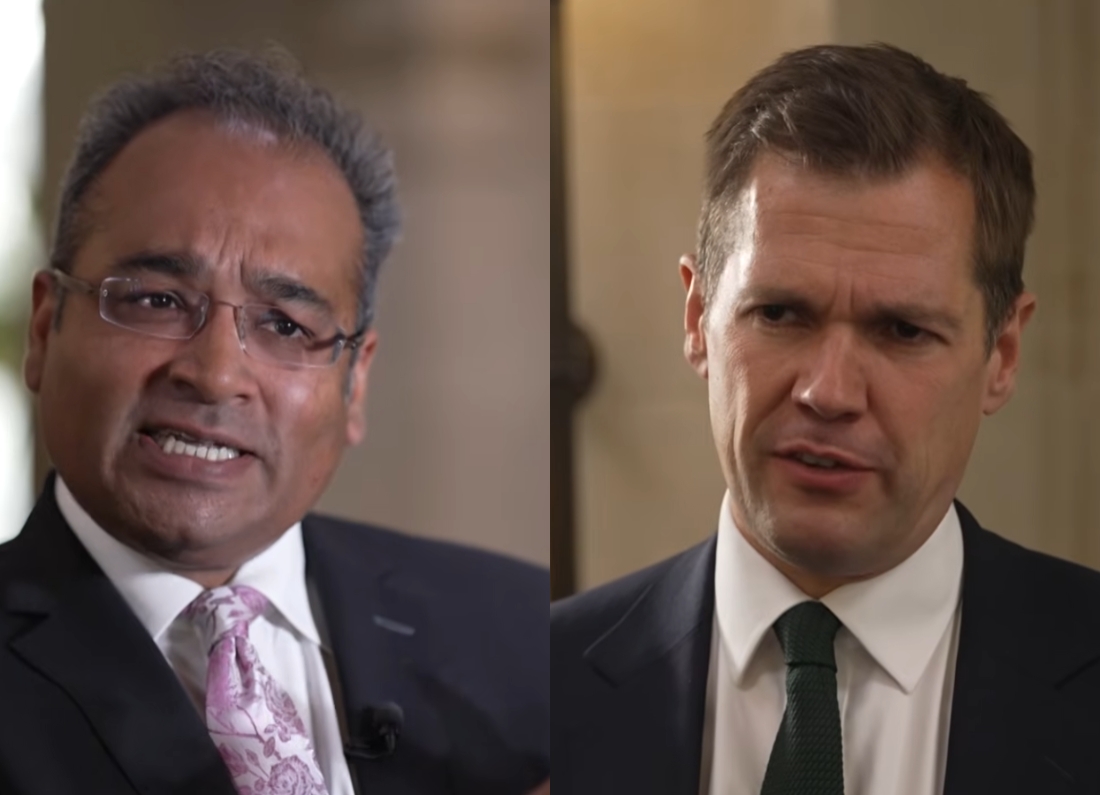
The debate about whether Nigel Farage’s “pure cold rage” call incited the Southampton riots came to a head on a Newsnight panel when Reform politician and prospective London mayoral candidate Laila Cunningham faced ex-Metropolitan Police superintendent Leroy Logan and Labour MP Jo White. The exchange became heated, illuminating and – at moments – barely controlled. Cunningham argued Farage had “named an anger” rather than incited violence. Logan said it was “clearly cause and effect.” White said everyone was failing the family who had asked for none of this.
The panel was chaired by Matt Chorley and aired in the days following the Southampton protest at which Tommy Robinson addressed the crowd, rioters threw bottles and bins at police and officers charged with perspex shields – as we reported in our Southampton riots piece.
Cunningham: naming an anger, not causing one
Laila Cunningham – a Reform politician who indicated during the discussion that she intends to run to be Mayor of London – mounted the most sustained defence of Farage’s language available to his party.
“When Nigel was talking about rage, he wasn’t talking about rage against anyone. He wasn’t talking about anyone hating anyone or any division. He was talking about rage at a system – a system that I think a lot of people in the country feel is broken.”
She framed the “naming” of anger as distinct from incitement of it: “I think what that video is what’s incited this anger. It’s incited anger in all of us. And naming that anger, as Nigel did in the video, is not what’s causing division. It’s actually telling people to be quiet and they can’t deal with it. In naming it, we can deal with it and make sure that Nowak never happens again.”
Her most specific argument concerned police behaviour. “I do think we have public servants who perhaps fear the accusation of racist more than they fear failing a victim. And perhaps the repercussions are stronger when there’s an accusation of racist. I’ve spoken to people from the Met who have told me that if they are faced with a mob of white people, they will use adequate force to contain it. But if it’s a mob of ethnic minorities, they will be more restrained.”
When asked whether she would accept that “pure cold rage” might have contributed to the Sophie riots, she was unequivocal: “No, I think what’s causing that anger is actually what happened. It’s not Nigel Farage. He just named an anger.”
Logan: cause and effect
Leroy Logan’s response to Cunningham’s framing was the most direct of the panel. A former Metropolitan Police superintendent with decades of front-line experience, he rejected the claim that language has no operational consequence.
“If anyone is telling me that when you run off your mouth to say rage and white lives matter and this two-tier policing which is not evidence-based at all, that doesn’t impact on people assembling outside a police station and then going on to other addresses – you’re fooling yourself. This is clearly cause and effect.”
On the question of whether Farage had apologised for his role in the events that followed: “The family said, ‘Please do not use my son in that way.’ And you still go and do it and there’s no apology from your side. I think it’s ludicrous.”
Logan then placed the two-tier policing debate in a historical context that Cunningham’s framing had bypassed. “In 1999 with the McPherson report, they were saying the same thing – police officers don’t know how to deal with black people, or they’re scared of being called racist. We had it. But policing went on. It wasn’t perfect.” He cited contemporary data: Black people are eight times more likely to be stopped by police than white counterparts. Black officers are four times more likely to be disciplined than white colleagues. Death in police custody shows similar disparities. “The systemic failures are there. But we still move on. The difference is we now have Reform.”
His assessment of the Farage-Robinson dynamic was pointed: “Farage says something, Tommy Robinson doesn’t – yeah, but they feed off each other. Don’t fool yourself.”
White: the family nobody is listening to
Jo White’s most consistent contribution was to redirect the panel toward the family and what they had actually asked for. While Cunningham and Logan debated the causes of the riots, White kept returning to the people being discussed rather than exploited.
“What makes me so angry is that this was a reasonable family who have just lost their son. We should be uniting with them and following their example and leading from them. What they’ve asked for is a campaign against knife crime. And they’re very clear – they were fearful that this would be the reaction. And as a consequence of that, the family are now experiencing hate online. And that’s not where we should be as a country.”
She also made the specific observation that the panel itself was part of the problem it was trying to analyse: “It’s crazy that this whole panel is about Nigel. When you have a boy that was failed drastically by the police, the main question is how to prevent this from happening again.”
On the specific footage of the officers’ response – “I don’t think you have been stabbed, mate” – White was precise: “That was horrific. What I want to see is the outcome of that investigation. Was it them messing up? Was it them just listening to what was being said without really making a full assessment of the situation?” She was careful not to prejudge the investigation while being clear the conduct was wrong.
What the panel revealed
The exchange illuminated the specific gap in the current political debate about the Nowak case. As we reported in our common sense and Labour politics analysis, Farage’s intervention is a calculated use of “common sense” politics – presenting contested narratives as self-evident facts that all rational people share.
Cunningham’s performance illustrated how that framework operates on television. She did not defend specific inaccuracies. She defended the legitimacy of the anger and the act of naming it. Logan identified the operational reality: political leaders with millions of followers call for “pure cold rage,” people respond, police are pelted with bottles, and the leader who made the call faces no consequence for the predictable result.
As we reported in our O’Brien on Farage piece, James O’Brien had specifically asked what “pure cold rage” meant if not a repeat of Southport. The Southampton riots came within 48 hours. On the Newsnight panel, that specific chain of events was the argument Logan was making. It was not answered by Cunningham’s “naming an anger” framing. It was not resolved by the panel. It is still unresolved.
You can watch the full Newsnight clip below:





Leave a Reply