

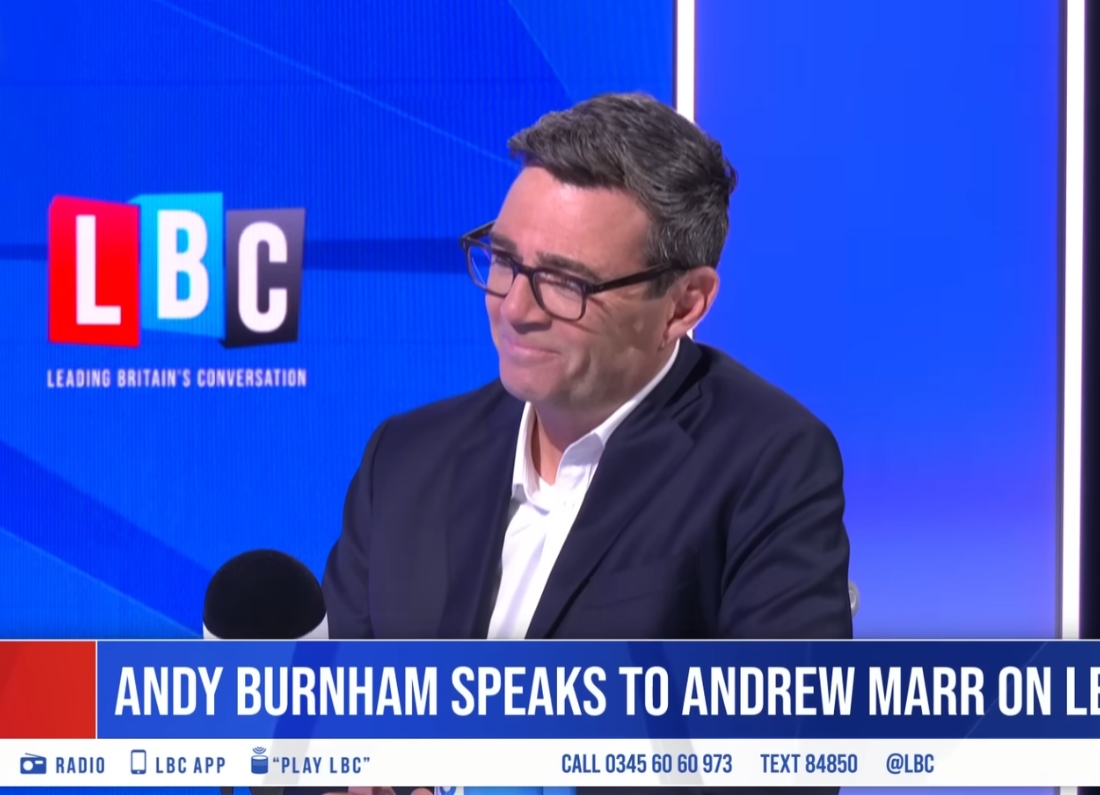
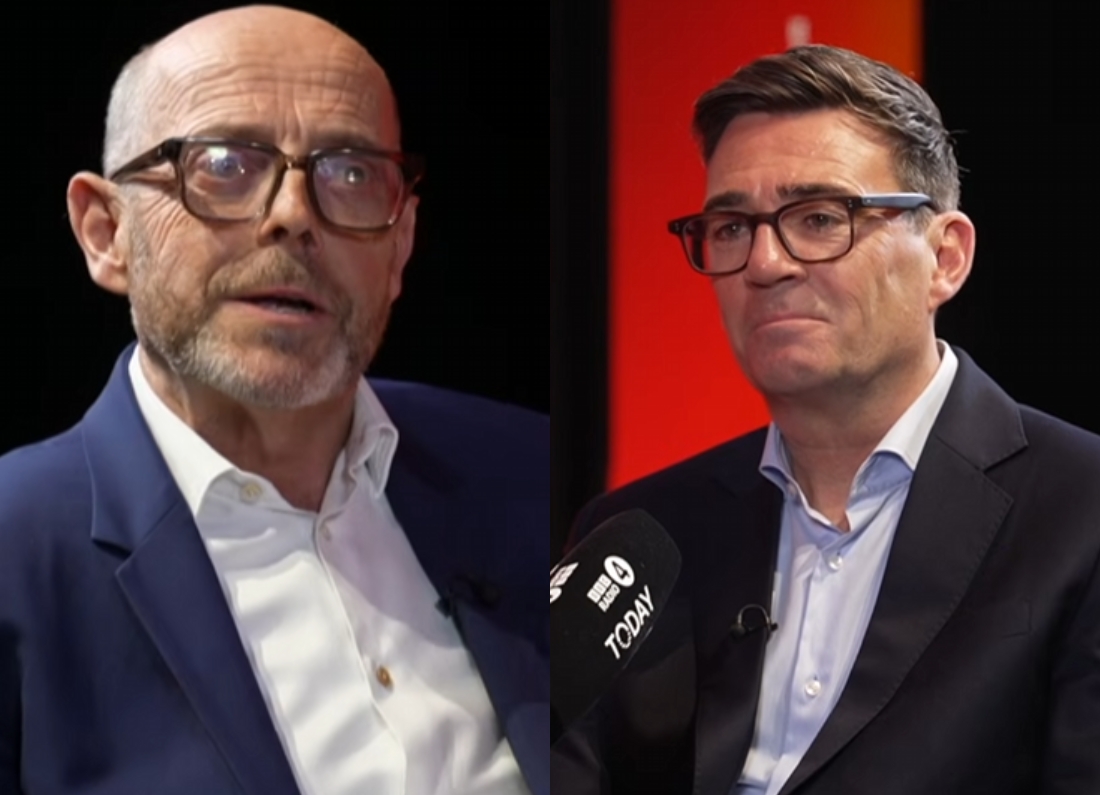
Andy Burnham gave his first broadcast interview since winning the Makerfield byelection to LBC’s Andrew Marr, ranging across tax, welfare, defence spending, devolution and his approach to Westminster culture in a conversation that filled out considerably more detail than his initial devolution speech had covered.
‘I stick by the manifesto’
Pressed directly on Labour’s 2024 manifesto commitments not to raise income tax, national insurance or VAT, Burnham was unambiguous. “I stick by the manifesto and the promises that it made. So let me be absolutely clear about that.” But he confirmed real flexibility within that framework: “There is some room within that manifesto for movement on tax. So if you take business rates, for instance, I believe there is a case for higher business rates on warehouses and the major developments we see on the outskirts of our cities, so that we can cut business rates for pubs.”
He set out the specific mechanics: a 20% cut in business rates for pubs, and lifting some high street businesses out of business rates altogether, funded by higher rates on the warehouse infrastructure serving online retail. “I say some and not all because I think it’s important to prioritise and reward the businesses that bring social benefit, the businesses that bring people together, the bars, the restaurants, the coffee shops, the hairdressers, because the high street really needs to get more of our attention. We need to bring life back to the high street.”
Defending his fiscal credentials
Burnham was notably assertive in pushing back against suggestions he might be fiscally undisciplined. “People can be certain of me of one thing. I hear read some of the commentary. I am not undisciplined when it comes to the public finances. I was in the Treasury. I ran the Department of Health and we had a very healthy set of finances. I’ve run Greater Manchester, the fastest growing city region in the country, for a decade, and you can’t make it the fastest growing city region in the country without strong business confidence in what you’re doing. The finances I have in Greater Manchester are rock solid, and from those rock solid public finances come business confidence that has helped us get the growth. I actually get frustrated at some of the narrative that people try to put around about me. My record says otherwise.”
Small businesses and energy costs
Asked whether he would produce a specific programme to help small businesses facing higher national insurance contributions, rising minimum wages and spiking energy costs, Burnham pointed back to the business rates plan but added a broader ambition on public control of utilities. “Businesses are also paying too much, and that is certainly true of energy. What I would do if successful is lay out a plan for more public control over water, energy, transport so that over the period we can get those bills down, fares down, and give people and give businesses breathing space. Britain needs more breathing space and I heard that on doorstep after doorstep in Makerfield.”
This connects directly to concerns already raised about the future of the Thames Water rescue deal, with investors reportedly worried Burnham’s leadership could mean nationalisation rather than the private rescue package currently being negotiated. Feargal Sharkey has separately called on government to “seize control” of Thames Water through special administration, a position that aligns with the direction Burnham appears to be signalling here.
A distinctive approach to welfare reform
On welfare, Burnham explicitly rejected the standard Westminster approach. “I’m not going to go with the crude cuts to benefit levels that then just put people who are struggling in even worse poverty and that often creates the backlash, and understandably so.” Instead, he set out a two-part alternative focused on prevention rather than punishment.
The first element concerns education and young people not in employment, education or training. “I will not defend an education system that is overly focused on the university route and does not lay out paths to technical qualifications for our young people. Too many young people get to year 10 at school and they can’t see where school is taking them because the system isn’t focusing on those young people. We need an education system balanced between academic and technical.” He proposed a guarantee of a work placement or apprenticeship for every 16 to 18-year-old who wants one, alongside free bus travel for that age group to access opportunities, modelled on a policy he introduced in Greater Manchester, and improved mental health support for young people.
The second element concerns housing. “If you build more council homes, you can bring down the housing benefit bill. You do it over a longer term in a more sustainable way.” Both proposals represent a structurally different approach to reducing the benefits bill than the direct payment cuts that have dominated recent welfare policy debate, aiming to reduce demand for benefits through investment rather than reducing the value of benefits directly.
Defence spending and the £15bn question
Asked whether he had known, before the Defence Investment Plan was published, that he would need to find an extra £15bn to fund it, Burnham was careful in his answer. “I didn’t have all of the details. I wasn’t in all of the discussions, but to be fair, the government had had an internal process ongoing.” Pushed on whether this represented a “hand grenade” lobbed at him by the outgoing prime minister, he declined to frame it that way. “I regard it as something that the country has to face up to very seriously. We’re in a changing world. The nature of the threat is changing. What I can say to you tonight is I will take my responsibilities fully to fund the defence investment plan. If I’m in the position to do so, I will take those responsibilities extremely seriously. No compromise on the security of the nation.”
Number 10 North: the details
Burnham confirmed for the first time a specific proposed location for his flagship devolution announcement. “There is already a proposal for a government digital campus close to Manchester Piccadilly. It is my intention, if I get the opportunity, is to base it there.” Asked whether he would personally spend time there, he said: “I will spend time there because I think it’s really important to show a new drive around taking power out of Westminster to get growth in every postcode around the country. The country is not wired for growth at this moment in time. I have shown in Greater Manchester how to get growth going. I want to take what we’ve done there, make it available to the Midlands, to the Southwest, to the East of England, all parts of it.”
Notably, he extended the offer to London as well. “Give London a new devolution deal, more freedom to do more for itself, more powers over education, over housing, more economic development powers, because I think we can free London up, actually, to go much further and to remain the world’s greatest capital city, which it is.”
Changing Westminster’s culture
Burnham was critical of how Westminster currently operates, describing it as “a more fragmented place, unhappier in many ways” than when he left it years earlier. He specifically criticised the use of the parliamentary whip to punish MPs voting on matters of conscience: “I personally don’t think the whip should be used to punish people who have a vote on a matter of conscience. I didn’t see that done in the Blair and Brown years and I don’t think it builds the sort of common spirit that you need.”
He also committed to a genuinely inclusive cabinet spanning Labour’s internal factions rather than one built from allies. “What I’m putting forward here is a very different approach. When it comes to the political direction, that is not up for negotiation. It is an end to trickle-down economics, which did not trickle down very much at all to places like Makerfield. It’s an end to neoliberalism. That means the deregulation, the privatisation. It has left us in a position, if you look at something like water, where the shareholders never lose, the public never win, because they’re paying ever higher bills, but that money isn’t going into infrastructure to benefit them. It’s going out to the shareholder.” This language echoes comments Burnham made on Newsnight about the pub in Orrell and 40 years of neoliberalism, suggesting this is now a settled and repeated framing for his broader political project rather than a one-off soundbite.
Cross-party cooperation on grooming gangs
Asked whether his stated goal of doing politics differently could extend to working directly with Kemi Badenoch on grooming gangs, Burnham pointed to precedent from his time as Greater Manchester mayor. “I brought forward a review into grooming gangs when I was first elected as mayor in 2017, and I had to work with the Conservative leader of Bolton and the Lib Dem leader of Stockport. That’s been the politics that I’ve been doing, and Britain does need something different. We’ve had a decade where politics really has not been working for people at all.”
On PMQs and personal accountability
Asked whether he would end the pattern of PMQs exchanges dominated by historical point-scoring rather than genuine answers, Burnham committed to a different approach while accepting collective responsibility for the current state of politics. “You can’t go around pointing fingers when you haven’t been good enough yourselves, and I would say that all politicians haven’t been good enough. My generation of politicians, I think, has failed in many ways in that the country isn’t where it should be right now.”
Not getting ahead of himself
Asked whether he would support a bank holiday if England win the men’s World Cup final, timed to fall the day after he could become prime minister, Burnham, an Everton supporter, was characteristically cautious. “We struggled, let’s say, and I’ve full respect to Congo Democratic Republic of Congo, but I think we might be getting ahead of ourselves. It would be a fantastic moment, wouldn’t it? And we can hope and pray that it comes off. But I do not ever back anything when it comes to football. I think they’ve got a bit of improvement to do before we can start seriously dreaming of it coming home.”
You can watch the interview below:




Leave a Reply