

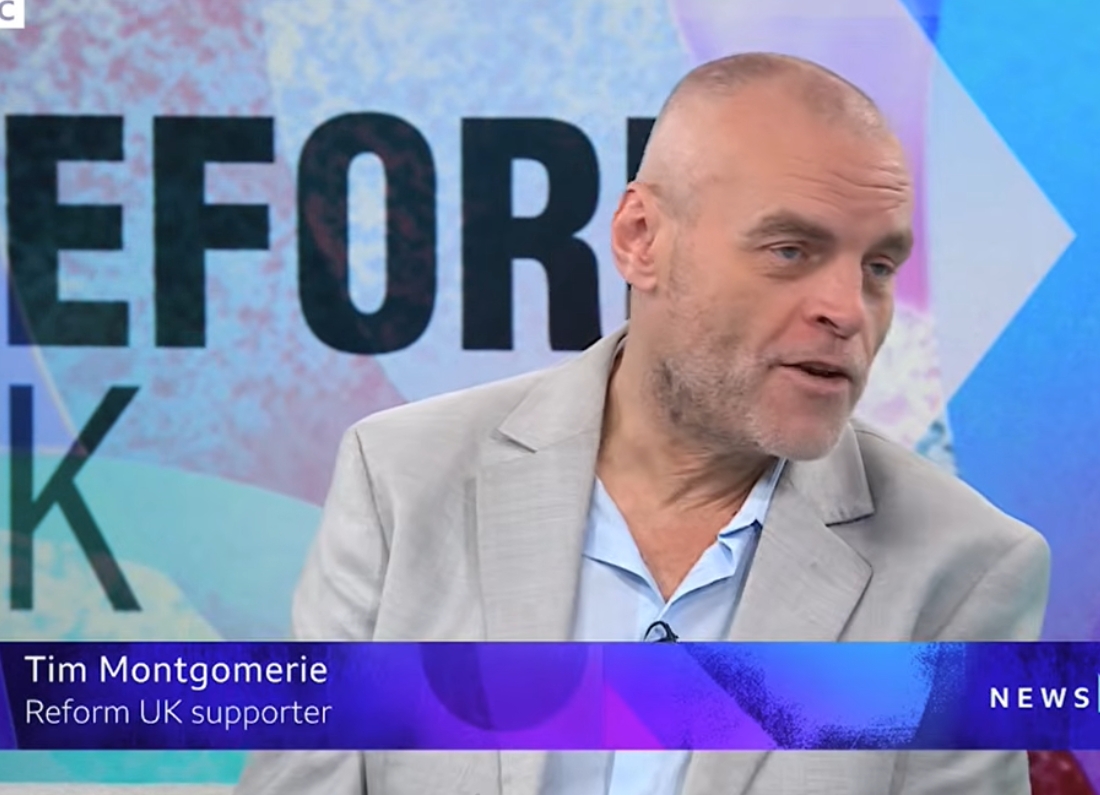
Tim Montgomerie has vowed to fight his suspension from Reform UK, turning an internal party row into a much bigger argument over whether Nigel Farage’s party can tolerate criticism from its own side.
The former Conservative activist and founder of ConservativeHome was suspended on Tuesday after publicly criticising senior Reform figures, including home affairs spokesperson Zia Yusuf.
Montgomerie is not quietly accepting the decision.
Speaking on BBC Newsnight, he said he wanted to remain in Reform but would challenge the suspension and make it a test of the party’s commitment to free speech.
“I’m going to make this a test case of whether it is a party that can tolerate free speech and dissent,” he said.
That is an awkward accusation for Reform.
The party has spent years presenting itself as an opponent of censorship and political conformity, while Farage has repeatedly positioned himself as a defender of people being able to say unpopular things.
Now one of its own prominent supporters is accusing it of trying to shut down internal dissent.
Montgomerie says he wants to stay in Reform
Montgomerie told Newsnight he still supports much of Reform’s political programme and has no intention of walking away voluntarily.
“I am going to fight this suspension. I want to stay in Reform,” he said, pointing to the party’s policies on immigration, crime and welfare as reasons he still wants to be part of it.
His problem is with how disagreement is being handled.
Montgomerie argued that censoring internal criticism was unhealthy and suggested the party risked undermining one of the principles it claims to stand for.
The dispute began after a series of increasingly public criticisms from Montgomerie.
He had already criticised Farage for failing to attend the Clacton by-election count and questioned the Reform leader’s response to the continuing parliamentary investigation into his financial declarations. Reform subsequently suspended him in line with party rules covering public criticism.
The latest row, though, has focused heavily on Zia Yusuf.
The row with Zia Yusuf
Montgomerie’s problems with Yusuf were laid bare during an interview with The Spectator’s Coffee House Shots podcast.
He accused Yusuf of failing to operate as a “team player” and suggested relations between them had broken down badly.
Montgomerie said Yusuf stopped speaking to him for around three months after discovering that he had helped facilitate Robert Jenrick’s move from the Conservatives to Reform.
Jenrick defected earlier this year and has since become one of Reform’s most prominent figures.
Montgomerie also criticised Yusuf’s public interventions on social media and questioned whether he was working properly with other senior figures in the party.
At one point he even suggested that “Nigel has fallen out of love with Zia”, although Farage and Yusuf remain working together.
The disagreement comes after Farage himself criticised Yusuf for describing former Conservative defence secretary Ben Wallace as a “traitor”.
That intervention appeared to expose tensions already simmering behind the scenes.
Montgomerie then made them considerably more public.
Reform says disagreements belong behind closed doors
Reform’s response has been fairly direct.
The party says its general secretary and chair had received complaints about Montgomerie’s behaviour and conduct over a period of months and decided action was necessary.
A senior Reform source said the party did not want to copy the sort of briefing wars that plagued previous Conservative governments and argued that internal disagreements should be dealt with privately rather than through national media.
That is where the disagreement really sits.
Montgomerie believes members should be able to criticise the party publicly without being pushed out.
Reform’s leadership appears to believe public attacks on colleagues are damaging and should be handled internally.
Neither position is particularly unusual for a political party.
What makes this more difficult for Reform is the language the party has used about free speech elsewhere.
If you make opposition to censorship part of your political identity, suspending someone who accuses the leadership of making mistakes inevitably invites questions.
Montgomerie clearly knows that.
Calling his appeal a “test case” puts pressure on Reform to explain exactly where it thinks legitimate criticism ends and disloyalty begins.
Did Nigel Farage know?
There is another interesting wrinkle.
Montgomerie has claimed Farage did not know he was being suspended before the decision was taken.
If accurate, that suggests the action came from elsewhere in Reform’s organisation rather than directly from the party leader.
It may also help explain why Montgomerie still appears keen to remain in the party.
He has not framed this as a final break with Farage.
Instead, he seems to be arguing that people around the Reform leader have become too intolerant of internal criticism.
That could make the disciplinary process more awkward rather than less.
A suspended member who wants to leave is relatively easy to deal with.
One who wants to stay, believes in the party’s policies and is publicly challenging its commitment to free speech is a much more difficult problem.
Reform’s difficult summer
The timing isn’t ideal.
Farage returned to Parliament last week after winning the Clacton by-election comfortably, a result that should have allowed Reform to spend several days talking about political momentum.
Instead, much of the attention has moved towards rows inside the party.
The Financial Times reports that the tensions have improved the mood among Conservatives, with some Tory MPs increasingly convinced Reform’s internal problems could give their party a route back.
That may be optimistic.
Reform remains a serious electoral force and has continued to compete at or near the top of national polling.
But the party has changed considerably as it has grown.
Former Conservatives such as Jenrick, Danny Kruger and Montgomerie have arrived alongside figures who have been part of Reform for much longer.
With more politicians coming in, differences over strategy and personalities were always likely to become harder to keep private.
Montgomerie’s suspension has simply dragged one of those arguments into public view.
The next question is whether Reform backs down, confirms the suspension or goes further and expels him.
Montgomerie has already made clear that he will not make the decision easy for them.
He wants to stay.
And he now wants Reform to prove that a party built partly around the language of free speech can cope when that speech is aimed at itself.





Leave a Reply