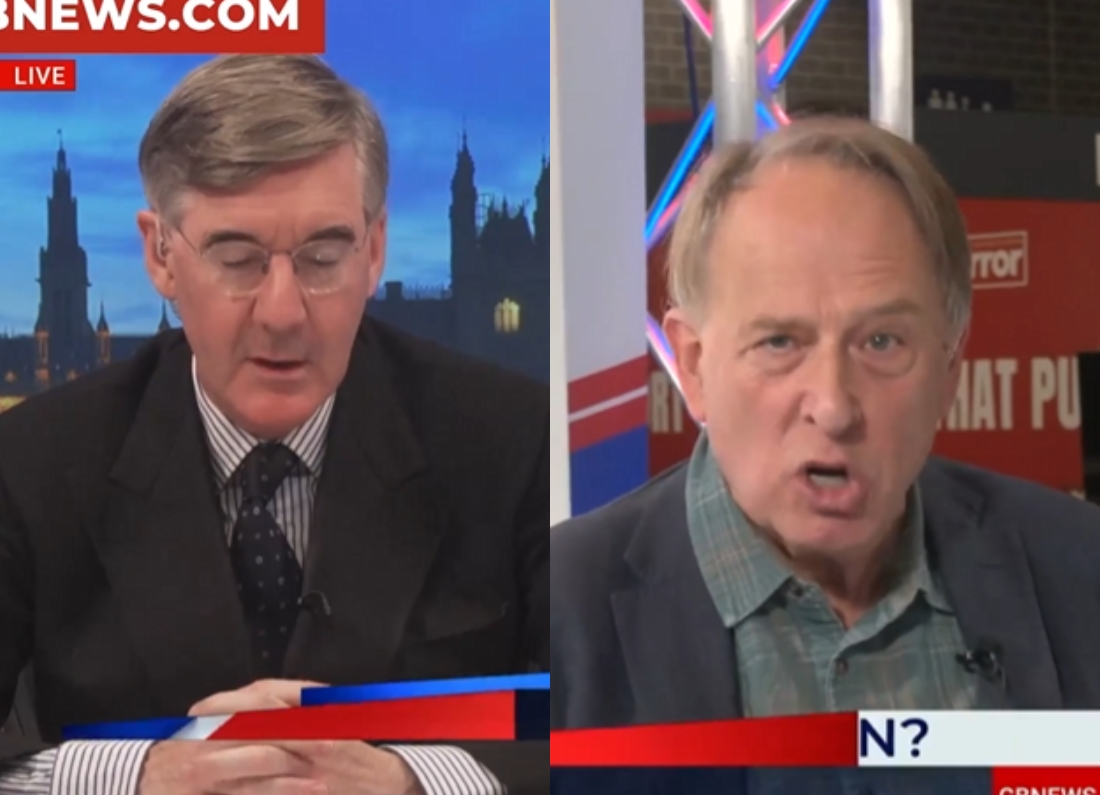
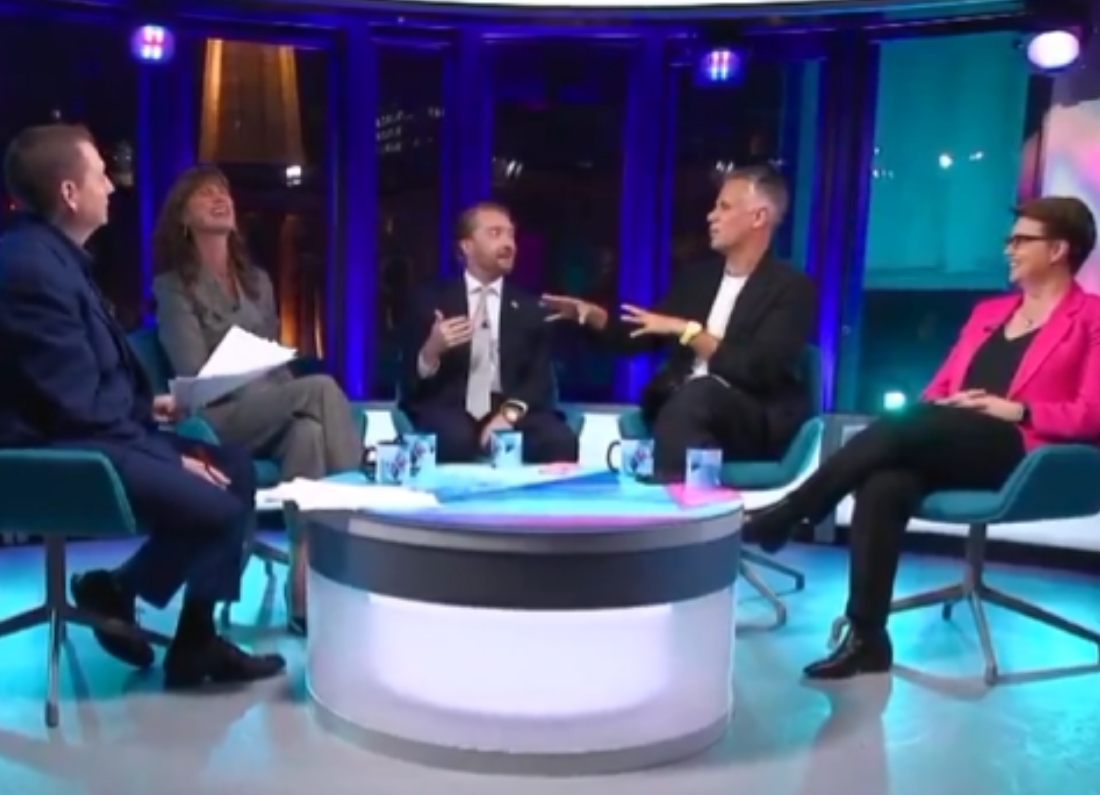
Jacob Rees-Mogg found himself on the receiving end of a particularly lively challenge on his own GB News programme after journalist Michael Crick took issue with his criticism of Andy Burnham’s first Labour conference speech as Prime Minister.
The pair clashed over housing, capitalism and the economic thinking Burnham has promised to move away from.
Rees-Mogg was unimpressed by Burnham’s speech, which included plans for a major expansion of council housing, greater public control of water and energy infrastructure and reforms aimed at bringing poor-quality private rented homes into public ownership.
Crick had a rather different assessment.
During the increasingly animated exchange, the veteran political journalist argued that some of the problems Burnham was describing were themselves evidence of failures in the market.
At one point Crick told Rees-Mogg:
“That is free market capitalism failing at its most.”
Rees-Mogg responded by telling his guest to “calm down gently”.
That did not have the desired effect.
Crick also took aim at what he called Rees-Mogg’s “ridiculous monologue”, while the two repeatedly interrupted and challenged each other as the discussion continued.
What were they actually arguing about?
The row followed Burnham’s speech to Labour conference in Liverpool on Tuesday.
Housing was one of its main themes.
Burnham promised what he described as the biggest programme of council housebuilding since the post-war period and said newly built council properties would be removed from Right to Buy so they remained available for future generations.
He also announced plans to give councils greater powers to acquire empty homes and properties rented out in poor condition.
Burnham told conference there were more than a million people on housing waiting lists and linked that figure to the loss of council housing through Right to Buy during the 1980s.
He said:
“Not seeing housing only as a market with winners and losers, but as an essential everyone needs for a good life.”
The Prime Minister also used the speech to promise greater public involvement in water and energy.
Labour plans to remove the existing barrier to government ownership of water companies and create Great British Grid, a publicly owned company intended to compete with private network operators.
Burnham presented the programme as a break with economic thinking stretching back several decades.
That was where Rees-Mogg and Crick’s disagreement really began.
Crick challenges Rees-Mogg’s defence of the market
Rees-Mogg, a former Conservative cabinet minister, has long argued for lower taxes, deregulation and free-market economics.
His response to Burnham’s speech reflected that position.
Crick pushed back by pointing to areas where private markets had failed to produce the outcomes promised by their supporters.
Housing became a particular point of contention.
Britain has struggled for years with housing affordability, a shortage of social homes and long waiting lists.
Burnham’s answer is to give local government a much larger role again.
Rees-Mogg’s criticism is that turning away from market-based policies risks repeating the shortcomings of greater state intervention.
Neither argument was likely to be settled during a television panel discussion.
But Crick clearly had little interest in letting Rees-Mogg deliver his criticism without interruption.
GB News itself clipped the exchange and shared it under the headline:
“That is free market capitalism failing at its most.”
Michael Crick nails this and is right. And to all those saying ‘why is Burnham dragging up Thatcherism’ this is why. The Thatcher government poisoned the well, sold off council houses, North Sea Oil, our commonly owned utilities. They broke it. https://t.co/wEZk1kjv5L
The broadcaster described it simply as a debate between the pair about free-market capitalism and Burnham’s conference speech.
Burnham is deliberately challenging the Thatcher-era settlement
There is a reason the discussion became so heated.
Burnham is not proposing a small adjustment to Labour’s previous programme.
His conference speech explicitly challenged some of the assumptions which have shaped economic policy since Margaret Thatcher’s governments.
On housing, he wants a much larger council sector.
On water, he wants to make public ownership possible again.
On electricity infrastructure, he wants a state-owned competitor.
And on social care, he wants a new universal service funded collectively.
Labour’s own summary of the speech describes the water reforms as removing a Thatcher-era barrier to public ownership and says the government wants “greater public control” of housing.
Burnham told conference:
“This is the break we are making with the flawed thinking of the last 40 years.”
It is difficult to imagine Jacob Rees-Mogg agreeing with that diagnosis.
Michael Crick clearly thought it deserved a defence.
The internet enjoyed the exchange
Clips of the argument quickly spread beyond GB News, with viewers particularly enjoying the fact it had happened on Rees-Mogg’s own programme.
@EddieBurfi wrote:
“Michael Crick is in no mood for Jacob Rees-Mogg’s failed ideas wrapped in a posh accent. Superb. 🔥”
@AbdulhadiMSA picked out one of Crick’s lines:
““Manchester City of GB news” 😂😂😂😂😂😂😂😂😂😂😂😉😉”
@colder_sarcasm wrote:
“This is an incredible interview by Michael Crick.”
And @SquareAlbert added:
“There’s a lot of logic and common sense here. And it’s all coming from Michael Crick”
A row Labour is probably happy to have
Burnham’s conference speech has opened up a wider argument about how much responsibility the state should take for housing, utilities and care.
His opponents can argue that greater public ownership means more government spending, more intervention and potentially less private investment.
Burnham’s answer is that decades of relying heavily on markets have left too many people without affordable homes while essential services have become increasingly unpopular with the public.
Crick and Rees-Mogg managed to compress much of that disagreement into a few minutes of increasingly testy television.
And given the reaction to the clip, GB News may have accidentally produced one of the more memorable debates about Burnham’s speech.
Joe Connor is a UK-based reporter specialising in politics, public policy, and national affairs. He has previously contributed to publications including The London Economic (JOE Media Group) and Spotted News.
At The Daily Britain, he covers Westminster politics, elections, and breaking political developments, alongside in-depth analysis of policy decisions and their real-world impact.




Leave a Reply