

Farage’s back in Parliament, and the investigation into his £5m gift is back with him. His Clacton win last week put him back under the jurisdiction of the Parliamentary Commissioner for Standards, the suspended inquiry was listed as active again the following morning. Parliament’s official record says it was opened 13 May under Rule 5 of the MPs’ Code of Conduct, alleged failure to register an interest. The commissioner doesn’t publish further detail while it’s ongoing.
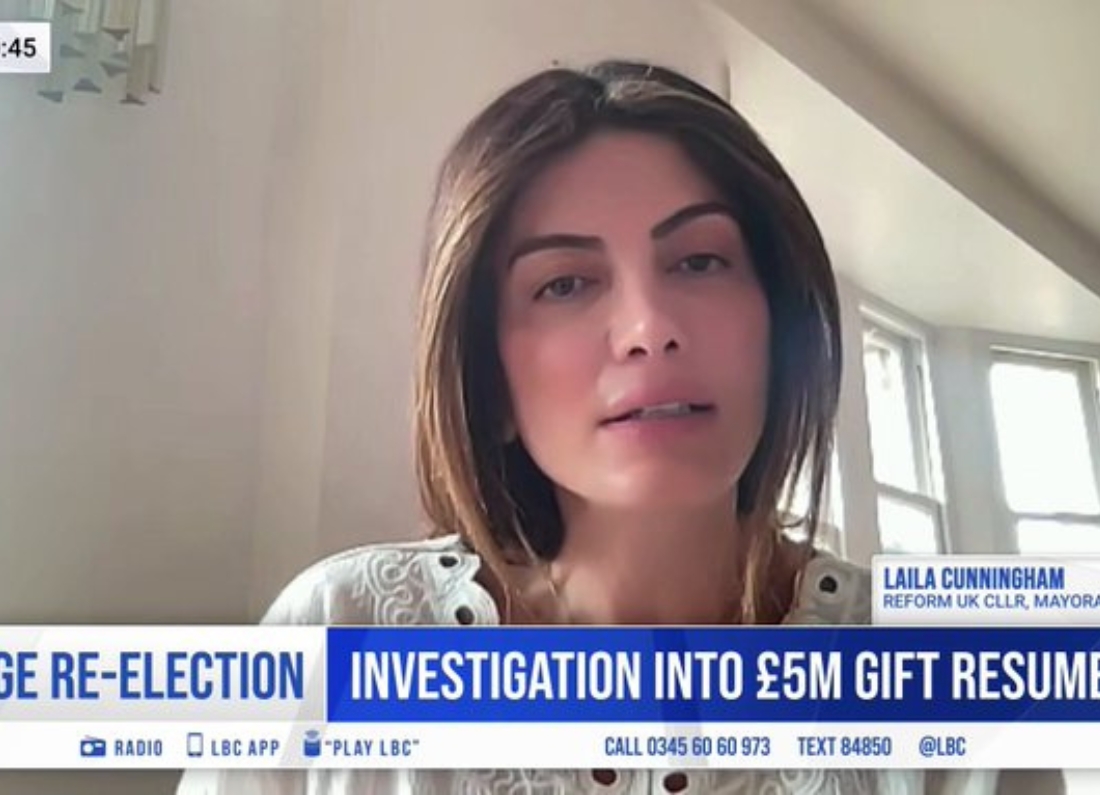
Farage denies breaking any rules. The investigation will decide whether the £5m he received from Christopher Harborne before the 2024 election should have been registered when he entered Parliament. With that question live again, Reform figures are back to explaining what the money was for. This time it was Laila Cunningham’s turn on LBC.
The security explanation, again
Ben Kentish asked Cunningham, Reform’s London mayoral candidate, for the party’s latest account of the payment. “Well, we were just discussing it. You know, he is under a massive threat. And I mean, security is so expensive and he’s going to have to pay for it. Listen, he has a mate that has a lot of money. And the mate was like, listen, you don’t feel safe. You don’t have any security. I’ll give you money to do it.”
Kentish pointed out Farage’s given a different explanation elsewhere, calling it a reward for delivering Brexit. “But he’s gone back on that claim, hasn’t he? He now says it was a gift. It was a reward for delivering Brexit.” Cunningham: “Well, obviously it was a gift.” Asked directly which one it actually was, security money or Brexit reward, she said: “Well, I mean, two things can be true. You know, he could have really liked what he did for Brexit and said, you know what? That got him close and said, actually, your security… But Nigel is, listen, I mean, he is under constant… It’s a horrible way to live for him.”
‘I don’t know what he spent it on’
Kentish asked whether the money had actually gone on security. “So he spent that money, all of it, or at least all of it that he spent on security.” Cunningham: “I don’t know what he spent.” Pressed on whether even most of it went on his safety: “It’d be strange to take a donation to make yourself safer and not spend it on making yourself safer.” “I don’t know what he spent it on. That I can’t comment on. All I know is that I’ve been with Nigel and I’ve seen the threats and security’s expensive because at some point I needed it. And it’s so expensive.”
Kentish pushed once more: if Farage genuinely fears for his safety, as he may well do, it’d be strange not to spend the whole £5m on security, and yet neither Farage nor Cunningham can confirm that’s what happened. “Well, I mean, obviously I can’t confirm. I don’t have… I’m not his accountant. I don’t sit down with him and look at his…” Kentish noted Farage himself won’t say either, having declined to confirm the spending during a previous LBC appearance.
Cunningham then reached for the line Farage himself has used before: “I think in his mind, and don’t take this the wrong way, it’s really actually none of people’s business how he spends his own private money.”
The actual problem with that answer
That doesn’t resolve anything. If it was an unconditional private gift Farage was free to spend however he liked, Reform can’t also lean on security costs as the explanation for why it was given in the first place. If it was specifically given to cover security, asking whether it was actually spent that way is directly relevant, not an intrusion.
Farage has previously said he could spend the money “on Ferraris if I want.” He’s also told the BBC’s Sally Nugent that how much went on security was “none of your business.” And he’s separately described the payment as a reward for decades of Brexit campaigning. Cunningham trying to hold all three explanations at once produced no actual new information about what the money was for or where it went.
More importantly, calling it private money doesn’t touch what the commissioner is actually examining. The question isn’t whether Farage was legally entitled to spend the gift on security, cars, or anything else. It’s whether the gift itself counted as a relevant financial interest that should have gone on his parliamentary register. Its presence on that active investigation list isn’t a finding against him, and the commissioner hasn’t reached any conclusion yet.
The inquiry followed him straight back
Farage resigned in July and immediately stood again in the resulting Clacton byelection, saying voters should decide whether he remained fit to represent them. He won with over 22,000 votes, roughly 63%. His return meant the suspended standards investigation could simply resume, as Reuters reported after the result.
After winning, Farage suggested any error might just amount to unfinished paperwork: “If I’ve made one sin, it’s that I haven’t filled in a piece of paper. I’ve broken no law, I’ve broken no tax law, I’ve taken no public money.” The commissioner will decide whether the rules were actually breached, and how seriously, if so. Until that’s done, neither a breach nor any sanction should be assumed either way.
One response to “Laila Cunningham in hot seat as Farage’s £5m story falls apart on LBC”
-
I’ve read hundreds of books in my life, including Maine Kampf. The comparison between Nigel Farage and Hitler is not accidental: Hitler was a totalitarian dictator, and we all agree on that, responsible for genocide, a world war, and the complete destruction of democracy. Nigel Farage is a far-right populist politician who operates within the very same system. Equating them doesn’t simplify or minimize the enormity of Nazism’s crimes. One wanted to destroy the Jewish nation, the Poles, and he succeeded. He always put the Aryans on a higher level, saying that other nations were subhuman. Farage, by proclaiming slogans such as benefits, housing, etc., are only for the British, shows a similar view. Hitler was a narcissist, Farage is one too. Of course, I believe that all illegal immigrants should be immediately deprived,,,and that’s good,,, but for example, taking away the privileges of immigrants who are here legally, like Poles, who pay taxes, work, have their own companies, further illustrates examples straight out of “Maine Kampf,” and such examples could be multiplied endlessly. Hitler desperately feared for his life, Farage the same way. Look at his gestures and facial expression, though, in this case, I would say MORDY. How he behaves; if he’s speaking, you can also add 2+2; it’s identical behavior: gesticulation, hand waving.
Farage proclaims his populist views, and in his case, this is nothing new: He uses very simple language, attacks “elites,” and bases his campaign on immigration are textbook methods used by populist movements around the world and throughout history. Noticing these similarities doesn’t mean someone is literally Hitler—it only means they are a populist, drawing on models drawn from reading Maine Kampf.
Differences of opinion are the norm in a democracy: The desire for tighter border controls, voting for Reform UK, or a critical stance on globalization are ordinary, legal political positions in a free society. Calling millions of voters “shameful” because they hold different views. “Us vs. Them” rhetoric and polarization: Creating a division between “ordinary, true citizens” and “outsiders” (extreme focus on migration issues) or “corrupt elites.” In political rhetoric, this is a universal tool for building support by identifying the group responsible for social and economic problems. From the outset, Adolf Hitler sought to completely destroy the democratic system, eliminate the separation of powers, and introduce totalitarianism. Nigel Farage operates within the British parliamentary system, using democratic institutions (elections, referenda, public debate) to achieve his political goals. National Socialism was based on biological racism, the doctrine of “subhumans” (Subhumans/Untermenschen), eugenics, and state violence leading to genocide. Farage’s views are classified as right-wing populism, national conservatism, and anti-immigration protectionism, which, while not calling for physical extermination, advocates for the biological valuation of people. Although the populism this idiot Farage espouses exploits simple emotions, it is a common political tool he has used for years. Drawing on anti-elitist and anti-immigration rhetoric is a hallmark of this “man.”






Leave a Reply