

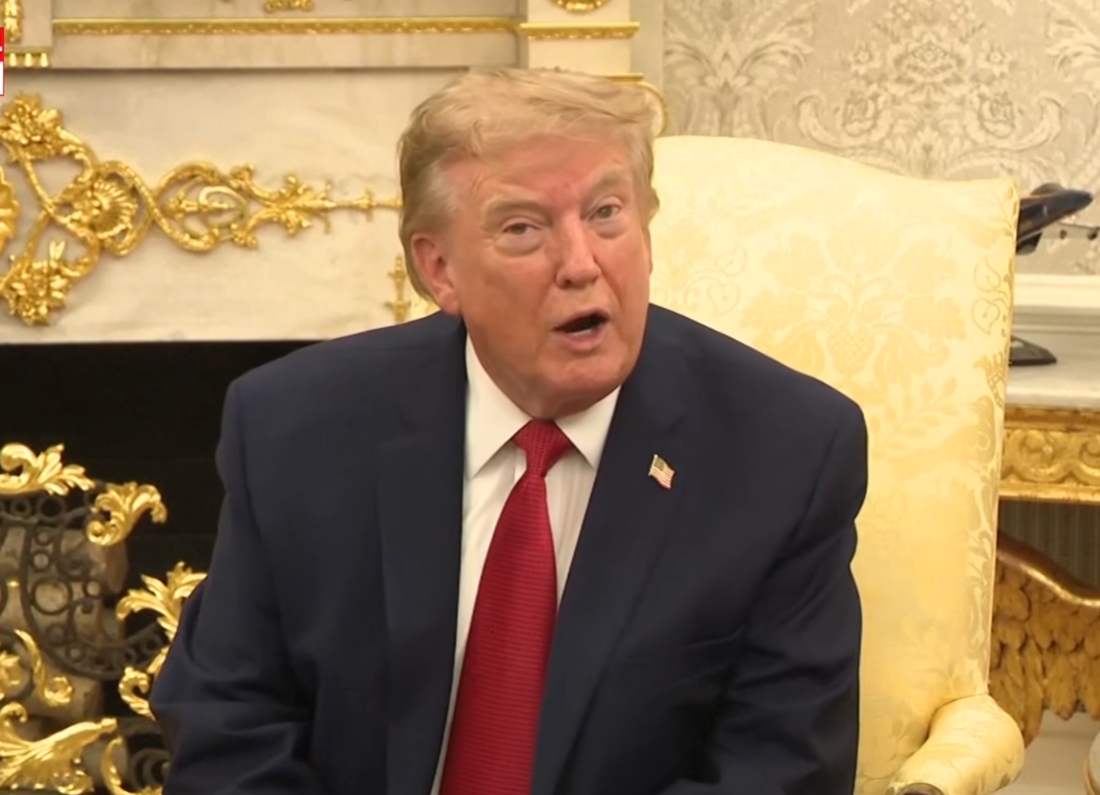
Donald Trump has posted a map of the Strait of Hormuz describing it as “NEW US Territory”, days after first suggesting the United States could claim the crucial shipping route as its own.
The US president shared the map on Truth Social on Tuesday as his administration’s stand-off with Iran showed little sign of easing.
Trump circled the strait, which sits between Iran and Oman, and wrote: “NEW US Territory.”
He later insisted that the American naval blockade remained in force and claimed the waterway was “open and operating”, despite Iran maintaining that it remains closed.
The claim has no recognised legal effect. The Strait of Hormuz does not belong to the United States and parts of the narrow waterway fall within the territorial waters of Iran and Oman.
But Trump’s post follows comments he made last week in which he suggested he could formally declare the strait US territory.
Speaking in New York on Friday, Trump said: “After we finish defeating Iran, which is being very badly defeated, pretty soon I’ll be declaring the Hormuz Strait a territory of the United States.”
Asked about the American blockade, he added: “Essentially, that’s what it is.”
Iran isn’t playing along
Iran has rejected Trump’s claims and insists it retains control over its side of the waterway.
Kazem Gharibabadi, Iran’s deputy foreign minister, responded to Trump’s earlier threat by saying the Strait of Hormuz could not be seized “by tweet” or “by aircraft carrier”.
The argument would be easier to dismiss as another extraordinary exchange between Trump and Tehran if Hormuz wasn’t so important to the world economy.
It is one of the busiest energy routes on the planet.
Around 20 million barrels of crude oil and oil products travelled through it each day in 2025, according to the International Energy Agency, accounting for roughly a quarter of the world’s seaborne oil trade.
There are few realistic alternatives if traffic through Hormuz is heavily restricted.
That has left oil traders watching every development between Washington and Tehran, including Trump’s social media feed.
Brent crude was trading at around $91 a barrel on Wednesday morning, with prices rising for a fourth consecutive session as traders tried to work out how much oil would be able to leave the Gulf.
The uncertainty is already forcing exporters to adapt.
Iraq has approved new arrangements to allow some crude exports to bypass Hormuz, while Chinese shipping companies have also rerouted shipments away from the strait.
Trump says there are no talks with Iran
Any hope that Trump’s post was simply part of negotiations with Tehran was complicated by another message from the president.
Trump said on Tuesday: “There are no talks or conversations going on, or scheduled, with the Islamic Republic of Iran.”
That followed conflicting signals over whether diplomacy could resume after the expiry of the temporary arrangement between the two countries.
Trump said the US naval blockade remained in place but claimed American forces had cleared mines from the strait and shipping could pass through.
Iran disputes that version of events.
The disagreement leaves shipping companies in an awkward position. Even if Washington says the route is open, sending vessels through an area where control is disputed carries obvious risks.
Traffic through Hormuz remains well below normal levels.
Trump has nevertheless become increasingly confident in talking about the strait as though Washington already controls it.
Friday’s suggestion that he would declare it American territory has now become a map simply labelling it as such.
Why Britain should care about Hormuz
The argument is happening thousands of miles from Britain, but the oil market isn’t particularly interested in geography.
Britain does not need to buy its petrol directly from a tanker passing through Hormuz for disruption there to matter. Crude oil is traded internationally, so a squeeze on global supply can push prices higher elsewhere.
That can eventually feed through to petrol and diesel prices and put fresh pressure on inflation.
There are similar concerns over gas. Qatar, one of the world’s biggest exporters of liquefied natural gas, normally sends much of its supply through Hormuz.
How serious the impact becomes depends on how long disruption lasts and how much shipping is able to move through the strait.
For now, traders are clearly nervous, although oil remains below the extraordinary highs reached earlier in the conflict.
Trump appears determined to keep up the pressure.
Iran appears equally determined to reject the idea that Washington controls the waterway.
And somewhere between those two positions sit the tankers carrying a sizeable chunk of the world’s energy supplies.
One response to “Trump posts map claiming Strait of Hormuz is ‘new US territory’ as Iran tensions escalate”
-
all countries should put an embargo on U.S goods I am sure that there is alternatives that other countries have









Leave a Reply