

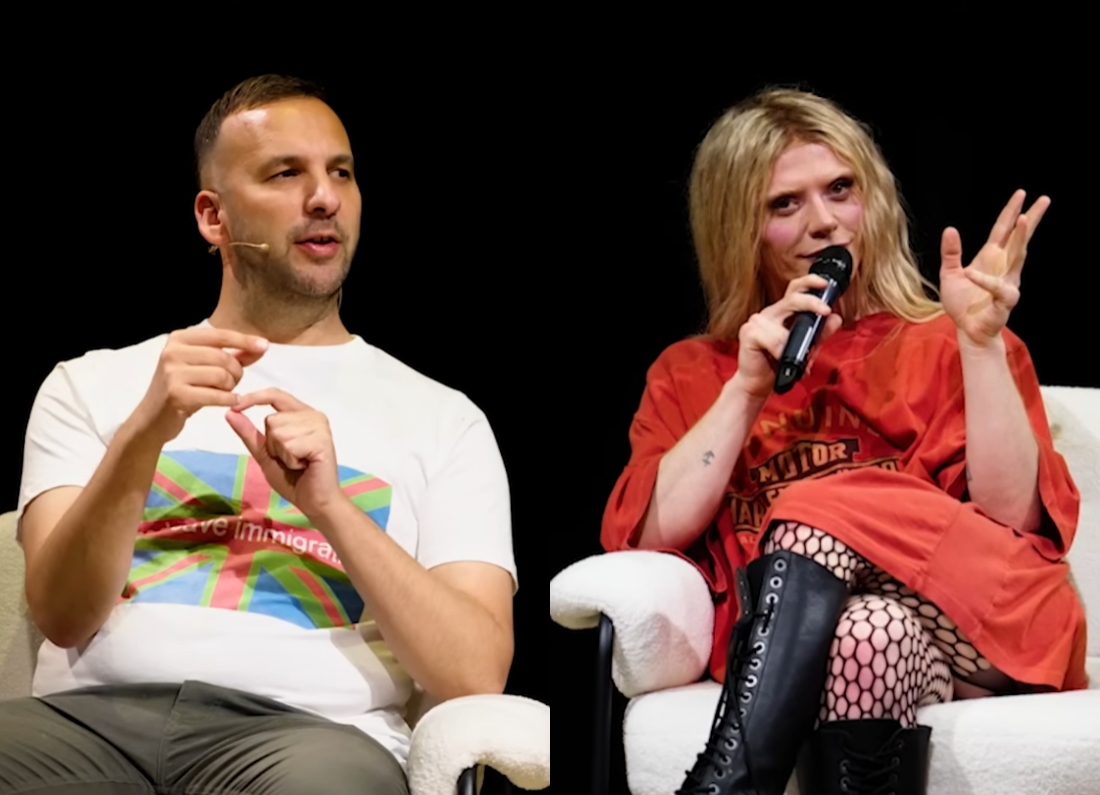
Zack Polanski’s guest on this week’s Bold Politics Live, filmed at the Sheffield Crucible as part of the Crossed Wires Festival, was Bimini Bon Boulash, the drag artist, writer, and Drag Race UK alumna who has become one of the more thoughtful public voices on gender, media distortion and political division in recent years.
Algorithms, not platforms, are the problem
Asked whether social media is a force for good or bad, Bimini drew a sharp historical distinction. Early social media, back when posts appeared chronologically rather than algorithmically, felt genuinely positive, a space where people could gather and organise. The shift, she argued, came with the introduction of algorithms designed to maximise engagement. “I think algorithms feed us and actually I think they are a big drive of division. Hate unfortunately fuels more hate. The more engagement, even if it’s negative, it could be vile stuff, it’s just going to get more and more and it riles people up.”
She raised Tommy Robinson’s specific response to her Pride post as a direct example, describing how a positive post celebrating Pride had been quote-posted “with some pretty vile words.” The pattern, she argued, is structural rather than incidental: platforms are built to reward whichever content generates the strongest reaction, regardless of whether that reaction is positive or hostile.
Why she thinks politics should be taught in schools
Bimini studied journalism, which she describes as her route into understanding politics and the media, having grown up without much access to political education. “I personally think politics should be taught in schools. I do. I think people should be learning about that from a young age because it controls everything that we do every day.”
She connected this directly to media ownership, noting that around 80% of the UK press is privately owned. “I think that’s a real big issue as well, because a lot of the really important things that happen day-to-day in our lives, someone is profiting from and there’s always an agenda. Like it’s £5 million pounds worth of an agenda.”
Great Yarmouth then and now
Bimini grew up in Great Yarmouth, a Norfolk seaside town, despite her father being from Clapham and her mother from Glasgow, giving her what she described as “a weird Cockney Scottish twang” as a child. She came out at 14 and describes it as a positive experience: her friendship group, largely girls, meant boys were generally too intimidated to give her trouble.
But she describes the town today in starkly different terms. “It just feels darker now, which is probably, well, we can know why politically, but it’s a shame because I think a lot of seaside towns have been forgotten about and there’s a lot of seaside towns that need a lot more investment and need regeneration. And it’s a shame because I think a lot of the people have misplaced feelings and anger and they point it at the wrong people, whereas building the community up is what needs to happen.”
In response, Bimini and her mother are opening a new charity in Great Yarmouth, Different Kinds of People, providing a permanent community hub for LGBTQ youth, allies, and specifically trans people in the area, addressing a gap she describes starkly: outreach groups that visit occasionally and then cancel, leaving trans people who need weekly support without anywhere reliable to go.
The Brexit connection
Asked directly whether Brexit fuelled the current climate, Bimini was unambiguous, though careful to avoid oversimplifying. “I don’t think everything stems from Brexit. But I do think Brexit started fuelling. It was a catalyst to an understanding that people are like, oh, maybe there are people that think like me about other things.” She cited a specific statistic on the scale of the shift: “Since Brexit, racism has doubled or tripled. Homophobia has doubled. Transphobia has tripled even more now. There can’t be a coincidence. There’s a definite correlation.”
She extended the critique beyond obviously extreme figures like Robinson to what she called “sensible” mainstream politics, pointing directly to Health Secretary Wes Streeting’s own record on trans healthcare: “I saw where Streeting tweeted ‘happy pride’ yesterday and I was like, this is the health secretary that has been removing gender healthcare for so many trans people and rolling back things. Actually I think Tommy Robinson is the extreme of that. But actually what I think we have is a kind of sensible, in inverted commas, politics that has been rolling back from LGBTQIA rights.”
The disco backlash as a template for today
One of the more historically striking parts of the conversation concerned the “disco sucks” movement of the late 1970s. Bimini explained that disco’s prominent artists were disproportionately Black, Latino and queer performers being celebrated for their music, before a backlash movement organised the mass burning of disco records at American sports stadiums, and radio stations stopped playing the genre entirely in favour of rock. “It just shows about toxic masculinity. Not all masculinity is toxic, but toxic masculinity is toxic.” She framed it as a direct historical parallel to the current backlash against LGBTQ visibility: a period of genuine cultural celebration of marginalised voices, followed by an organised and often literal effort to erase it.
On being edited, in reality TV and in politics
Bimini drew a considered parallel between how drag queens describe “blaming the edit” on reality television and how she sees the same dynamic operating in political media coverage. Polanski responded with his own direct account of being editorialised by broadcasters, describing interviews where 20 minutes of conversation are compressed into a single minute with a framing narration attached before and after, and noting that outlets which once exclusively sought environmental soundbites from Green politicians now do the reverse, deliberately excluding any mention of climate or nature from the edit.
Polanski also raised a specific fabricated claim, made by an unnamed creator, that he had received £3.5m from Bill Gates, a claim the creator later revealed was invented specifically as an experiment to test how many people would believe it without watching to the end. Bimini’s response raised the question of press regulation directly, referencing a recent conversation with Hacked Off, the campaign group founded following the phone hacking scandal, which told her that the majority of people affected by press intrusion are not public figures at all, but ordinary members of the public, including bereaved parents and patients of the Tavistock clinic whose lives were damaged by fabricated reporting, and that the press regulator IPSO is itself run by the newspaper editors it is meant to regulate.
Drag Race, the drag economy, and Josh
Discussing Drag Race’s legacy, Bimini was candid that the show, while giving her a genuine career and platform, has also narrowed the wider drag scene economically, with fewer people now working the kind of packed Saturday night gig circuit she once did, and drag brunches far less common than at their peak. She also confirmed the tattoo on her bum reads “Josh,” the name of a man she met and got matching drunk tattoos with while working in Thailand, and has not seen since.
Veganism, SAS: Who Dares Wins, and hope
Bimini discussed her veganism, adopted from childhood after questioning why her family’s dog was treated differently to farm animals, and her approach of humour over lecturing. She also reflected on her time on SAS: Who Dares Wins, a deliberate choice to understand a masculine, patriotic world she had previously only criticised from outside, without it changing her fundamental opposition to war itself: “I think war should be illegal. I don’t know why it’s not, but it’s also because it’s big rich men making money.”
Asked what gives her hope, she pointed to a recent “Homes Not Hate” protest and the importance of physical, communal spaces: “We need to be back out on the streets and dancing and celebrating. We are on this planet for not a long time. Why make it harder for everyone else?”
Her new album, in a genre she is calling “electro punk,” is expected following her departure from her previous record label after four years.
You can watch the full episode below:




Leave a Reply