

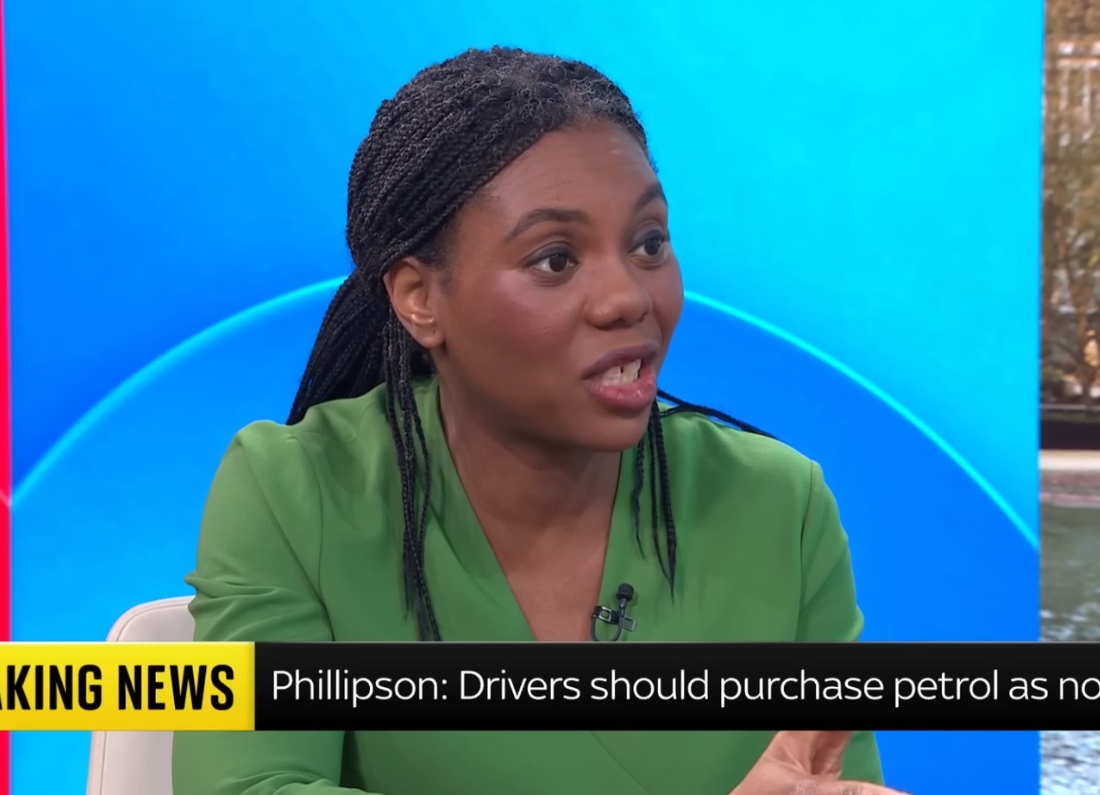
Kemi Badenoch faced a difficult morning on the nation’s airwaves on Monday after she put North Sea oil and gas drilling at the heart of her response to the UK’s energy crisis – only to be confronted, repeatedly, with the same awkward truth: it won’t lower anyone’s bills.
The Conservative leader used interviews on both Sky News and the BBC to formally launch the party’s “Get Britain Drilling” campaign, a three-point plan calling for an end to the government’s moratorium on new oil and gas licences, the scrapping of the windfall tax on energy profits, and greater financial support for the fossil fuels industry. She also dismissed the UK’s legally binding 2050 Net Zero target as a “slogan” – a remark that is likely to generate significant controversy given that the target was introduced by former Conservative prime minister Theresa May and is enshrined in law.
What Badenoch is actually proposing
The “Get Britain Drilling” plan centres on three specific asks: ending the moratorium on new oil and gas licences, ditching the windfall tax on energy profits, and providing more financial support for the fossil fuels industry. Badenoch specifically called for the government to lift licences at the Rosebank and Jackdaw fields off the North Sea coast, where she claims pipeline infrastructure is already in place.
Speaking on Sky News, Badenoch was clear about where she believes the priorities lie. “The first thing the government should do is start drilling our own oil and gas in the North Sea,” she said. “It’s important for our energy security, our economic security, our national security, and they’re not doing it.”
She also sought to tie the plan to a broader political argument, invoking the monarchy in a pointed exchange with presenter Trevor Phillips, saying the King “does not want to see the country bankrupt because of a slogan” – a reference to Net Zero, which she characterised as an unworkable policy undermining British economic competitiveness.
“Governments are elected to do the right thing right now. That is not to bankrupt the country with a plan that is not working,” she told Sky News. “What we need is cheap, abundant energy – it should be clean, that means doing everything we can: nuclear, renewables, and oil and gas, too.”
The problem the interviews kept coming back to
The difficulty for Badenoch is that, however compelling the broader energy security argument may be, the central question being put to voters – will it bring bills down? – produced a notably uncertain answer.
On Sky News, presenter Trevor Phillips pressed her on the immediate timeline. He pointed out that no oil would be coming from the Rosebank field this year, and asked what the plan was for the next few months, when households are actually worried about what happens to bills over summer.
When Badenoch insisted she was “talking about this year,” Phillips fired back directly: “There will be no oil coming out of Rosebank this year, you know that.”
The Tory leader argued that gas, rather than oil, could be accessible sooner – potentially by this winter – and that the revenues and taxes generated from drilling could be used to subsidise household bills. She cited a figure of around £2.5bn per year that could be generated from North Sea tax revenues, which she suggested could be directed towards lowering household bills by up to £80.
But even that argument ran into trouble on the BBC, where presenter Laura Kuenssberg pressed Badenoch on whether she was misleading the public by implying the policy would make bills cheaper. The Tory leader pushed back: “No, I’m not saying that once you drill oil and gas in the North Sea, it’s going to go straight on to your bills. No one has said that – but it is all related. And pretending that it is not related is very dishonest from a government that has a terrible energy policy.”
Kuenssberg also noted that Badenoch’s own shadow energy secretary, Claire Coutinho, had previously said on the record that new licences “wouldn’t necessarily bring energy bills down.”. Badenoch did not dispute this, instead arguing that the link between drilling revenues, energy security and consumer costs needed to be made by government policy – not assumed automatically.
What the experts say
Independent experts have been sceptical of the plan’s ability to deliver meaningful near-term relief on energy bills. Channel 4 News FactCheck spoke to two experts – Dr Hafez Abdo and Dr Mark Ireland – who both said that while ramping up production in existing active North Sea sites would be a better short-term option than drilling in entirely new areas, even that would not be directly effective in bringing consumer prices down.
Dr Abdo told FactCheck that the UK should “prioritise accelerating production” from existing energy projects to address potential short-term supply shortages, but cautioned that new drilling projects are “unlikely to provide immediate benefits” as they “typically require significant time before production begins.”
Research by energy campaign group Uplift and consultancy Voar found that hundreds of new North Sea licences granted by the Conservatives between 2010 and 2024 produced only 36 days’ worth of gas. Tessa Khan, executive director of Uplift, accused Badenoch of “peddling a dangerous fantasy,” while Greg Jackson, CEO of Octopus Energy, noted that more North Sea drilling would have little effect on prices because the UK energy market is integrated with European and global markets – meaning domestic production volumes alone cannot move the dial on what British households pay.
Why this matters now
The backdrop to all of this is the ongoing Iran conflict, which has placed enormous pressure on global energy supply chains. Iranian forces have been targeting oil tankers in the Strait of Hormuz, the critical shipping lane through which a significant proportion of global oil supplies pass. The disruption has pushed wholesale gas and oil prices upward, and there are genuine concerns that the energy price cap – which is set to fall to a lower level for April to June – could rise again sharply for the July to September quarter.
It is in this context that Badenoch is making her pitch: that Britain should be producing more of its own energy rather than remaining exposed to the volatility of global fossil fuel markets. It is not an argument without merit, and energy security has become an increasingly urgent national conversation. But critics argue that the specific proposal – resuming North Sea drilling – addresses a long-term structural question without offering meaningful help for the households who face rising bills in the months ahead.
Labour’s response
Unsurprisingly, Labour was swift to capitalise on the broadcast difficulties. Anna Turley, Labour’s party chair, said: “Kemi Badenoch’s energy policy has completely fallen apart. She’s been forced to admit her central energy intervention won’t bring people’s bills down. And she can’t say whether she’d support families who might need help.”
Turley also connected the energy row to the broader Iran debate: “Badenoch wanted to send British troops head first into a war without thinking about the consequences. Now she’s putting forward energy plans that she freely admits won’t help Brits struggling with their bills. She is completely out of her depth.”
Energy minister Michael Shanks added: “The Conservatives and Reform want to outsource Britain’s energy security to fossil fuel markets over which we have no control. Meanwhile Labour is bringing down bills next week and investing in clean, homegrown power to bring bills down for good.”
The bigger picture
Badenoch’s “Get Britain Drilling” campaign is clearly designed to serve a dual purpose: to present the Conservatives as having a concrete response to the energy crisis, and to wedge Labour on a policy – Net Zero – that polling suggests many voters are ambivalent or even hostile towards.
Whether voters find the argument convincing in the run-up to May 7 is another matter. The core problem Badenoch faces is that the honest version of her policy – drilling for energy security and long-term national resilience – is a genuinely defensible position. But the version that lands on doorsteps – “drill now, lower bills” – is one that even her own colleagues have struggled to substantiate.
You may also like: Starmer slams Tories and Reform over Iran as Labour launches local election campaign




Leave a Reply