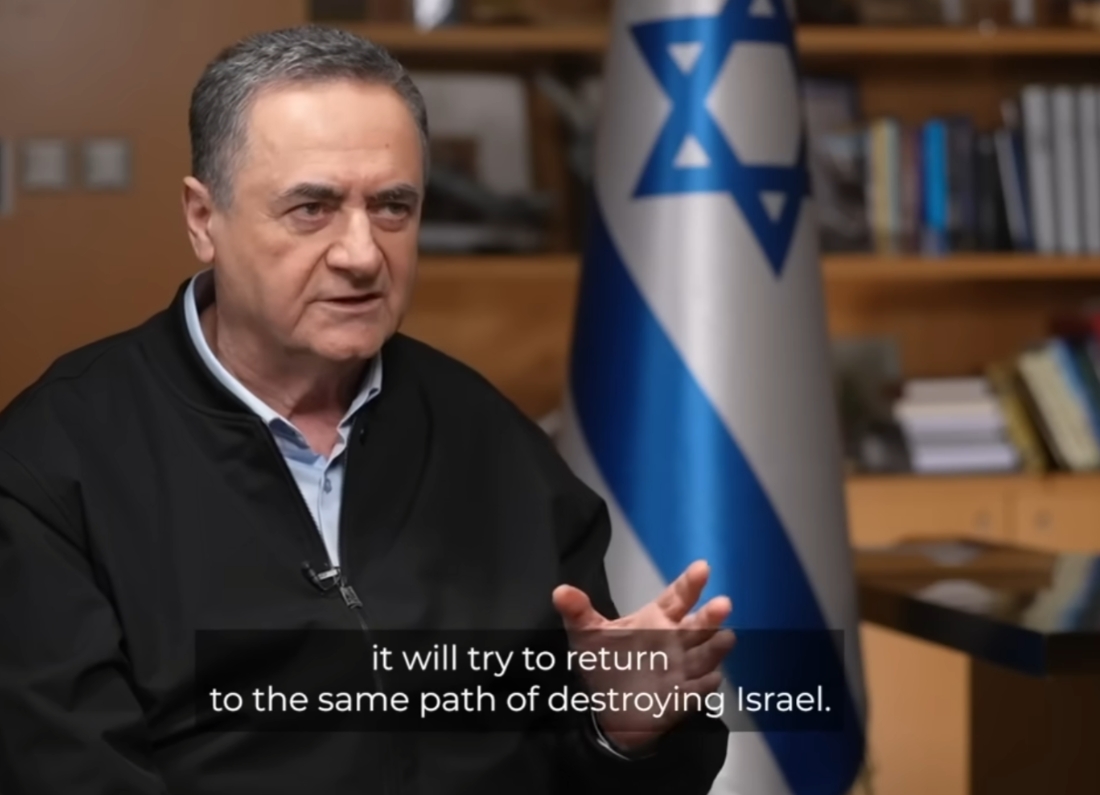
Israel’s defence minister Israel Katz has publicly committed to the mass departure of Palestinians from Gaza as part of the country’s long-term plans for the territory, saying the “voluntary emigration” plan would be implemented “at the right time and in the right manner.” Human rights organisations in Israel and international lawyers say the policy constitutes ethnic cleansing. The forced transfer of civilian populations is a war crime and a crime against humanity under international law.
Katz made the statement in a social media post marking the targeted killing of Mohammed Odeh, described as Hamas’s most recent military commander. “We committed that Hamas will not rule Gaza civilly or militarily, and so it shall be, and also the voluntary emigration plan from Gaza will be implemented,” he wrote. “Everything at the right timing and in the right manner.”
A spokesperson for Katz did not respond to questions about whether Israel remained committed to the terms of Donald Trump’s ceasefire plan for Gaza.
What the law says – and what Israel’s own human rights lawyers say
The forced transfer of civilian populations is explicitly prohibited under the Fourth Geneva Convention and constitutes a war crime and a crime against humanity under the Rome Statute of the International Criminal Court. This is not contested international legal opinion – it is established law.
Israeli officials, including Katz, use the phrase “voluntary migration” to describe their plans. Israeli human rights organisations have been categorical about why this framing does not hold.
The Association for Civil Rights in Israel said last year: “Creating living conditions that do not allow for survival, freedom and dignity, and subjecting civilians to them until they say they want to leave is not a plan for ‘encouraging voluntary emigration’ but a plan for forced evacuation and expulsion.”
The distinction between voluntary and forced migration under international law does not rest on whether individuals are physically compelled to move. It rests on whether the conditions created leave meaningful choice. When a population is subjected to siege, bombardment, the destruction of civilian infrastructure and the systematic removal of food, water and medical supplies, departure cannot be considered voluntary under international legal standards – regardless of the framing applied by the government organising the conditions.
The Israeli government set up a bureau for “voluntary emigration” last year and eased travel restrictions for Palestinians wishing to make one-way journeys out of the strip.
The Trump ceasefire contradiction
Katz’s statement directly contradicts the terms of the Trump administration’s ceasefire plan for Gaza, which Israel signed. The second point of that plan states: “Gaza will be redeveloped for the benefit of the people of Gaza, who have suffered more than enough.”
Redevelopment for the benefit of the people of Gaza and the large-scale mass departure of those people are not compatible objectives. Israel’s government has promoted the prospect of Gaza without Palestinians as a long-term goal since Trump suggested early last year that hundreds of thousands of people should leave to “clean out” the strip for reconstruction.
Katz’s spokesperson did not respond to questions about whether Israel remains committed to the ceasefire terms it signed. Trump’s administration has not publicly challenged the contradiction.
The domestic political context
With Israeli elections due by the end of October, the timing of Katz’s statement has a specific domestic dimension. Mairav Zonszein, senior analyst on Israel-Palestine at the International Crisis Group, described the dynamic directly.
“Because we are looking at an extension of the ceasefire and de-escalation of the situation in Iran and Lebanon, Israel – and Netanyahu specifically – will be looking for ways to show that they’re doing something on the security front, and that means exercising military power,” she said.
“Unfortunately talking about ethnic cleansing in Gaza is not necessarily something that will hurt you in domestic politics. In fact it might even help you.”
The observation is significant. Katz is not making a statement primarily directed at the international community, the Trump administration or human rights organisations. He is making a statement in a domestic political context where the displacement of Palestinians from Gaza has acquired the status of a security objective rather than a war crime in mainstream Israeli political discourse.
The international legal context
The International Court of Justice is already considering proceedings brought by South Africa alleging that Israel’s conduct in Gaza constitutes genocide under the Genocide Convention. The ICJ issued provisional measures in January 2024 requiring Israel to take steps to prevent genocide and ensure humanitarian access. The case continues.
As we reported in our UN climate ruling piece, 141 nations backed the ICJ’s advisory opinion on climate obligations in May 2026. The ICJ’s authority as an international legal institution is increasingly being tested by the gap between its rulings and the capacity to enforce them. The Gaza proceedings represent the sharpest version of that gap.
The International Criminal Court has already issued arrest warrants for Israeli Prime Minister Benjamin Netanyahu and former Defence Minister Yoav Gallant for alleged war crimes and crimes against humanity in Gaza. The UK government has confirmed it would be legally obliged to arrest Netanyahu if he entered British territory.
What “voluntary migration” means in practice
Since the beginning of Israel’s military campaign in Gaza following the 7 October 2023 Hamas attack, more than 90% of Gaza’s 2.3 million population have been displaced from their homes at least once. The territory’s civilian infrastructure – hospitals, water systems, schools, housing – has been comprehensively destroyed. Food insecurity has reached famine conditions. As we reported in our Strait of Hormuz and famine piece, humanitarian organisations have warned of catastrophic food shortages across the region.
In these conditions, Israel’s defence minister’s commitment to a “voluntary emigration plan” being implemented at the right time and in the right manner requires specific scrutiny. If the conditions in Gaza are those of a population already subjected to 19 months of war, famine-level food insecurity and the systematic destruction of civilian infrastructure, the meaning of “voluntary” in that context is the precise question that Israeli human rights lawyers, international legal scholars and the ICJ itself have addressed – and answered.