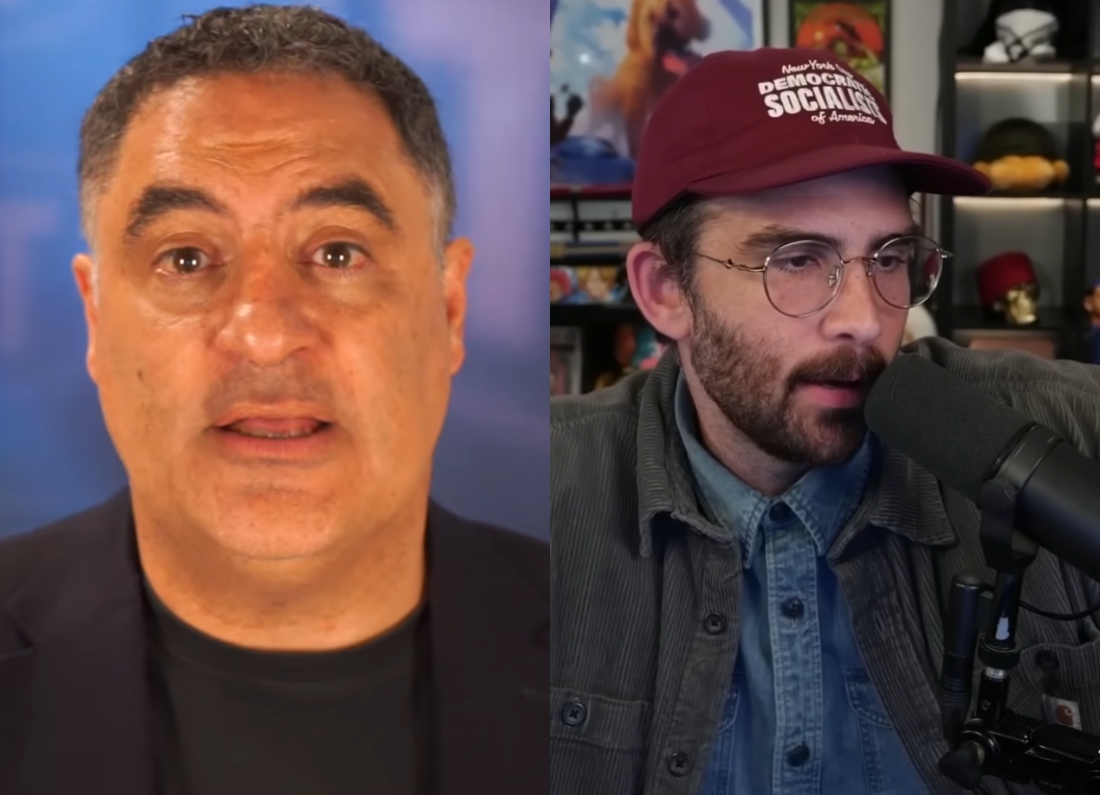
The UK government has cancelled the electronic travel authorisations of Cenk Uygur, host of the Young Turks online political show, and Hasan Piker, a prominent left-wing streamer, barring both from entering the country to attend speaking engagements at SXSW London. The Home Office said their presence “may not be conducive to the public good.” Free speech organisations, the Green Party leader in England and Wales, Zarah Sultana MP and Jeremy Corbyn have condemned the decision. Ash Sarkar described it as “an authoritarian turn motivated by Labour’s fear of being called antisemitic.”
Both Uygur and Piker have been vocal critics of Israel’s conduct in Gaza. Both have faced accusations of antisemitism, which they deny. Uygur was also due to speak at an Oxford University student event. The bans were made through the cancellation of electronic travel authorisations – the mechanism that has replaced visas for many short-term visitors from certain countries.
Who was banned and what they have said
Cenk Uygur founded the Young Turks, one of the most prominent left-wing political shows in American online media. He has been accused of propagating antisemitic tropes in his criticism of Israel and US-Israel policy relations. He rejects the characterisation, saying his criticisms are confined to an analysis of Israeli influence over US policymaking. He said on Monday: “The mighty United Kingdom is afraid of speech that shows you who’s responsible for those war crimes. But no amount of censorship will get us to stop telling the truth.”
Hasan Piker is a high-profile political streamer with millions of followers. He has faced a sustained backlash over several comments, including a remark on a 2019 stream that “America deserved 9/11” – which he subsequently apologised for and described as “inappropriate.” He has stood by his characterisation of Hamas as “1,000 times better” than Israel and his statement that he “would vote for Hamas over Israel every single time.” He has said he is anti-Israel rather than antisemitic. Piker appeared at the Oxford Union last year without any Home Office intervention – an event at which he described antisemitism as “a canary in the coalmine of fascism” and said Jews had “always been singled out by those in power as a scapegoat for instability.”
The responses
Zack Polanski, leader of the Green Party in England and Wales, called the bans “grim” and placed them within a specific political context. “People often talk about the dangerous road we’d go down under a Reform government – this is another clear warning we’re down there already.”
Jeremy Corbyn was more direct: “Banning Cenk Uygur and Hasan Piker from entering the UK is an absurd and cowardly decision from an increasingly authoritarian government. Let us call this what it is: an attack on the freedom to criticise Israel, as well as the UK government’s own complicity in genocide.”
Zarah Sultana, MP for Coventry South, has written formally to Home Secretary Shabana Mahmood demanding the bans be reversed. Her letter asks the Home Secretary to clarify the precise legal basis for the decision, whether the men’s public statements about Palestine, Gaza or Israel formed any part of the process, and what safeguards exist against immigration powers being used to suppress lawful political expression.
Sultana’s letter draws a direct contrast. “Under this Labour government, a leader whose words featured in genocide proceedings receives the red-carpet treatment, while journalists who oppose the mass killing of civilians are turned away at the border.” The leader she is referring to is Israeli President Isaac Herzog, who was received by the Prime Minister at Downing Street. As we reported in our Israel defence minister displacement piece, the ICJ has been actively considering proceedings against Israel over its conduct in Gaza. Herzog’s statements – including his assertion that “it is an entire nation out there that is responsible” for the October 7 attacks – were cited during those proceedings.
What free speech organisations said
Jemimah Steinfeld, chief executive of Index on Censorship, described the government’s decision as a “worrying escalation.” She said she was not downplaying concerns about harmful speech or minimising the impact on Jewish communities, but argued that banning people invited to speak “makes access to the UK a taste-test based on the current government’s determination of what is in the public good.”
“It’s paternalistic and assumes we are just passive consumers of views rather than people who can think, judge and challenge,” Steinfeld said. “Free speech is tested by hard cases and, in this instance, the UK is failing.”
Akiko Hart, director of Liberty, called on the government to be transparent about its rationale: “Free speech can only exist when we defend it for those we disagree with, as uncomfortable as it may feel.”
The Oxford Union’s president Arwa Elrayess said the body was “deeply concerned,” adding that it “was founded on a simple principle: that ideas should be challenged through debate, not ignored or silenced.”
Ash Sarkar, a Novara Media journalist who had been due to chair a discussion with Piker at SXSW, said the decision was evidence of “an authoritarian turn motivated by Labour’s fear of being called antisemitic, and fear of being called out for their position on the genocidal war on Gaza.”
The case for the ban
The decision was not without defenders. Labour MP David Taylor called for Piker to be prevented from speaking before the ban was issued. The Community Security Trust, which represents the Jewish community on security matters, urged SXSW organisers not to allow the UK to be a “platform” for Piker, citing his “record of promoting rhetoric that includes antisemitic themes, denial of well-documented atrocities and apparent support for extremist groups.”
The Home Office’s formal position is that: “Decisions to refuse or cancel an ETA on these grounds are based solely on an assessment of the potential risk an individual may pose to UK society.”
What SXSW said
SXSW London said it brings together “a wide range of speakers with different associations, affiliations and perspectives” and that “inclusion in the programme does not imply endorsement of all organisations with whom a speaker may be directly or indirectly affiliated.” The event has not cancelled the engagement entirely but the specific appearances cannot now take place in person.