


Reform UK’s position at the top of the opinion polls has weakened, with the party falling to its lowest polling level in nine months amid signs that its surge in support may have stalled.
The latest weekly voting intention figures from YouGov, conducted for Sky News and The Times, show Reform down two points to 24%. While the party remains narrowly ahead, its lead over the Conservatives has shrunk to four points, marking a notable shift from the dominance it enjoyed through much of late 2025.
The Conservative Party, under leader Kemi Badenoch, gained one point to reach 20%, continuing a gradual recovery after hitting historic lows following the 2024 general election. Labour Party also saw a modest improvement, rising two points to 19%, offering some relief for Prime Minister Keir Starmer after months of deteriorating public confidence.
📊 The latest numbers and what changed
The polling indicates a narrowing gap at the top and suggests Reform’s growth is no longer accelerating. Although 24% still leaves Farage’s party in first place, the reduction in the lead matters because it changes the political incentive structure. Rivals do not need a dramatic surge to catch up; a steady, incremental recovery now has the potential to reshape the contest.
That context is important because weekly polls are often noisy. The key question is not whether Reform has a good or bad week, but whether a pattern is forming.
🗣️ What analysts are saying about Reform’s ‘peak’
Commenting on the data, Sky News deputy political editor Sam Coates said the results pointed to a wider direction of travel rather than a one-off wobble. Writing on X, he noted that while any single poll can be an outlier, the latest numbers “are part of a broad downwards trend in Reform support since what appears to have been their peak around October”.
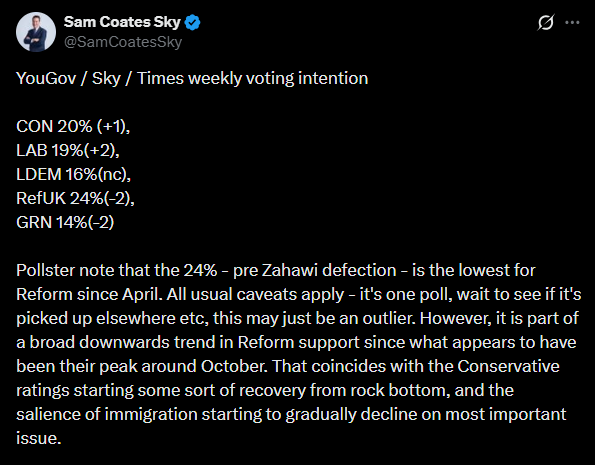
Coates also linked Reform’s slowing momentum to changes in the wider political environment, arguing that Conservative ratings are beginning “some sort of recovery from rock bottom”. He added that the salience of immigration has started to “gradually decline” as the most important issue for voters, potentially weakening the issue terrain on which Reform has performed best.
📉 The Conservative recovery and Labour’s small lift
The Conservatives rising to 20% matters not only because it narrows Reform’s lead, but because it suggests some voters who drifted away after the 2024 election are starting to return. That does not yet amount to a full recovery, but it increases the likelihood that Reform’s ceiling could be tested as the right-of-centre vote becomes more contested.
Labour’s improvement to 19% is also significant in context. It does not restore the party to the position it held at the 2024 election, but it reduces the sense of relentless decline and offers Starmer a small political reprieve. In a fragmented field, even small movements can affect how parties and donors interpret the direction of travel.
🔁 Why the Zahawi defection matters to the next poll
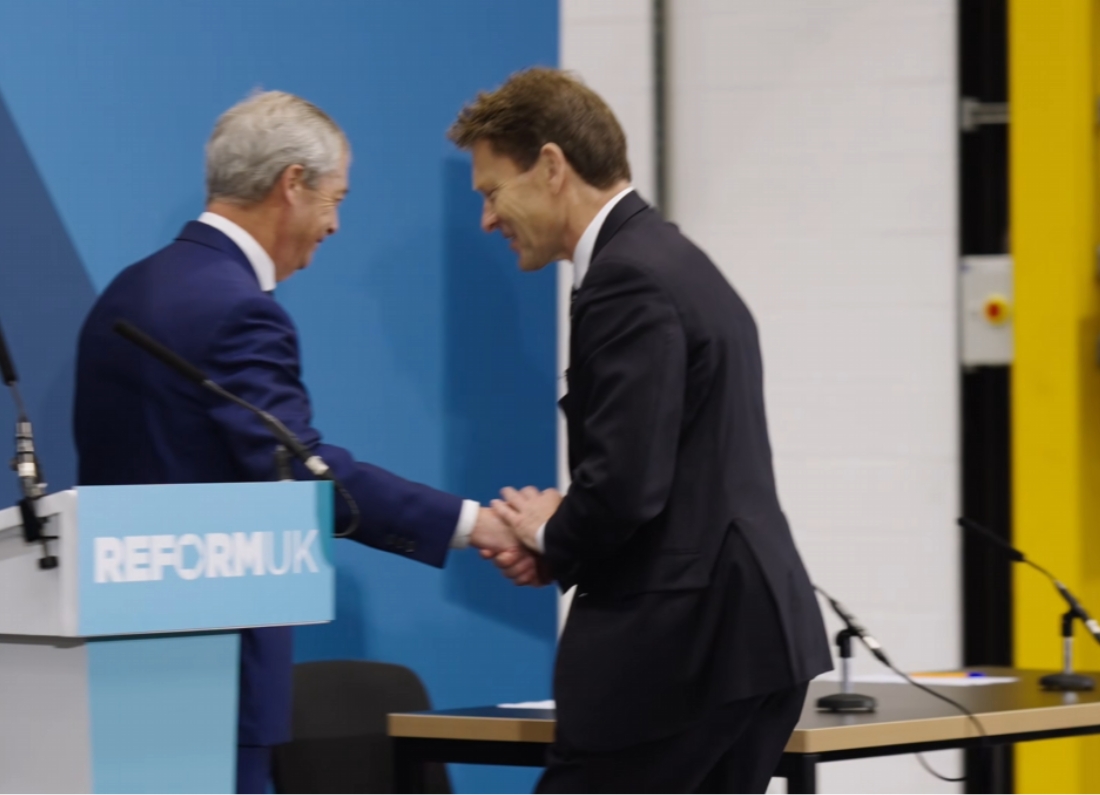
The timing of the YouGov survey is likely to become a major part of the next political argument because it was conducted before former Conservative chancellor Nadhim Zahawi defected to Reform. The move has been framed by Reform as proof that experienced figures now see the party as a serious force, but critics suggest it could also cut the other way.
For a party that has sold itself as an insurgent alternative to Westminster, absorbing figures associated with recent Conservative governments risks blurring the contrast Reform has relied on. The political impact may therefore depend on whether voters see the defection as credibility-building or as establishment recycling.
🧾 Leadership polling raises a separate problem for Farage
The weekly voting intention numbers were followed by further YouGov polling on leadership preferences, which will worry Reform strategists for different reasons. In head-to-head comparisons asking who would make the best prime minister, Farage was beaten by Starmer, Conservative leader Badenoch and Liberal Democrat leader Ed Davey.
This matters because a party can be popular in the abstract while its leader remains a barrier for voters who want protest politics but not necessarily protest leadership. If Reform’s support stabilises rather than grows, leadership perceptions become more important, not less.
🌱 Fragmentation continues as Greens rise in visibility
Separate polling has also highlighted the broader fragmentation of political support. Green Party leader Zack Polanski edged ahead of Farage in one survey measuring prime ministerial suitability, a finding that reflects increased visibility and a shifting media landscape, even if it does not translate neatly into electoral outcomes.
The bigger takeaway from these leadership comparisons is that no single figure is commanding wide confidence. That vacuum can create volatility, but it can also produce sudden shifts if one party appears to stabilise while another loses momentum.
🔎 What the polling suggests about the year ahead
Reform remains top of the polls, but the claim that the party is on an unstoppable trajectory is harder to sustain when its lead is shrinking, immigration is declining as the dominant issue, and its leader is losing head-to-head popularity tests. The Conservatives are not yet strong, but they are no longer collapsing. Labour is not yet recovering strongly, but it is no longer sliding uncontested.
In that environment, the next few polling cycles will matter less for who tops the table and more for whether the drift becomes a trend. For Reform, the test is whether it can broaden its appeal beyond a single dominant issue and convert protest support into durable confidence.






Leave a Reply