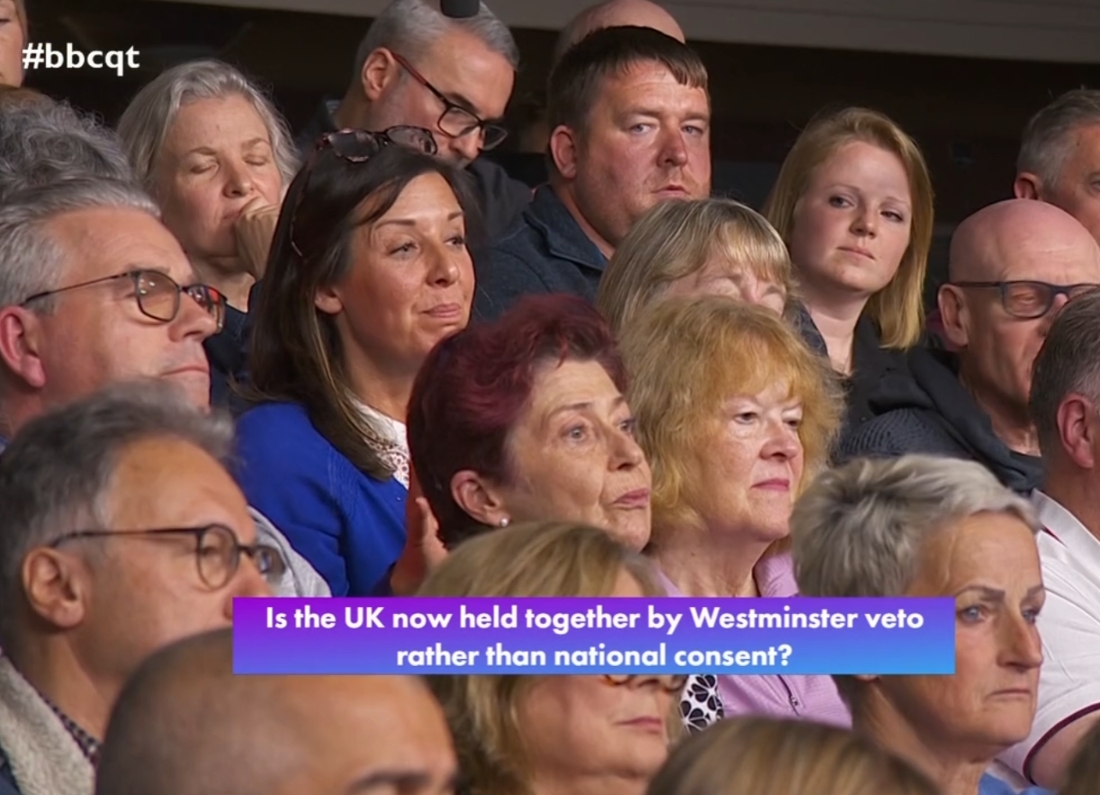
A Question Time audience member in Scotland has delivered one of the most direct arguments yet for why Labour should unite around rejoining the European Union – saying that the cost of living crisis the party is trying to address is a direct consequence of Brexit, and that ending the party’s infighting is as simple as taking a clear position on the question the government keeps refusing to answer.
The intervention comes at the end of a week in which the Brexit debate has returned to the centre of Labour politics with a force the government had been hoping to avoid, triggered by Wes Streeting’s description of Brexit as a “catastrophic mistake,” Andy Burnham’s careful hedging about rejoining “in the long term,” David Lammy’s five separate refusals to say whether the UK should rejoin the EU on Sky News, and a Labour backbencher calling the entire reopening of the debate “absolutely brainless.”
What the audience member said
The woman’s intervention was notable for its directness. She did not frame the question in terms of ideological preferences or abstract political values. She framed it as a practical economic argument.
“We’re talking about lots of things to do with the cost of living, but we’re just papering over the cracks – we have to acknowledge that we need back into the European Union,” she said.
“We need to make much more of a bigger deal of this and Labour can stop some of this infighting by actually uniting the party at Westminster by supporting us going back into the European Union.”
“Lots of our issues, lots of the things we’re talking about tonight and the economic problems we’re facing are as a result of Brexit,” she added.
The argument is specific and two-part. First: the economic problems Labour is attempting to address through individual policies – energy bills, housing costs, wages, public services – are downstream of Brexit and cannot be fully solved without acknowledging that. Second: the party’s internal divisions, which have paralysed it for weeks, would be resolved rather than exacerbated by a clear pro-rejoin position.
The week that forced the question
The Brexit debate did not restart by accident. As we reported in our Lammy five refusals piece, the specific trigger was Wes Streeting’s decision, in interviews following his cabinet resignation, to describe Brexit as “a catastrophic mistake” and say the UK should rejoin. It was a deliberate positioning choice by a leadership candidate calculating that a pro-rejoin stance plays well with Labour members even if it plays badly in Leave-voting seats.
The problem it created for Burnham was immediate. As we reported in our Burnham electoral reform pledge piece, he is standing in Makerfield – a constituency that voted Leave and where Reform won 50.4% of the local election vote in May. He said he is in favour of rejoining “in the long term” but that he is “not advocating that in this by-election.” The careful hedging is a direct concession to the political reality of the seat he needs to win.
Jonathan Hinder, Labour MP for Pendle and Clitheroe, put the opposing case in terms no focus group would endorse: “The idea that we can reconnect to our working class base by reopening this debate is just a staggering level of out of touch. It’s just absolutely brainless.”
The case for and against the audience member’s argument
The audience member’s argument has specific economic evidence behind it. The OBR estimates Brexit costs 4% of long-run productivity. Net migration hit 944,000 following Brexit – the opposite of what was promised. The UK economy is 6-8% smaller than pre-Brexit projections. 63% of Britons say they would now vote to rejoin. These are not fringe statistics. They are the mainstream economic consensus.
The argument that rejoining would end Labour’s infighting has a specific logic: if the question is answered clearly, it cannot be used to divide the party repeatedly. Every interview with every Labour figure becomes an opportunity to expose the gap between what ministers privately believe and what they are publicly permitted to say. David Lammy’s five-answer sequence on Sky News is the most visible example, but it is not unique.
The counterargument – Hinder’s “absolutely brainless” – is also specific. The voters Labour is losing in Makerfield, Wigan, and across the Leave-voting north are not persuaded by economic data about productivity costs. They are responding to something the rejoin argument cannot speak to: the feeling of having had their vote respected and their community heard. Reopening the Brexit question signals to those voters that the party still does not understand why they voted Leave in the first place.
Both arguments contain real truths and real limitations. The OBR data is accurate. The political map is also accurate. The audience member is right that Brexit is a source of economic problems and that papering over them has costs. Jonathan Hinder is right that a party whose leadership contest is already engulfed in resignation letters and leadership bids is not in the ideal position to also fight a culture war about 2016.
What Burnham’s position means for the debate
Burnham’s formulation – “in my lifetime, but not the next five to ten years” – is an attempt to hold both truths simultaneously. He acknowledges the long-term case for rejoin without triggering the immediate political cost in the byelection seat he needs to win. As we reported in our Burnham EU rejoin piece, his priority is “fixing Britain first” – and his programme of renationalisation, devolution and electoral reform is designed to address the economic conditions the audience member is describing without reopening the specific question of EU membership.
Whether that sequencing satisfies the audience member’s argument depends on whether you believe the economic problems she is identifying can be meaningfully addressed without the specific institutional framework of EU membership – or whether the only way to “stop papering over the cracks” is to remove the structural cause rather than manage the symptoms.
That argument will not be resolved in the Labour leadership contest, the Makerfield byelection or any single Question Time exchange. It has been waiting since 23 June 2016 and it will still be waiting in 2029.