

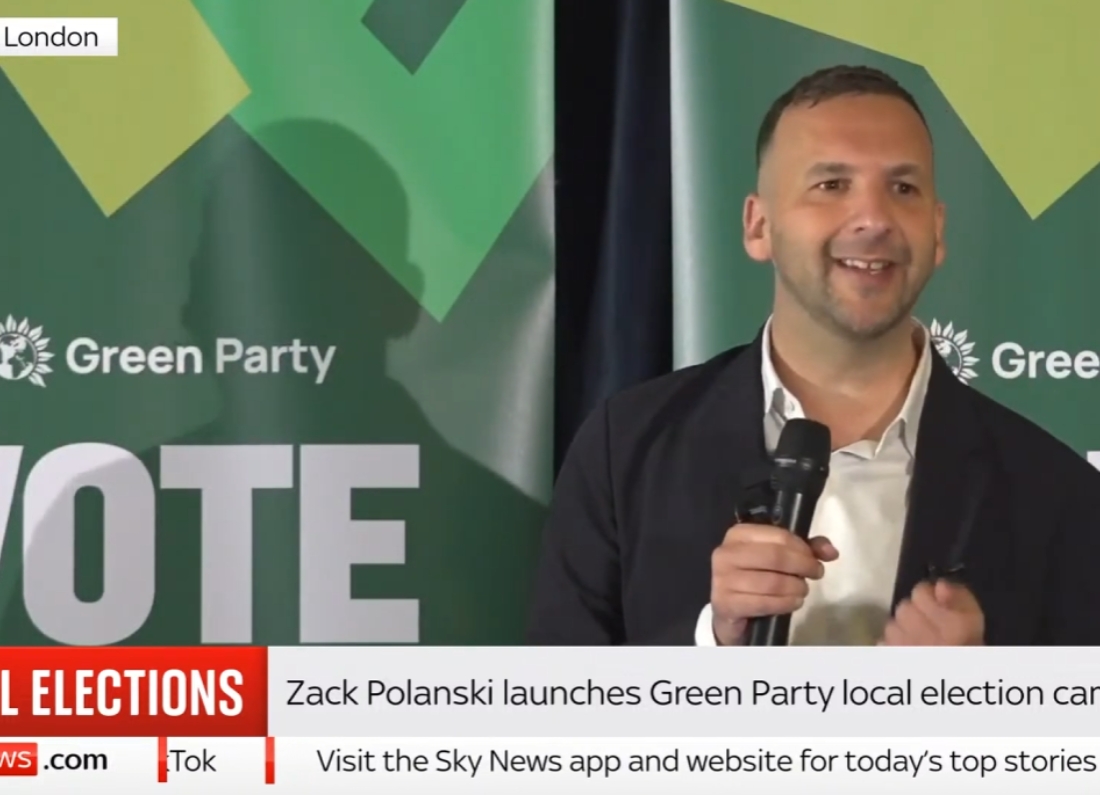
Zack Polanski has used the formal launch of the Green Party’s local election campaign to call for “robust sanctions” against Israel – including the withdrawal of the UK-Israel trade agreement – and to demand an end to the genocide, as the party positions itself to capitalise on anti-war sentiment and disillusionment with the Labour government ahead of the May 7 polls.
Speaking at an event in south London, the Green Party leader opened by addressing “what we’ve all seen on our TV screens and our phone screens, both over the last few years, but in Lebanon in the last 24 hours” – a direct appeal to voters for whom the Middle East conflict has become a defining political issue and a key reason for turning away from Labour.
The Israel and Iran message
Polanski’s call for sanctions went further than any major party leader has yet been willing to go publicly. “What is it going to take for this government to actually put robust sanctions on Israel?” he demanded. “It is outrageous that Israel are still enjoying diplomatic and trade privileges from the international community. As a Green Party, we are calling on this government to make much more robust sanctions, to withdraw the UK-Israel trade agreement and to end the genocide.”
He also addressed the Iran war directly – and in a way that will draw a sharp contrast with the government’s position. While Starmer has maintained publicly that Britain is not a belligerent and is involved only in defensive operations, Polanski argued that the use of British bases by American bombers makes that claim untenable.
“The prime minister is not being entirely truthful with us all, with the country,” Polanski said. “He keeps saying that we are not involved with this war, but we still have UK soil and UK bases where US bombers are flying over to Iran.”
His prescription was unambiguous: “What we need to do is disentangle the UK military and the US military, ban the US from using our airspace, and do exactly what other European allies like Pedro Sánchez in Spain have done and say: this war is not in our name and we want nothing to do with it.”
He also used the Iran war to draw a direct contrast with Reform UK, noting that on “day one and day two” of the conflict, Farage was “calling for us to get even more involved with the war, which would not just be a humanitarian disaster, but for people in this country, we know that would mean higher bills.”
The domestic pitch
Having set out the Greens’ foreign policy positions, Polanski pivoted to the domestic issues that will determine the outcome of May 7 in most wards – housing, energy costs and living standards.
His framing of the Labour government was unsparing. “What we have seen is a toxic combination of chaos and cowardice, a government that has no plans, no vision and no real change, a government that has not just been complicit in genocide.” He added that Labour had “watered down its promises on workers’ rights” and “brought Peter Mandelson into the very heart of its administration.”
On housing, Polanski targeted Labour-run councils in London – particularly Lambeth and Hackney, both of which the Greens are actively targeting in May. He pointed to the government’s pledge to ban section 21 no-fault evictions – which, he argued, Labour councils were still using via loopholes even as the government dithered over implementing the ban nationally.
“In Lambeth, next door, they were still proclaiming themselves to be the party of renters – yet they were investigated for maladministration, essential repairs weren’t being carried out, there were people living with no heating, no hot water, while they were still claiming to be the party of renters,” he said. He made similar criticisms of Hackney’s Labour administration.
The energy message tied the foreign and domestic together: “We’re already seeing sky-high bills, we’re seeing rising rents, and we’re going to see increasing energy shocks and prices that are already coming down the track.”
Why voters are looking for an alternative
Polanski offered a clear-eyed diagnosis of why the Greens are rising. “Why are people looking for an alternative? We had 14 years of Conservative austerity, and then we elected a Labour government two years ago that promised change. I don’t know about you, but I’ve not seen much change.”
He said he understood why voters were turning away from Labour and the Conservatives alike – and made explicit that the Greens, not Reform, represent the credible alternative.
That contrast with Reform has become central to the Greens’ pitch. The YouGov tactical voting data published earlier this year found that in a straight head-to-head between the Greens and Reform, 42% of voters would back the Greens compared to 27% for Farage’s party. The Greens’ Gorton and Denton by-election victory demonstrated that once the party establishes itself as the credible anti-Reform option in a constituency, voters across the progressive spectrum will consolidate behind them.
The visual politics of the campaign
On the ground, the Greens’ local election campaign has adopted a distinctive visual approach. In parts of London including Willesden Green in Brent, Green activists have been canvassing wearing Palestinian keffiyeh scarves – a deliberate signal to voters for whom the Gaza conflict is a determining factor in how they vote, many of whom moved away from Labour following the government’s initial handling of the conflict.
The approach reflects a strategic calculation: that in urban multicultural areas where Labour has historically dominated, the combination of anti-war politics, pro-renter housing policy and climate messaging can build a coalition capable of winning council control. Whether that calculation proves correct will become clear on 8 May.
Labour’s response
Labour responded to the Greens’ local election launch by highlighting what it described as the Greens’ record of opposing housebuilding in councils across the country – a counter-narrative designed to undermine Polanski’s housing message by suggesting the party talks about the housing crisis while blocking the solutions.
The exchange reflects the unusual nature of the political battle now underway in urban England: a fight not primarily between Labour and the Conservatives, but between Labour and the Greens for the progressive vote. In that fight, Polanski’s ability to sustain a dual message – anti-war on foreign policy, pro-renter on housing – while attacking Labour’s record from the left will determine whether the Greens’ national polling surge translates into seats.
You may also like: Reform UK polling falls to lowest level in over a year as Kinnock brands it a ‘posh boys club’



Leave a Reply