

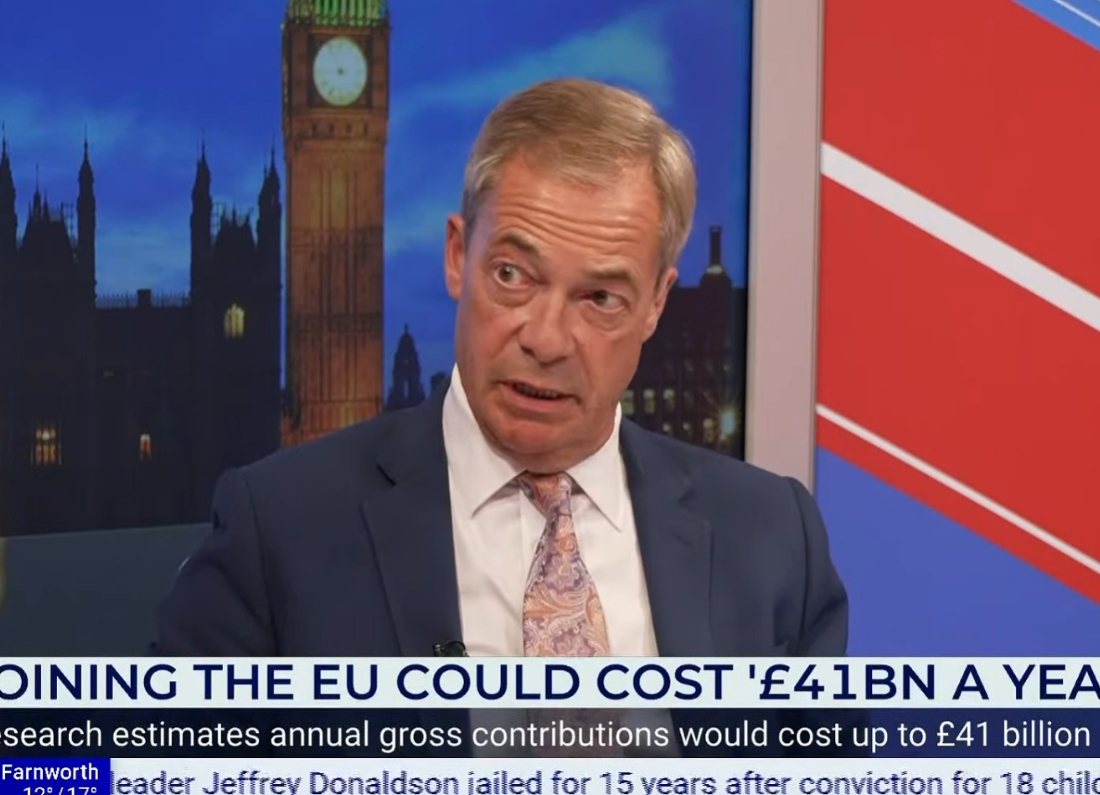
Campaigners are demanding that Ofcom investigate Nigel Farage’s primetime GB News programme after fresh research found Britain is one of only a tiny number of European countries where serving politicians are allowed to present current affairs shows.
Best for Britain has launched a petition calling on the broadcasting regulator to examine whether Farage’s programme on 15 September complied with impartiality rules, after the Reform UK leader used the show to discuss political donations at a time when both he and his party were at the centre of major funding controversies.
Farage is not simply a political commentator appearing occasionally on television.
He is the leader of Reform UK, the MP for Clacton and the presenter of his own weekly primetime programme on GB News.
Best for Britain argues that the combination raises fundamental questions about where political broadcasting ends and party advocacy begins.
Its petition says:
“Nigel Farage leads a political party. He’s a sitting MP. And he now hosts his own weekly primetime show on GB News.”
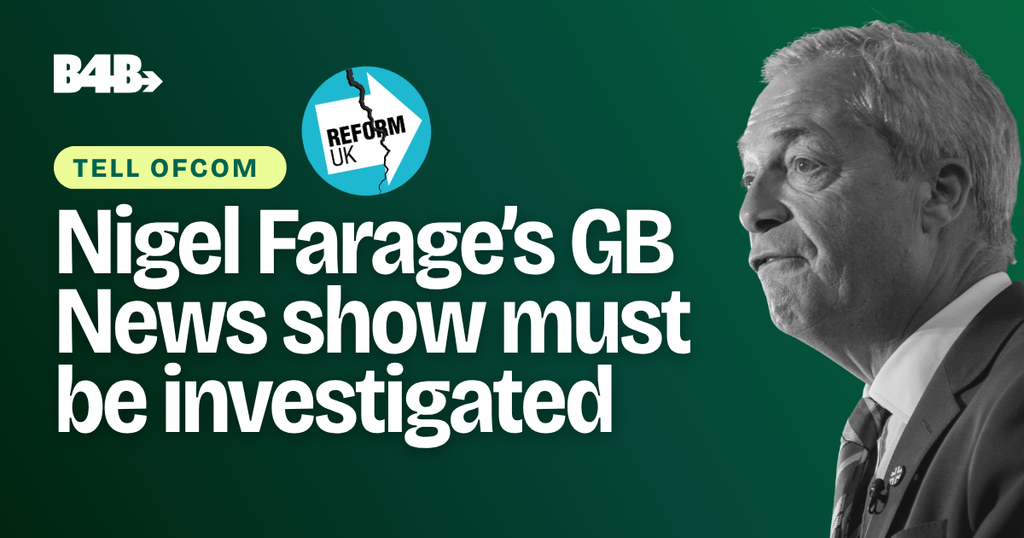
The campaign is calling on Ofcom to open a formal investigation into Farage’s programme, clarify the distinction between news and opinion on channels that present themselves as news services, and consider whether serving MPs and party leaders should be allowed to present current affairs programmes at all.
You can sign it here.
Why the 15 September programme matters
The specific broadcast highlighted by Best for Britain aired on 15 September, shortly after Reform received two extraordinary £36 million donations from cryptocurrency billionaires Christopher Harborne and Ben Delo.
The combined £72 million was the largest pair of political donations ever received by a British party and transformed Reform’s financial position almost overnight.
Farage used his return to GB News after a six-month absence to defend the donations.
At the same time, he was personally under investigation by the Parliamentary Commissioner for Standards over a separate £5 million gift from Harborne that Farage had not initially registered.
Reform was also dealing with a police investigation into separate allegations concerning political funding and polling, which the party denies involved wrongdoing.
Best for Britain argues that this created an obvious conflict between Farage’s roles as politician and broadcaster.
Its fundraising appeal describes the September programme as:
“That’s not impartial. That’s a conflict of interest, live on air.”
That is the campaign group’s interpretation rather than an Ofcom ruling.
No regulator has yet concluded that Farage broke broadcasting rules during the programme.
Ofcom rules are more complicated than campaigners sometimes suggest
The legal position is not quite as simple as saying politicians are banned from presenting news.
Ofcom’s Broadcasting Code states:
“No politician may be used as a newsreader, interviewer or reporter in any news programmes unless, exceptionally, it is editorially justified.”
News must also be reported with due accuracy and presented with due impartiality.
However, politicians are allowed to present current affairs programmes.
That distinction became particularly important after GB News successfully challenged earlier Ofcom findings in the High Court.
In 2024, Ofcom ruled that five GB News programmes presented by serving politicians had breached impartiality rules.
Those programmes included shows hosted by Jacob Rees-Mogg and Esther McVey and Philip Davies.
GB News took two of the rulings to judicial review.
The High Court subsequently held that, under the wording of the existing Broadcasting Code, a programme could not simultaneously be classified as both news and current affairs for the purpose of the rule.
Ofcom withdrew the previous decisions in 2025 and decided not to reinvestigate them.
The regulator considered rewriting its rules so that politicians could not present news material even inside current affairs programmes, but ultimately decided against changing Rule 5.3.
Instead, it strengthened its guidance.
That means Farage is legally allowed to host a current affairs programme, provided GB News complies with the wider impartiality requirements.
Britain is now an outlier in Europe
That technical distinction has come under renewed scrutiny after new research found Britain’s approach is exceptionally permissive compared with most of Europe.
An analysis carried out by Dr James Painter of the Reuters Institute for the Study of Journalism for the Demos thinktank examined broadcasting rules across 37 European countries.
In 35 of those countries, regulators reported no recent examples of serving politicians presenting news or current affairs programmes.
Only the UK, Iceland and Malta had recent examples.
Eight countries, including France and Norway, explicitly prevent politicians from presenting news or current affairs programmes through legislation or broadcasting regulation.
Another 26 restrict the practice indirectly through rules requiring broadcaster independence, impartiality or separation from government and party politics.
The report concluded:
“This demonstrates the extent to which the UK is an outlier in Europe with regards to the practice of political presenting news and/or current affairs programmes and the regulatory framework that surrounds it.”
The comparison is particularly striking because GB News now features several figures closely associated with Reform UK.
Farage has his own programme.
Reform MP Lee Anderson also presents regularly.
Former Reform candidate and political commentator Matt Goodwin has another regular slot.
That has led critics to argue that the channel has become unusually closely intertwined with a single political movement.
GB News rejects that characterisation and says it features a wide range of political views.
Best for Britain wants three changes
The petition makes three specific demands.
First, it wants Ofcom to investigate Farage’s programme of 15 September and determine whether the way political donations were covered complied with impartiality requirements.
Second, it wants much clearer labelling so viewers know whether material being broadcast on a channel with “News” in its name is actually regulated news or current affairs and opinion.
That distinction matters because the rules are significantly different.
A politician cannot normally act as a newsreader, news interviewer or reporter in a news programme.
The same politician can host a current affairs programme and express personal views, provided the broadcaster meets wider due impartiality rules over relevant programming.
Best for Britain argues that many viewers are unlikely to understand that distinction while watching the same presenters, studio and channel.
Third, the group wants Ofcom to examine whether serving MPs or party leaders should be able to host political programmes at all.
Ofcom says current affairs programmes remain legal
Ofcom has defended the existing framework.
A spokesperson said its code was clear that politicians cannot normally present news programmes, while politicians remain permitted to present non-news output provided they are not candidates during an election period and the programme complies with impartiality rules.
The regulator said:
“While politicians are permitted to present non-news programmes – provided they are not standing in an election taking place – such programmes must still comply with the other due impartiality rules in the code.”
It added that changing the statutory standards Parliament had established would ultimately be a matter for government and MPs.
That effectively leaves Ofcom enforcing a distinction which even the regulator has acknowledged can be difficult for audiences to recognise.
Its own research has found that the boundaries between news and current affairs have become increasingly blurred.
The government is now looking at the issue
The row may eventually move beyond Ofcom.
Culture Secretary Lisa Nandy has previously expressed concern about serving politicians presenting television programmes and confirmed that ministers were “exploring action in this space”.
It remains unclear whether that will result in legislation.
The new European research gives supporters of reform a much stronger argument because it shows Britain is not simply applying one common democratic model among many.
Almost every comparable European broadcasting system either prevents the practice entirely or appears not to tolerate it in practice.
France is among the countries with an explicit ban.
Norway also prohibits serving politicians from acting as presenters in this kind of political broadcasting.
Malta is one of the few exceptions and has a highly unusual media system in which political parties themselves are permitted to own television stations.
GB News has already won this argument in court once
Any attempt to tighten the system will have to reckon with GB News’s previous legal victory.
The broadcaster has consistently argued that current affairs is different from news and that politicians have long participated in opinion-led broadcasting.
It also argues that preventing elected politicians from presenting programmes would unnecessarily restrict freedom of expression.
GB News chief executive Angelos Frangopoulos has said the channel provides a range of political perspectives and complies with Ofcom’s rules.
The High Court judgment strengthened the broadcaster’s position by confirming that Rule 5.3, as written, applies specifically to news programmes rather than current affairs programmes.
That is why Best for Britain is no longer simply asking whether Farage technically fits within the existing rules.
Its petition is asking whether those rules themselves are still fit for purpose.
Farage’s dual role is likely to keep the issue alive
The argument has become more politically significant because Farage is no longer simply a campaigner or former MEP with a television programme.
He leads a major political party with MPs, thousands of councillors and tens of millions of pounds in campaign funding.
He is also widely presented as a potential future prime minister.
When he discusses Reform policy, Reform scandals or attacks on the government during his own primetime television programme, the question of which role he is performing becomes increasingly difficult to avoid.
Under the present rules, the answer can depend on whether the programme is legally considered “news” or “current affairs”.
Best for Britain wants Ofcom, and potentially Parliament, to decide whether that distinction is still good enough.
One response to “Petition calls for Ofcom probe into Farage presenting GB News while leading Reform”
-
Serving politicians should be banned from presenting any type of programme on TV or Radio, they are unfair propaganda







Leave a Reply