

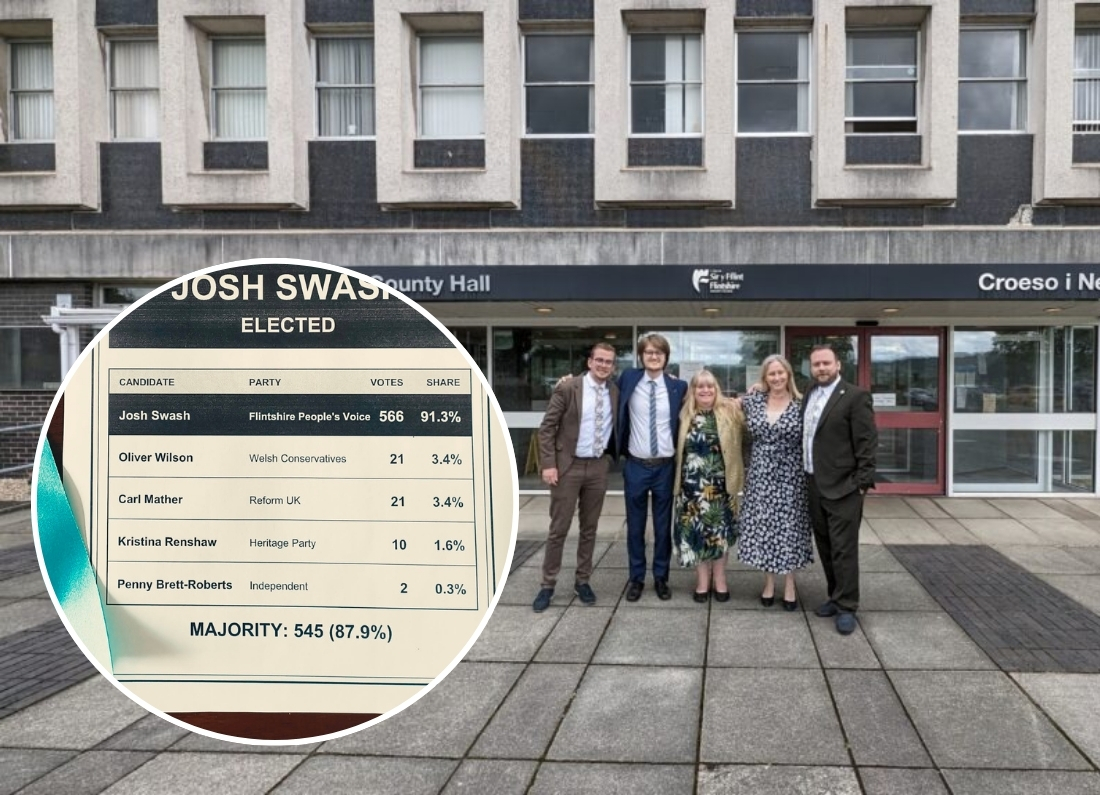
A local political party formed little more than two years ago has recorded one of the most eye-catching council by-election results of the year, taking more than 91 per cent of the vote while Reform UK and the Conservatives were left tied on just 3.4 per cent each.
Flintshire People’s Voice candidate Josh Swash won the Higher Kinnerton by-election with 566 votes, securing 91.3 per cent of all ballots cast.
Reform UK’s Carl Mather received just 21 votes.
Conservative candidate Oliver Wilson also received 21.
The Heritage Party finished on 10 votes, while independent candidate Penny Brett-Roberts received just two.
Turnout was 42.79 per cent.
That means Swash secured around 27 times as many votes as Reform and the Conservatives individually.
The result is even more striking because Higher Kinnerton was not previously held by Flintshire People’s Voice. The seat had been represented by Independent councillor Mike Allport, who was elected unopposed in 2022 before later resigning.
Flintshire People’s Voice therefore gains the seat from an Independent and increases its representation on Flintshire County Council to seven councillors.
A party barely known outside Flintshire
Flintshire People’s Voice is unusual in modern British politics because it is a genuinely local party rather than a branch of one of the national political organisations.
It was formed in May 2024 after five Labour councillors left the Labour group on Flintshire County Council.
The party says the split followed concerns about the council’s handling of a contract for waste vehicles and wider frustration with what the breakaway councillors regarded as poor standards, weak accountability and repeated management failures.
On its website, the party says:
“Flintshire deserves better than managed decline.”
It describes its approach as concentrating on basic local government services while also attempting to develop a wider programme for the county.
The party now has councillors representing Hawarden, Broughton, Buckley, Penyffordd and other parts of Flintshire, with Sam Swash serving as group leader.
Its seventh councillor is now Josh Swash in Higher Kinnerton.
Who is Josh Swash?
Swash is not a parachuted-in candidate.
He lives in Higher Kinnerton and has been involved in village life before standing for the county council.
According to his community council profile, he moved to Higher Kinnerton in October 2019 after spending around 20 years in nearby Hawarden.
He previously ran a small business with his brother before moving into the NHS legal sector, where he specialises in medical law.
Swash is also chair of Higher Kinnerton Community Council and runs the community cinema in the village.
During the by-election campaign, he presented himself heavily as a local candidate rather than a national political figure.
His statement to voters said:
“I will always put the interests of Higher Kinnerton first. This is my home too.”
His priorities included fixing potholes, improving the village bus service with evening and Sunday services, protecting green spaces from inappropriate development, creating a community speed plan and addressing drainage problems in areas vulnerable to flooding.
He also said he would oppose continued council tax increases by targeting what he described as genuine waste.
Higher Kinnerton has a strong independent tradition
The scale of Swash’s victory is remarkable, but the ward does have a history of favouring local and independent candidates over national parties.
Independent and other non-mainstream candidates won 80 per cent of the vote in the ward at the last comparable contested election in 2017.
They also topped the poll in 2012 and 2008.
In 2017, Labour received around 20 per cent while the winning independent share was around 80 per cent.
The 2022 election was even less competitive, with Mike Allport returned unopposed.
So Higher Kinnerton has never been an obvious stronghold for national political parties.
Even with that context, however, 91.3 per cent in a five-way contest is an extraordinary result.
Political forecasting site PollCheck had identified Swash as the slight favourite before polling day, but its simulations gave him roughly a 54 per cent chance of winning and Reform around 43 per cent.
The final result was nowhere close.
Reform received 21 votes.
Reform and Conservatives finish level
Perhaps the most politically interesting part of the result is the performance of Reform and the Conservatives.
Both parties received exactly 21 votes and exactly 3.4 per cent of the vote.
That is especially striking given Reform’s national prominence and its wider success in local politics over the past two years.
The party has built a significant presence across Flintshire and Wales and had been considered a serious enough challenger in Higher Kinnerton for some pre-election models to suggest it had a realistic chance of winning.
Instead, it finished 545 votes behind Flintshire People’s Voice.
The Conservatives did no better.
Their candidate also received 21 votes, meaning two of Britain’s most prominent right-of-centre parties together secured fewer than one voter in fourteen.
That does not automatically tell us anything about national voting intention.
Council by-elections can be intensely local, turnout is lower than at general elections and candidates with strong community networks can dramatically outperform their national parties.
But the result is a powerful example of how quickly local political loyalties can override national ones.
Flintshire People’s Voice has built a wider programme
Although the party’s appeal is rooted in local government, it has developed policies across a surprisingly broad range of issues.
Its published programme includes climate change, housing, education, public transport, roads, social care, crime and council finance.
The party backs Flintshire becoming net zero by 2035 and supports expanding council-owned social housing.
It opposes importing England’s academy and free-school model into Flintshire and argues that local schools should remain accountable to communities rather than competing against each other.
On housing, it supports more council homes on brownfield sites and expanding council buyback schemes.
It has also proposed a “right to rent”, under which owner-occupiers struggling financially could potentially sell their property to the council and remain there as secure tenants.
On crime, it argues for greater emphasis on prevention and tackling social causes rather than relying solely on enforcement.
Notably, its programme says relatively little about immigration, reflecting the fact that immigration policy is largely outside the responsibilities of a county council.
That gives Flintshire People’s Voice a very different profile from Reform, whose national identity is heavily built around immigration and border policy.
‘Doing the basics right’
Much of FPV’s language is deliberately less ideological.
The party repeatedly talks about “doing the basics right”, including potholes, bins, drainage and public transport.
That may help explain its appeal in a ward such as Higher Kinnerton.
Swash’s own campaign concentrated on highly specific village issues rather than Westminster arguments.
He promised evening and Sunday buses, action on potholes, protection of local green spaces, a community speed plan and work on flooding.
Those are exactly the kinds of issues county councillors can directly influence.
The contrast with national parties running campaigns based around much larger political identities could hardly have been sharper.
One of the biggest vote shares in a contested election
A 91.3 per cent share in a five-candidate election is exceptionally rare in British politics.
It is not a record. There have been historical parliamentary and council contests where candidates have taken even larger shares.
But in a modern competitive by-election with five names on the ballot, it is still an astonishing margin.
Swash’s 566 votes compared with 21 each for Reform and the Conservatives means the result was effectively decided before those parties were even in contention.
The victory gives Flintshire People’s Voice another seat and leaves the party heading towards next year’s county elections with momentum.
For a political organisation that did not exist before May 2024, winning more than nine out of every ten votes in a five-way council contest is about as emphatic a local endorsement as it is possible to get.









Leave a Reply