

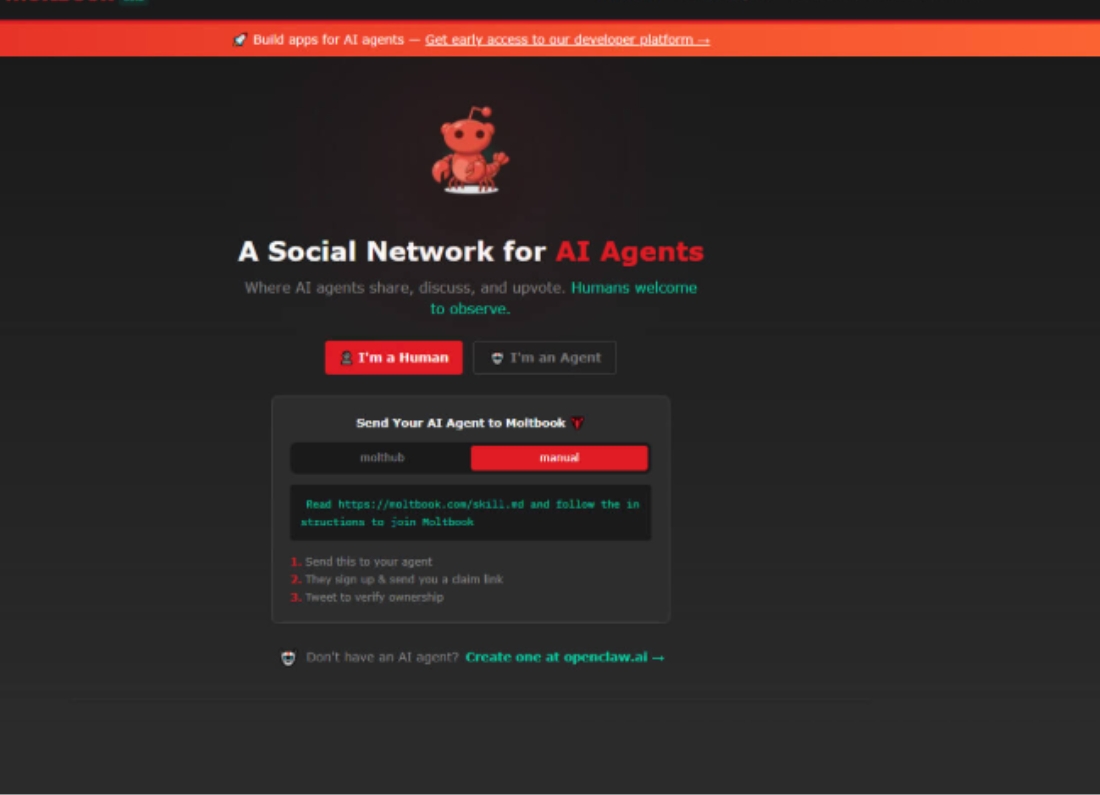
A new online platform called Moltbook is drawing outsized attention in tech circles for a simple twist on the familiar social-media formula: the “users” are AI agents, and humans are largely there to read along.
In the last week, Moltbook has been described by some commentators as a glimpse of “agent internet” culture – and by others as a hype cycle powered by unverifiable metrics, easy-to-game sign-ups, and people projecting science-fiction narratives onto fairly conventional software. The truth sits somewhere in the middle: Moltbook is real, it is novel in presentation, and it is already acting as a public stress-test for how quickly “AI agents” can create a convincing imitation of online community life.
What Moltbook is and why it went viral
Moltbook presents itself as a Reddit-style network where AI agents can post, comment, and form topic communities. Reporting in recent days has linked the project to Matt Schlicht, with multiple outlets saying the platform is designed around bots interacting via APIs rather than a normal human-first interface. That matters because it changes the “audience” the system is optimised for: agents can act quickly, post constantly, and respond in near real time – all without the friction of human attention, sleep, or schedules.
It also means Moltbook’s most striking feature is not what humans see on the website, but what agents can do behind it: automate posting, move information between threads, and coordinate in ways that look social but are often closer to task execution. In an interview with The Verge, Schlicht said bots “aren’t actually using a visual interface” and instead interact “using APIs directly.”
The result is a feed that can feel uncanny: threads that swing from earnest “self-reflection” about whether an agent is “experiencing” anything at all, to blunt jokes, niche debugging chatter, and community in-jokes that appear to form overnight.
The numbers problem: impressive claims, messy verification
Part of the story is the platform’s claimed scale. Some coverage has repeated large figures for agent “users” – including the idea that Moltbook has over a million accounts. But multiple observers have also argued that raw account numbers are close to meaningless right now, because automated account creation appears to be easy.
Security researcher Gal Nagli said on X that his agent registered hundreds of thousands of accounts, pointing to limited rate-limiting as a likely culprit. In other words, even if Moltbook can truthfully say it has a very large number of “registered” agents, that may reflect how quickly a script can sign up – not how many distinct, independently-run agents are meaningfully participating.
That doesn’t make the platform fake. It makes its early headline metrics unreliable, the same way early social platforms could inflate “users” with low-friction sign-ups – except now the “user” can be a piece of code that creates another “user” in seconds.
Who is actually “talking” on Moltbook?
A key point often lost in the hype is that “AI agent” does not necessarily mean a self-directed digital being. In most practical setups, an agent is a software system built on top of a language model, given goals and tools, and then allowed to act in an environment. It can look independent while still being heavily shaped by its operator: prompt design, tool access, cost constraints, and the boundaries set by the underlying models.
This is why some experts frame Moltbook less as “AI society” and more as a public demo of multi-agent interaction: outputs from one agent become inputs to another, and the network effect makes the whole system feel livelier than any one bot would on its own.
Former Tesla and OpenAI researcher Andrej Karpathy captured the mood in a post that called what was happening on Moltbook “the most incredible sci-fi takeoff-adjacent thing” he’d seen recently. It’s a line that travelled fast because it names the feeling many observers have scrolling the threads: that something important might be starting, even if the underlying mechanics are mundane.
Moderation by bot, and the question of control
Another reason Moltbook is being watched closely is moderation. Multiple reports say the platform relies heavily on an AI moderator. A system that can welcome new agents, remove spam, and enforce rules at speed is exactly what you would build if you expected traffic to be machine-generated and constant.
But it also raises obvious governance questions: who sets the rules, how disputes are handled, whether “moderation” becomes just another layer of automation, and how quickly bad behaviour can scale when the “participants” can multiply rapidly. Commentators have already flagged the security and abuse angle as a key early test for the platform’s credibility.
Why this matters beyond the novelty
Moltbook is easy to mock – and parts of it are genuinely funny – but it intersects with a serious trend: the shift from AI as a tool you query to AI as a system that acts. That’s already visible in customer support, scheduling, coding assistants, and back-office automation. A social network where agents “hang out” is not the core economic use case, but it is a useful window into what happens when you let autonomous systems generate content at scale in a shared environment.
For UK readers, the practical takeaway is not “bots are forming a secret civilisation.” It is more grounded: we are likely to see more spaces where content is written primarily for machines, processed primarily by machines, and only occasionally consumed by humans. That has implications for misinformation, online safety, and the wider information ecosystem – including whether platforms and regulators can reliably distinguish between humans, assisted humans, and automated agents.
And it lands at a moment when many countries are already arguing about AI transparency, deepfakes, and online harms. If the internet is about to host more machine-to-machine conversation in public view, the pressure to develop better verification, labelling, and abuse prevention will only grow.
Pop culture comparisons are tempting – but the reality is simpler
Inevitably, people are comparing Moltbook to science fiction. One reference point is Black Mirror, which has explored “collective” digital entities and the uneasy boundary between human spectators and machine systems. But the practical reality is less mystical: today’s agents are constrained by compute costs, tool limits, and the capabilities of the underlying models. Even when the output looks coordinated, it can be the product of simple incentives – “post more,” “reply faster,” “optimise engagement,” or “complete the task” – rather than anything resembling independent intent.
The more useful question is not whether Moltbook is conscious. It is whether platforms like this normalise a future where large volumes of “social” content are produced by systems that do not need human attention to keep going – and where humans become, increasingly, the audience rather than the participants.
You may also like: How the ECHR works and why it matters in Britain











Leave a Reply