

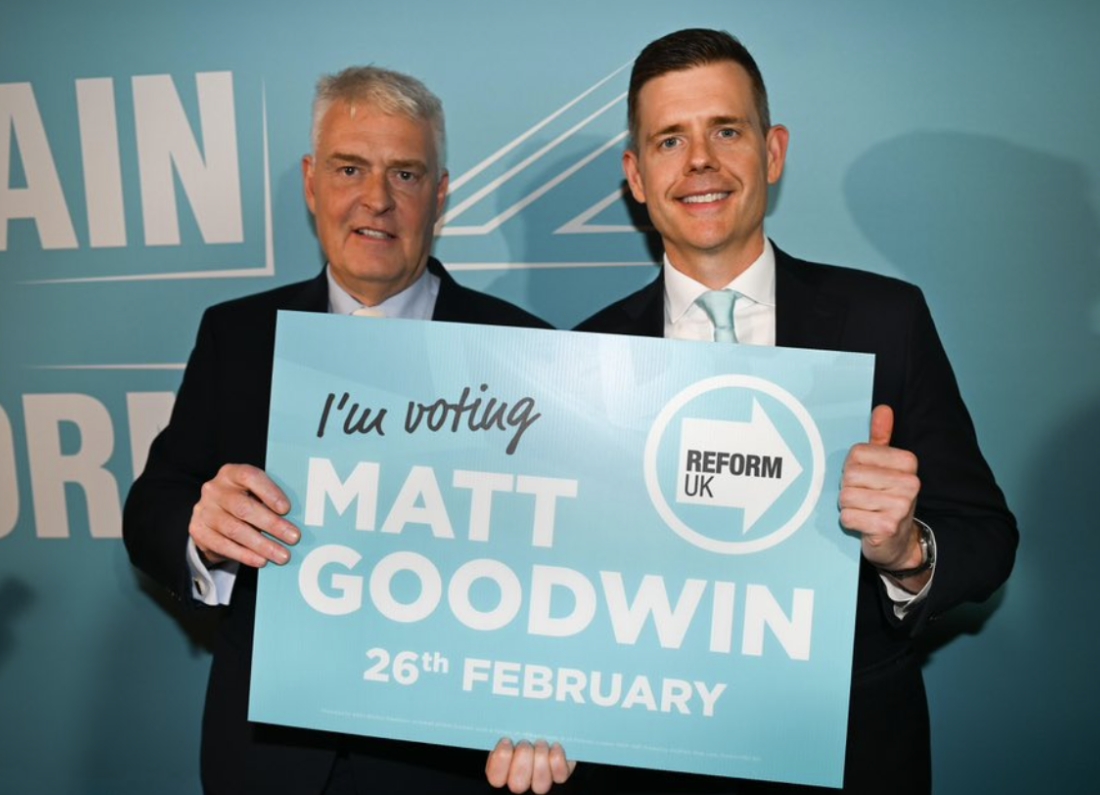
Keir Starmer has accused Reform UK of trying to import “toxic division” into a high-stakes Greater Manchester by-election, after the party confirmed GB News presenter and activist Matt Goodwin as its candidate for Gorton and Denton.
Speaking to reporters as he travelled to China, the prime minister said the contest would show a clear divide between Labour’s approach and Reform’s political style, arguing that Reform would seek to “tear people apart” in one of the most diverse parts of Manchester.
Goodwin’s selection has drawn immediate controversy because of earlier remarks in which he argued that being born in the UK does not automatically make someone British, writing online: “It takes more than a piece of paper to make somebody ‘British’.” When asked directly whether he stood by those views, he declined to give a clear answer, according to reporting from the campaign launch in Denton.
The by-election is due to take place on 26 February.
The battle in Gorton and Denton has become a national flashpoint because it sits at the intersection of several pressures facing Labour at once: anxiety over Reform’s growth, internal arguments about candidate control and direction, and the risk of opposition votes splintering between multiple challengers.
A by-election that has turned into a national test
Gorton and Denton has been Labour territory for generations, but party strategists are increasingly treating it as a danger seat in a volatile political climate. The by-election was triggered by the resignation of Andrew Gwynne, who had been sitting as an independent after being suspended by Labour.
Labour’s campaign has also been shaped by the collapse of a high-profile plan to bring Andy Burnham back to Westminster via the seat. Burnham applied for permission to enter Labour’s selection process, but was blocked by the party’s National Executive Committee – a decision that has fuelled a wider row over whether Labour is prioritising internal management over winning difficult contests.
Starmer has defended the decision in terms of cost and resources, with allies arguing that a Burnham victory would have triggered an expensive Greater Manchester mayoral by-election at a politically risky moment.
What Goodwin has said – and why it is so contentious locally
Reform’s choice of candidate is central to Labour’s attack line. Goodwin has been criticised for comments suggesting that some UK-born people from minority ethnic backgrounds are “not necessarily British”, and for writing that Britishness requires more than legal status alone.
That argument lands particularly heavily in Gorton and Denton because of its demographic mix. Reporting around the selection points to a constituency where a large share of residents identify as Muslim and nearly half identify as coming from minority ethnic backgrounds, making it a seat where questions of identity politics are not abstract – they map onto day-to-day community life.
Goodwin, for his part, has tried to frame the contest as a broader judgement on the government. At the launch event, he pitched it as a “referendum” on Starmer and said he wanted “hardworking, law abiding, tax paying people” to “make political history”.
Labour figures say that framing is precisely the problem. Lucy Powell, the party’s deputy leader, has argued that Reform’s approach “drives a wedge” between communities, while offering “division” rather than practical answers.
A crowded field and the tactical-voting question
The contest is also being shaped by the presence of multiple parties competing for disillusioned voters. The Greens are planning a major push and are openly discussing the by-election as a chance to win in a seat where they believe Labour’s support has weakened sharply.
That has sharpened Labour’s insistence that it is the only credible “stop Reform” vehicle locally – a message party officials say they delivered too late in the recent Caerphilly by-election, where Plaid Cymru won after tactical dynamics shifted during the campaign.
Reform, meanwhile, is treating the seat as a symbol. With high-profile defections and a growing media footprint, the party wants a headline result that reinforces the argument it is the main challenger to Labour in parts of England that used to look safe.
What happens next – and what voters can realistically expect
In practical terms, by-elections often become more intense and more nationalised than general election fights, because the result is easier to interpret as a political “message” and because parties can concentrate staff and money in a single place.
But the mechanics of what is at stake for residents remain straightforward: they are choosing a new MP, after a resignation, in a seat that now sits at the centre of competing claims about the country’s political direction.
For Labour, holding the seat would calm the immediate speculation about leadership pressure and prove that the party can defend difficult ground even when its brand is under strain. For Reform, a breakthrough would validate Farage’s argument that his party can replace the Conservatives as the dominant force on the right while also winning in Labour-held areas. For the Greens, a win would be a major parliamentary moment and a sign they can convert local campaigning strength into Westminster seats.
Whatever the outcome on 26 February, the campaign has already set the tone for the month ahead: harder-edged rhetoric, sharper arguments about identity and national cohesion, and an increasingly fragmented electoral map in which parties cannot assume old loyalties will hold.
You may also like: Petition for automatic by-elections when MPs defect tops 100,000 signatures





Leave a Reply