

Journalists are supposed to ask difficult questions of powerful people. That is the theory, anyway.
In practice, a lot of modern political interviewing can feel like carefully stepping around the obvious point, accepting evasions in real time, and making sure the person at the podium is not made too uncomfortable in case access is lost next time.
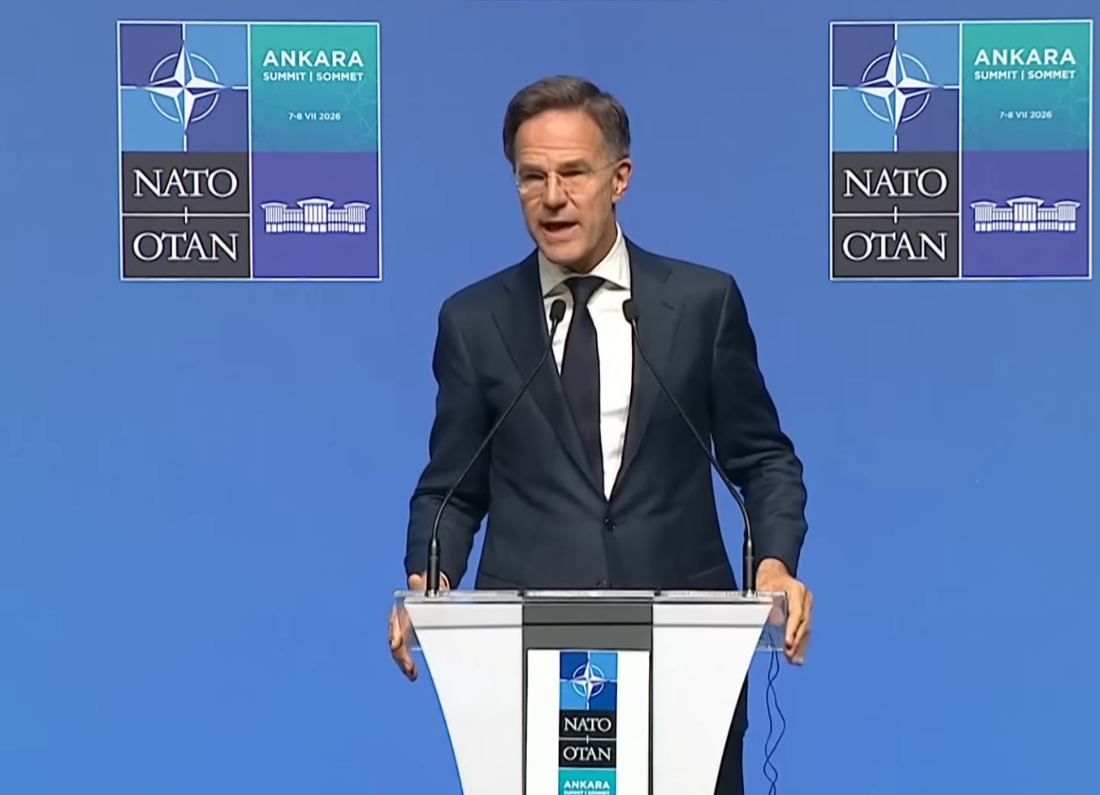
Fortunately, one Danish reporter at the NATO summit in Ankara did not appear to have received that memo. When NATO secretary general Mark Rutte appeared at a press conference, the journalist asked him the question many people have been wanting to ask while watching his handling of Donald Trump.
The question
The clip was shared widely on X by Aaron Rupar, @atrupar, who wrote: “WOW — Danish reporter goes there with Mark Rutte.”
The reporter asked Rutte: “You sit next to Donald Trump at moments when he talks about conquering Greenland, talks about lashing out at allies like Spain, things it doesn’t seem like the old Mark Rutte would approve of. Does this have any affect on your self-respect when you sit there and say nothing?”
That is not just a question. That is a public service. It cut straight through the diplomatic padding and went directly to the heart of the issue: what exactly happens to the leader of NATO when the most powerful member of the alliance openly threatens allies, talks about taking control of Greenland, attacks Spain, and treats collective security as if it is a personal loyalty test?
Rutte’s answer
Rutte’s response did not exactly meet the moment. According to India Today, he pivoted to praising Trump, saying he always acknowledged “when praise is due” and arguing Trump deserved credit for making NATO “so much stronger” by pushing European members to spend more on defence, achieving what the United States had sought since Eisenhower: a more balanced split of defence spending between America and Europe.
Which is one answer. Just not really an answer to the question about self-respect.
Why the question landed
The question worked because it was not coming out of nowhere. Trump had used the Ankara summit to reopen multiple fights with US allies. Reuters reported he demanded the United States cut trade ties with Spain, called Madrid a “terrible partner” in NATO, renewed his demand for US control of Greenland, and then later insisted there had been “a lot of unity” among NATO leaders.
That is the whole contradiction in one paragraph. Publicly: threats, insults, territorial pressure and trade-war language. Diplomatically: unity, solidarity, everything is fine.
Rutte’s job is not easy. A NATO secretary general is not a normal party politician; his role is to hold together a military alliance of 32 countries, including an American president who has repeatedly questioned the value of that alliance and used public pressure to force allies into higher defence spending. But that is exactly why the Danish reporter’s question mattered. There is a point where alliance management begins to look less like diplomacy and more like public submission, and the question was asking whether Rutte himself knew where that line was.
The Greenland problem
The Greenland part of the question was especially pointed because Greenland is not some abstract Trump talking point. It is a self-governing territory within the Kingdom of Denmark, a NATO member. So when an American president talks about wanting US control of Greenland, he is not threatening an adversary. He is putting pressure on an ally.
This is not a new pattern. Trump has repeatedly returned to the Greenland demand throughout the year, at one point dropping a tariff threat over the territory after NATO talks, a move critics described as gaining him nothing. A Danish MEP’s speech on the subject went viral for its blunt language directed at Trump, and Elon Musk himself has mocked Trump’s “Board of Peace” branding with a Greenland land-grab pun.
Reuters reported Trump again demanded US control of Greenland during this summit, saying the island was “very important for the United States” and arguing Denmark had not properly recognised its value. Danish prime minister Mette Frederiksen responded by making clear Greenland was not up for grabs. French president Emmanuel Macron noted the obvious alliance problem, saying NATO has rules of solidarity if one member is attacked, but also rules ensuring allies do not attack one another.
The Spain row
The Spain reference was just as important. Reuters reported Washington and Madrid were already at odds because Spain had rejected Trump’s demands for European countries to sharply increase military spending and had refused to allow the US to use Spanish airspace or bases for the Iran war. Trump then called Spain a “wasted cause” and said he wanted trade cut off, including visits.
Spain’s health minister Monica Garcia responded bluntly on X: “We are a sovereign, democratic country that defends multilateralism and peace,” adding that what was “terrible” was confusing diplomacy with bullying.
This is the backdrop to the Danish reporter’s question. It was not just “why are you nice to Trump?” It was: why do you sit there while the president of the United States threatens and humiliates allies, then present that as alliance management?
Rutte’s calculation
To be fair to Rutte, there is a coherent explanation for his approach. He has previously shown he is capable of pushing back directly on Trump, rebuking the president’s claim at Davos that European allies would not defend the US. NATO leaders went into this summit trying to avoid a blow-up, with allies attempting to “mollify” Trump and show progress on defence spending, Rutte himself calling for “clear, concrete and credible plans” to meet spending targets. The summit was also expected to restate NATO’s commitment to Article 5, the collective defence principle under which an attack on one member is considered an attack on all, and the fact that leaders felt the need to reaffirm that so openly showed how fraught the alliance had become.
In that context, Rutte’s defenders would argue the secretary general’s job is not to win a moral purity contest in front of cameras. It is to keep the Americans inside the tent, keep Ukraine supported, keep European defence spending rising, and prevent Trump from blowing up the alliance in public. NATO did produce a declaration affirming an “ironclad commitment” to collective defence under Article 5, alongside a €70bn pledge in military assistance to Ukraine for 2026.
The weaker argument is that doing all this by endlessly praising Trump and refusing to call out the obvious can make the alliance look less stable, not more.
The reaction
The online response was swift and overwhelmingly appreciative. Denison Barb, @DenisonBarbs, wrote: “This is how reporters used to ask questions before days of news stations being a mouthpieces for a political party in this country.” Mehdi Hasan, @mehdirhasan, kept it simple: “If only we had more reporters like this.” Hemant Mehta, @hemantmehta, said: “Hey, look! A reporter calling out obvious bullshit! This should be the norm.”
That really is the central point. The clip went viral because the question felt unusually direct, when it should not have felt unusual at all. A journalist asked a senior public figure whether their behaviour matched their principles. That should not be shocking. It should be the job.
The Rutte criticism
Plenty of the reaction was aimed squarely at Rutte himself. Laurence Boorstein, @LarryBoorstein, wrote: “Before Mark Rutte became a failed secretary general of NATO, he was a failed prime minister of the Netherlands. Rutte is a spineless coward. Donald Trump, who violated UN Charter Art. 2 to attack Iran, is threatening Greenland, which belongs to NATO ally Denmark.”
Mr Demos of Pnyx, @gem_ste, was even more brutal: “Rutte is nothing, stands for nothing, has not a single value in his person except as a conduit for power. He spent 14 years as the Dutch PM ruling like this. He is a pristine neoliberal, a vacuum of principle and ethics with not the slightest scruple.” Anthony Scaramucci, @Scaramucci, also piled in: “He doesn’t have any. He thinks he is a Trump whisperer but he is a Trump dissolvable suppository.” That last one, you suspect, may not make it into the official NATO minutes.
Why it struck such a nerve
The reason this exchange resonated is not just because the question was blunt. It is because it put a name to a wider frustration with how democratic leaders and institutions keep handling Trump. They know what he says, what he threatens, what he does to allies, and what contempt he shows for international norms when those norms become inconvenient. But instead of confronting it directly, too many figures try to manage it, flatter it, or pretend the latest outrage is just another negotiating tactic.
NATO can write the right words into a communique. But if the alliance’s most powerful leader spends the summit threatening allies and its secretary general responds mainly with praise, the public performance starts to matter almost as much as the formal text.
More of this, please
The broader reaction became less about Rutte alone and more about journalism itself. Non-Partisan Independent, @corruptentities, wrote: “We should applaud every journalist that ‘go there’ with spineless sycophants. The world is in a much more fragile state than we choose to admit.” million, @million_aire1, said: “damn. been awhile since i seen a journalist absolutely body a politician like that. cooked him.” juju, @julest10003, added: “Uggghh the Danish get tough truth-spitting Viking gods in their press pool and we get Peter Douchey of Faux News… WHY CAN’T WE HAVE NICE THINGS?!!!!”
That was the mood. People were not just applauding one sharp question. They were responding to the sight of a reporter doing the thing many people feel political journalism has stopped doing often enough: asking the obvious question without apologising for it.
The question was not rude. It was not unfair. It was not a stunt. It was direct. And when politics is this unstable, directness matters.
Rutte was asked whether sitting silently beside Trump while he talks about Greenland, Spain and allies has any effect on his self-respect. That question will outlast whatever answer he tried to give.
One response to “Mark Rutte got absolutely cooked by a Danish reporter over Trump”
-
I am Danish, and first of all ,I think you should know that there isn’t a psychological, demographic connection between the Greenlandish people and the Danish. Actually, the only thing the Greenlandish people seem to want is to be independent, but because they don’t have the economy for being so, they can still use our money…
When it comes to Rutte, I can’t see that the question chocks him at all – probably because he is used to childish questions about his personal feelings ( what about your self respect? ) that are irrelevant for Nato’s survival – and definitely the survival of Denmark. too.
If the threat from Russia is real – and that is what the the Danish government keeps telling us… – we should thank Rutte for making it attractive for Trump to stay in Nato. If USA leave us now, we are unable to defend ourselves at all.
So all the Danish people – the Danish prime minister and the “brave” journalist is as well – should pay less attention to Rutte’s self respect and be thankful for his skill as a diplomat. He has actually succeeded in keeping Nato intact in a period where it is in deep trouble and challenged by member counties with totally different interests.






Leave a Reply