

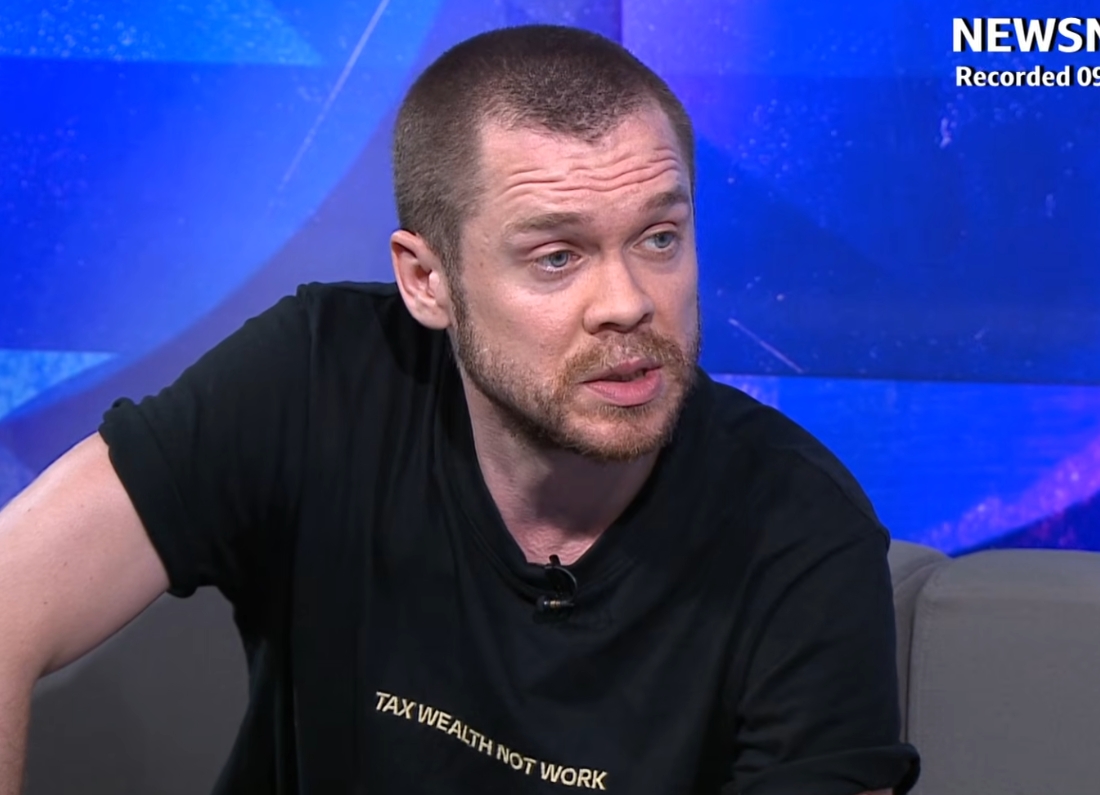
Gary Stevenson, the economist and campaigner behind Gary’s Economics, appeared on Newsnight this week to discuss wealth taxes, his hopes for incoming prime minister Andy Burnham, and his new Channel 4 documentary, How To Get Filthy Rich with Gary Stevenson.
A track record he’s keen to remind people of
Asked whether the prospect of Burnham replacing Keir Starmer was something his brand of economics had predicted, Stevenson pointed to his own record. “Go back and watch the video that I put out just before the election in 2024. I said Starmer will win a landslide. He will not do anything about inequality. Living standards will continue to fall and he will be incredibly unpopular very quickly. I’ve been predicting for more than a year he’d be replaced after local elections. So I’ve got a good track record of predictions.”
This mirrors Stevenson’s earlier explainer on bond markets, in which he argued media coverage blaming Burnham for bond market volatility was largely nonsense, and that Britain’s next government faces only three real options: tax the rich, tax working people, or continue dismantling the welfare state.
The Burnham message
Pressed on whether Burnham represents a genuine break from Starmer’s approach, Stevenson was direct. “I think it’s very important for Andy Burnham that he establishes himself very quickly as meaningfully, significantly different from Starmer on the economy. And the policy the public want is wealth taxes, and they want tax wealth not work. If Andy Burnham doesn’t go with some meaningful action, or at least some change in messaging on that, it’s hard for me to see what he’s going to do that establishes himself as different on the economy.”
He confirmed he has never actually met Burnham, despite trying: “I’ve been trying my best to speak to people who are close to him. I go into parliament and I try and lobby politicians, and as you can probably guess, there’s a long queue outside. There’s a lot of people with a lot more money and power than me that try and speak to Andy Burnham, and I’m taking my place in the queue.”
The central argument
Stevenson’s core claim is that Britain’s wealth distribution has undergone a dramatic reversal over recent decades. “Thirty years ago, men like my dad could work for 20 grand a year and buy a house and have a pension, have a retirement, send your kids to university. Government wealth has gone from plus 100% of GDP to negative 100% of GDP. Working-class wealth lost, government wealth lost, gone to the super rich. We’ve got a trillionaire class now growing their wealth at 20% a year. If you allow that to happen and they’re untaxed, everybody else is going to lose their wealth.”
He was careful to frame his proposal as damage limitation rather than a cure-all. “It’s not a magic bullet. If you’ve got cancer and I cure your cancer, you’re not going to win the marathon, but you will not die. I’m trying to stop the economy from collapsing.”
The Norway and Switzerland challenge
O’Connell pushed back hard on the practical evidence, noting only three blanket wealth taxes remain in Europe, in Spain, Norway and Switzerland, and that wealthy individuals often simply relocate. Stevenson’s response was that wealth taxes get reversed because “all of the richest and most powerful people in the world don’t want wealth taxes and they push aggressively hard for them to get reversed.” Pressed specifically on Norway, where the number of wealthy people leaving doubled after a 2022 increase, Stevenson argued the solution was an exit tax alongside any wealth tax: “I think you need an exit tax. It’s just a basic way of defending the wealth in your economy.”
The billionaire question he wouldn’t answer directly
The most heated exchange came when O’Connell repeatedly asked whether Stevenson wants fewer billionaires in the UK. Stevenson consistently redirected the question toward asset ownership rather than headcount: “China does not allow me to own £10bn of Chinese assets, live in Britain, and then say ‘sorry, I live in Britain’ when they ask for tax on those assets. Do you want Britain to be owned by British people who pay British tax, or do you want this country to be owned by foreign billionaires who can hold us to ransom?”
When O’Connell noted that only 50,000 individuals, the top 1.1% of taxpayers, pay at least 10% of all income tax, Stevenson made a sharper distinction: “The top 1% of taxpayers is not the top 1% richest people. Top 1% of taxpayers is people who work for their money, because we have a tax system that taxes workers but does not tax wealth.”
On his own wealth, and stepping back
Asked how “filthy rich” he actually got before quitting trading to start his YouTube channel, Stevenson said he was worth “between one and 10 million pounds,” adding pointedly that he’d been “aggressively harassed by Piers Morgan” on the same question previously.
He confirmed he intends to step back from public campaigning after the documentary’s release: “I’m tired, Paddy. I’ve been doing this for years. I’m tired of betting on people’s living standards collapsing and trying to tell people every year and getting called a liar by liars and getting called an idiot by idiots. This is not a Marvel movie. This is not Gary Stevenson Saves the World. I’ve worked incredibly hard for two and a half years here, and I’ve given everything I’ve got to give.”
He connected his own family history directly to the argument, describing his grandmother being born in poverty in London a century ago, three of her siblings dying of tuberculosis, and the subsequent decades of change that produced the more secure world his own father lived in. “This is not Gary Stevenson saves the world. I’m on it. The British public has a choice to make. Either they choose to come with me, tax the rich, get a fair share, or they choose to allow the rich to take everything, and the British public will make its choice, and it will get what it deserves.”
Why the reaction split so sharply
The interview generated an enormous volume of comment, overwhelmingly supportive of Stevenson and critical of O’Connell’s questioning style. One widely liked comment read: “I’m tired of being called liars by liars and an idiot by idiots is deep, we need to break that illusion.” Another argued: “Insane how out of touch the legacy media is, a wealth tax is backed by 70% of the population. Yet they make it look like it’s a contentious or controversial issue.” A recurring theme was frustration at what viewers saw as O’Connell repeatedly trying to force a “gotcha” on the billionaire headcount question rather than engaging with the substance of asset taxation, with one commenter writing: “Such a combative interviewer desperately trying to create a gotcha sound bite,” while another offered the opposing view that Stevenson himself had been evasive: “‘Do you want billionaires to leave the UK?’ …. ‘They cannot take their assets with them.’ …. ‘But what if they leave?’ This reminds me of that time I tried to teach algebra to my neighbour’s cat.”
Several commenters connected Stevenson’s argument to the wider debate this year around wealth concentration, including Jayati Ghosh’s own recent interview on degrowth and global wealth taxation, and referenced Gabriel Zucman, the French economist Stevenson name-checked as evidence his position reflects mainstream economic thinking rather than fringe activism, having co-written proposals with seven Nobel Prize-winning economists.
Where this leaves things
Stevenson’s documentary has drawn sharp criticism from tax expert Dan Neidle, who called it “populist claptrap,” a line O’Connell put to him directly, along with a suggestion that Stevenson might simply be “thin-skinned.” Stevenson’s response was blunt: “For somebody who’s thin-skinned, I’ve been doing it a long time.” Whether his declared intention to step back from campaigning holds, or whether, as one commenter suggested, “it’s not over yet,” remains to be seen. For now, the documentary and the interview together have reignited exactly the debate Stevenson says he’s spent years trying to force into the open: not whether inequality is growing, but what, if anything, Britain’s new prime minister intends to do about it.
4 responses to ““We’ve got a trillionaire class now”: Gary Stevenson just gave Andy Burnham the economic warning he cannot ignore”
-
The system in the UK was always designed so that the very wealthy DON’T pay tax – especially the aristocracy. Because their wealth equals power, and that is something they will never allow to diminish. The post-war period was a blip, not the norm in the history of these islands.
-
Why does the media in the UK constantly support the richest most powerful people not the majority of the people.
I get they get funded and pressured by people with eye watering amounts of money. But where is the moral stance. Especially the BBC who is funded by the TV licence payers. Things are going seriously pear shaped and the average working and middle class people are the ones who are going to be disadvantaged. It’s very scary.
-
Gary is on the right track but I would like to understand why just 2% and not more.
-
I believe 2% is calculated to not be confiscatory/punitive, on the basis that the wealthy generally earn significantly more than 2% on their assets. It’s not always the case though. The aristocratic landowner in the documentary is probably struggling to make 2% if that, so one can sympathise with his reaction, so I personally think “the solution” part of Gary’s propositions needs work, but I agree that there is a wealthy section of society who need to be made to pull their weight in paying tax one way or another.
-






Leave a Reply