


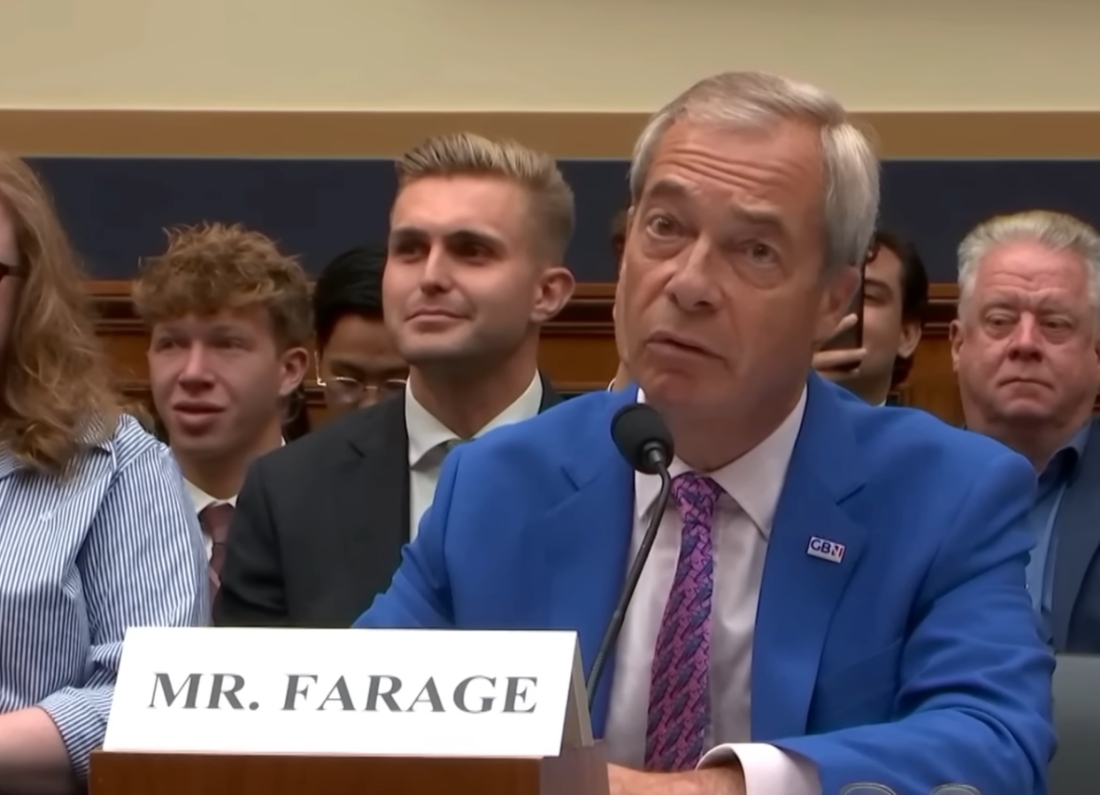
Lisa Nandy has suggested that a government led by Nigel Farage would be “fascist”, as ministers grow increasingly alarmed by Reform UK’s rise in the polls.
The culture secretary made the remarks during an interview with Sky News on Sunday, where she was asked about warnings she had reportedly delivered behind closed doors to cabinet colleagues.
Asked directly whether she believed a Farage-led government would be fascist, Nandy stopped short of using the label explicitly but left little doubt about her view.
“If it walks like a duck and it quacks like a duck, in my experience it usually is a duck,” she said.
🏛️ Cabinet warnings as Reform surge continues
Nandy’s comments come amid polling that suggests Reform UK could win the next general election if current trends continue, prompting growing unease inside Labour about how to confront Farage’s movement without legitimising it.
According to reports, Nandy warned a recent cabinet meeting that the UK could be heading towards its first “fascist” government, a claim that reflects mounting concern among senior ministers about Reform’s rhetoric on immigration, identity and national decline.
While she declined to repeat her exact words from the meeting, she confirmed the substance of her concern during the broadcast interview.
“I think we’ve been here many times in history before,” Nandy said. “Certainly when I was growing up in the 1980s in Manchester, coming from a mixed-race background, I’ve seen this playbook before.”
⚠️ ‘A familiar and dangerous playbook’
Nandy, whose father is Indian, framed her remarks around personal experience rather than abstract political theory, drawing parallels between current political rhetoric and earlier periods of social tension.
“I’ve seen this playbook before,” she said. “Where people try to scapegoat and demonise other people, try to pit us against one another and try to divide us from one another.”
She argued that such tactics are used when political movements lack substantive answers to the country’s underlying problems.
“They do it for one reason and one reason alone – because they have no answers to the problems that this country faces,” she said. “It takes us to some very dark and dangerous places and I think we should have no truck with it at all.”
🌍 ‘Not migrants who caused the crisis’
Nandy also pushed back directly against Reform UK’s focus on migration, insisting that migrants and ethnic minorities are not responsible for Britain’s economic and social difficulties.
“It’s not migrants, it’s not people with different coloured skin, who are responsible for the problems that the country has,” she said. “It’s one group of people and one group of people alone – and it’s the people he’s welcoming with open arms to his own party.”
While she did not name individuals, the remark was widely interpreted as a reference to wealthy donors, corporate interests and former Conservative figures who have defected to Reform UK in recent months.
🎙️ Pressed on the ‘fascist’ label
Presenter Trevor Phillips challenged Nandy directly on whether she would use the word “fascist” to describe a Farage-led government.
“Would you use the word ‘fascist’ about a Nigel Farage-led government or not?” he asked.
Nandy initially demurred, saying labels could sometimes distract from the substance of the issue.
“I’m not sure that labels are particularly helpful,” she replied. “But I’ve got a lot of experience of living with the consequences of othering and people who are trying to divide us from one another.”
She then returned to her earlier analogy.
“I guess I would just say that if it walks like a duck and it quacks like a duck, in my experience it usually is a duck.”
Phillips responded dryly: “I think I know what that means.”
📊 Labour’s tightrope as election nears
Nandy’s remarks highlight the delicate balance Labour is attempting to strike as Reform UK continues to gain ground.
Ministers want to warn voters about what they see as the dangers of Farage’s politics, while avoiding language that could be dismissed as alarmist or elitist.
Farage has repeatedly rejected accusations of extremism, presenting Reform UK as a populist alternative to what he describes as a failed political establishment. Critics, however, argue that Reform’s rhetoric mirrors patterns seen in other countries where populist movements have drifted toward authoritarianism.
As the election approaches, Labour figures appear increasingly willing to confront those concerns directly.






Leave a Reply