

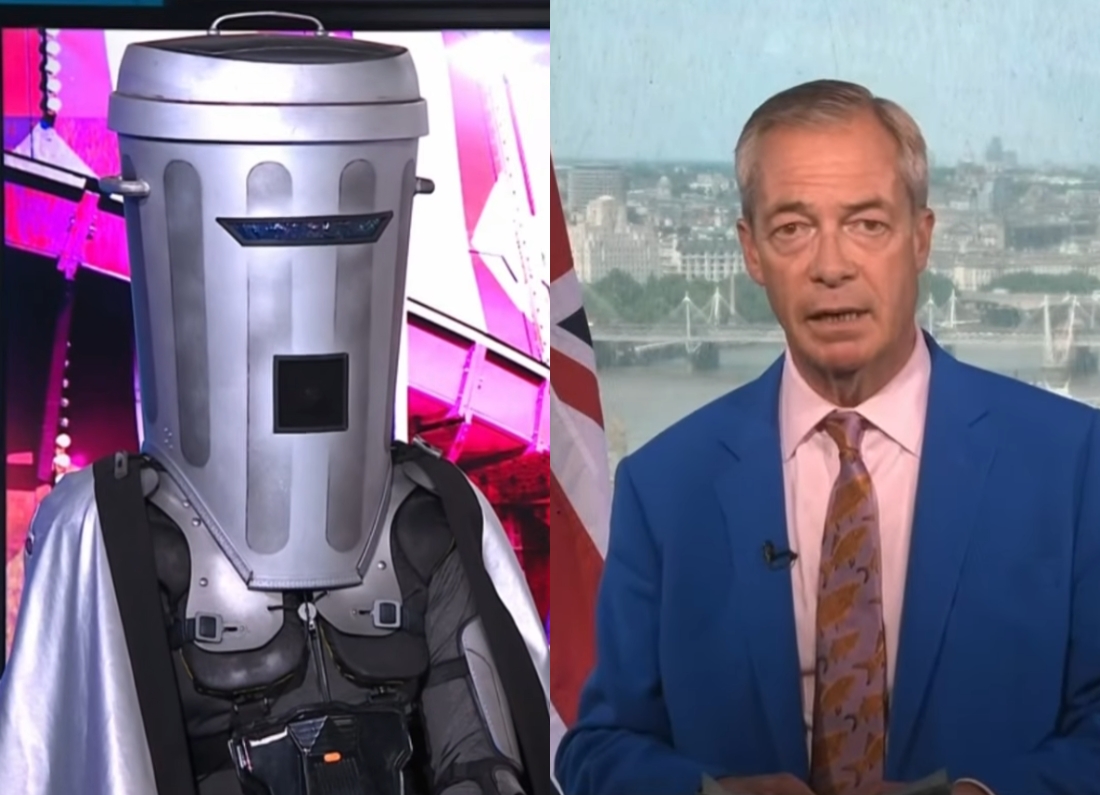
Count Binface appears to have caught Nigel Farage on the hop in the Clacton by-election by doing something rather unexpected: announcing a set of policies aimed specifically at the people who live there.
On 13 August, the intergalactic space warrior from the planet Sigma IX will go up against the Reform UK leader in one of the strangest by-elections in recent British political history.
Farage created the contest by resigning as Clacton’s MP, only to announce that he would immediately stand for the same seat again. He described the forthcoming vote as a battle between “the people and the establishment”, arguing that his constituents should be allowed to judge the controversy surrounding his finances.
Labour, the Conservatives, the Liberal Democrats and the Greens all refused to take part, dismissing the election as a political stunt. Their absence has left Farage facing a field of smaller parties and independent candidates, with Count Binface emerging as his highest-profile opponent.
Other declared challengers have included Laurence Fox, Piers Corbyn and a Monster Raving Loony Party candidate. There may be plenty of competition for the novelty vote, but it is Binface who has captured the national mood.
Now he has released a pledge card that manages to be funny while also drawing attention to some of the most serious criticisms of Farage’s time representing Clacton.
Count Binface’s promises to Clacton
The pledge card was shared by former Labour spin doctor Alastair Campbell, who said Binface’s policies had been designed to exploit Farage’s weaknesses. They certainly do not require much decoding.
“I will hold weekly constituency surgeries. I will answer all letters and emails within three days. For every day I spend overseas, I will spend ten in Clacton. Any outside earnings will be donated to Clacton charities. On a postcode lottery basis, I will help one family per week put their bins out.”
The final pledge gives people the joke they expect from a candidate who campaigns wearing a silver bin-shaped helmet. The rest are aimed squarely at Farage’s political record.
There is a promise to hold regular surgeries, something critics have repeatedly accused Farage of failing to do. There is a pointed reference to the amount of time he has spent abroad, particularly in the United States, since being elected. The commitment to donate outside earnings to local charities also comes at an especially awkward time for the Reform leader.
Farage received millions of pounds in outside earnings and gifts while serving as Clacton’s MP. According to analysis by DeSmog, he received more than £2.3 million from external work and benefits across his two years in Parliament, on top of his MP’s salary. That included earnings from GB News and Gold Bullion, as well as gifts from political supporters.
Farage has also been under scrutiny over a previously undeclared £5 million gift from cryptocurrency investor and Reform donor Christopher Harborne. Farage has described the money as an unconditional personal gift and denied breaking parliamentary rules.
The Parliamentary Commissioner for Standards opened an inquiry into whether the gift should have been declared. That process was paused when Farage ceased to be an MP, but would resume if he wins the by-election and returns to the House of Commons.
Farage barely mentioned Clacton in Parliament
Binface’s promises carry more weight because of Farage’s record in the Commons. An analysis of parliamentary records by DeSmog found that Farage mentioned Clacton just twice in the House of Commons during the final 12 months of his time as its MP.
Since first being elected in July 2024, he referred to his constituency six times in total, an average of roughly once every four months. Farage made 69 spoken contributions in the Commons during those two years. His then-deputy Richard Tice made 391, while Lee Anderson contributed on 204 occasions.
The comparison becomes even more uncomfortable when looking at how frequently they raised their own constituencies. Tice mentioned Boston and Skegness at least 34 times, while Anderson referred to Ashfield on at least 28 occasions.
Of course, counting how often an MP says the name of their constituency cannot provide a complete picture of their work. MPs may raise local matters without using the constituency’s name, and some casework takes place away from the floor of the Commons. Even with that qualification, six mentions in two years is strikingly low for a politician who presents himself as a tireless voice for neglected communities.
Clacton faces serious local challenges, including deprivation and pressure on public services. Parts of the wider Tendring area are also vulnerable to coastal flooding. An MP has plenty of opportunities to raise those concerns with ministers, question government policy and demand funding.
Farage instead spent a significant part of his parliamentary career maintaining his media work and making international appearances. He also made far fewer spoken Commons contributions than other senior Reform figures.
That history is what makes Binface’s pledge card more effective than a conventional comedy manifesto. The jokes are not random. Each promise points towards something critics believe Farage failed to do during his two years in the job.
The poll that put Binface ahead
Binface has also received a boost from national polling. An Ipsos survey asked people across Britain whether they would prefer Count Binface or Nigel Farage to win the Clacton by-election. Binface finished ahead by 33 per cent to Farage’s 21 per cent. A further 32 per cent wanted neither candidate to win, while 13 per cent said they did not know.
That result does not mean Binface is leading in Clacton. It was a nationwide survey rather than a constituency voting-intention poll, and Farage won the seat comfortably at the 2024 general election with 46.2 per cent of the vote. It does, however, show how badly Farage’s decision has gone down beyond his existing support base.
A separate YouGov survey found that 43 per cent of British adults opposed the by-election, compared with 24 per cent who supported it. Sixty per cent said they did not believe Farage had been honest about his finances.
The Clacton result will be decided by local voters, and there has not yet been credible constituency-level polling showing Binface on course to win. Farage remains the obvious favourite, particularly with the major parties sitting out the contest.
Nevertheless, Binface is doing something more politically useful than merely standing beside Farage at the count while wearing a costume. He is using the absurdity of the by-election to ask a legitimate question about what Clacton received from its former MP.
A joke candidate making a serious point
Count Binface has contested several high-profile elections since appearing in British politics in 2017. He has stood against Theresa May, Boris Johnson and Rishi Sunak, as well as running for mayor of London.
His manifestos have previously included promises to bring back Ceefax, nationalise Adele and force Thames Water executives to swim in the Thames. Most people understand that the character, played by comedian Jon Harvey, is a vehicle for political satire rather than a realistic candidate for government.
The Clacton campaign feels slightly different because the contest was already farcical before he joined it.
Farage resigned his seat to obtain a new mandate while facing questions about his finances. The standards investigation was paused as a consequence of him leaving Parliament and will restart if he returns. Should a future finding lead to the recall process, Clacton could eventually face yet another vote.
The main parties responded by stepping aside, allowing Farage to present their refusal to participate as evidence that he is fighting the establishment. That decision also removed any conventional challenger capable of holding his record to account during the campaign.
Binface has stepped into that space and turned Farage’s own populist style against him. His campaign asks why an anti-establishment politician earned millions outside Parliament, spent so much time overseas and mentioned the constituency he represented so infrequently in the Commons.
The promise to help residents put out their bins is clearly a joke. Holding surgeries, answering correspondence and prioritising the constituency are not.
That is what makes the pledge card land. Beneath the helmet and the story about arriving from Sigma IX, Binface is promising the basic visibility and local attention people should be able to expect from any MP.
However, it says something about the state of this by-election that the candidate treating it most like a local election is the one dressed as an intergalactic space warrior.



Leave a Reply