

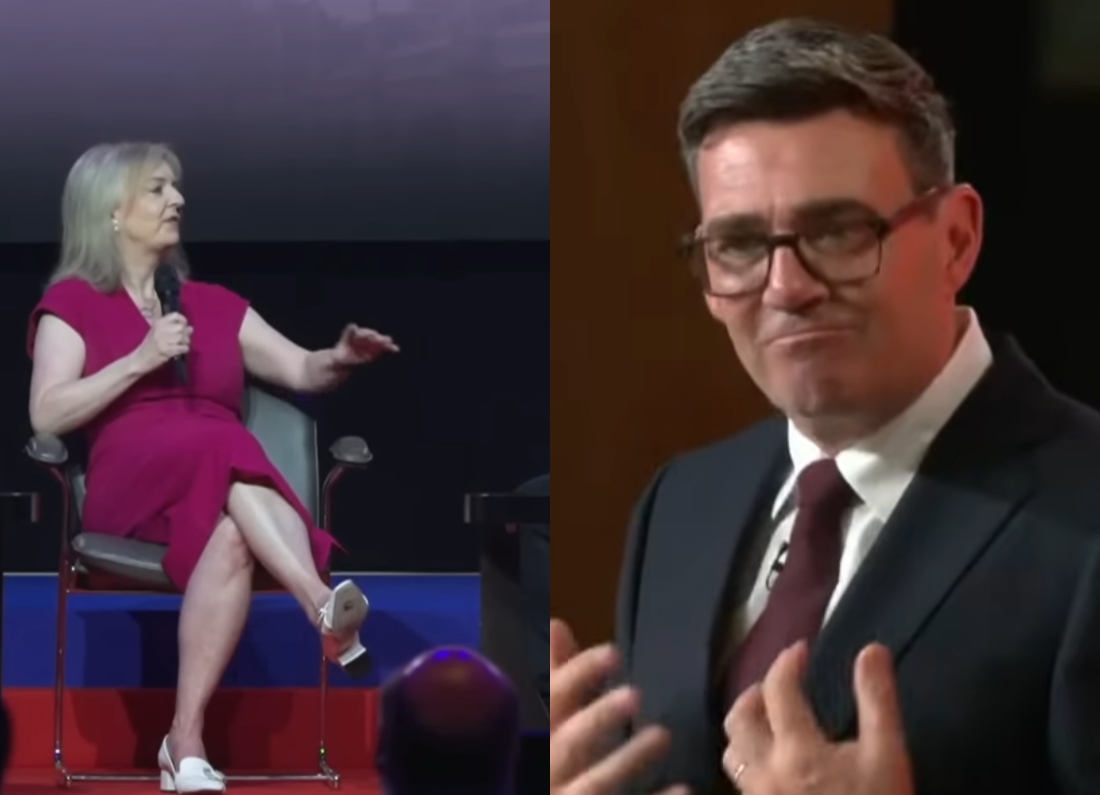
Liz Truss has warned that Andy Burnham could plunge Britain into a financial crisis, offering further evidence that irony remains alive and well in British politics.
The former Conservative prime minister made the prediction at CPAC GB, the MAGA-style right-wing conference she helped bring to London, as Burnham prepared to replace Keir Starmer in Downing Street.
Truss told those who had turned up that Britain’s finances would deteriorate under the incoming Labour prime minister and suggested his government might not survive until the next general election.
“The money’s going to run out,” she said. “I think the problems with migration are going to get worse and the general decay and stagnation of Britain is going to continue.
“I think the question is how long the pro-progressive authorities can continue.
“My prediction is that there will be another prime minister before 2029.”
It was a remarkable intervention from any former prime minister, but particularly from one whose own economic programme caused such immediate turmoil that it helped bring her premiership to an end after just seven weeks.
Burnham has not even entered Downing Street yet. Truss, however, has already concluded that he will run out of money, deepen Britain’s problems and probably be replaced before voters get their next scheduled chance to pass judgement on him.
There is always the possibility that she possesses some previously undiscovered gift for economic forecasting. Her own record suggests caution.
A financial warning from Liz Truss
Truss entered Downing Street in September 2022 promising to transform the British economy with tax cuts and a rapid dash for growth.
Her government’s so-called mini-Budget, delivered by then-chancellor Kwasi Kwarteng, included approximately £45 billion in unfunded tax cuts. The announcement sent the pound tumbling and caused government borrowing costs to rise sharply.
The upheaval spread into the pensions industry, where some funds faced an urgent liquidity crisis. The Bank of England announced an emergency bond-buying intervention worth up to £65 billion to restore stability and prevent the disruption from becoming more serious.
Mortgage products were pulled from the market as lenders struggled to price them, while households already dealing with rising living costs faced the prospect of significantly higher monthly repayments.
Truss initially defended the programme. Kwarteng was eventually dismissed, significant parts of the mini-Budget were reversed and Jeremy Hunt was brought into the Treasury in an attempt to calm the markets.
It was not enough to save her premiership.
Truss announced her resignation on 20 October 2022, becoming the shortest-serving prime minister in British history. Her tenure had lasted just 49 days from appointment to departure.
That background makes her decision to predict a Burnham-induced financial crisis particularly bold. He will not formally become prime minister until Monday and has yet to unveil a full economic programme, but Truss is already warning that the money will run out.
Four years after the mini-Budget, the political memory of what happened has not disappeared quite as quickly as Truss might like.
The IMF warning was not quite the endorsement Truss needed
There are genuine questions about the economic choices awaiting Burnham.
The International Monetary Fund has warned the incoming prime minister and his expected chancellor to maintain fiscal discipline as Britain deals with elevated debt, weak growth and pressure on the public finances.
Its latest assessment urged the government to focus on reducing the deficit and be careful about making spending commitments without identifying how they would be funded. The IMF also warned against relying on optimistic forecasts for future tax revenues.
The organisation’s message was that Burnham will inherit little room for error. Rising borrowing costs, inflation and pressure on public services mean any new government will have difficult decisions to make.
Burnham has sought to reassure markets by committing himself to the government’s existing borrowing rules. He has also presented himself as pro-business while arguing for greater public control of essential infrastructure and a stronger industrial strategy.
None of that guarantees his economic programme will succeed. Once he begins announcing detailed policies, they should be tested against their costs and likely consequences.
Truss is entitled to criticise those plans. The trouble is that she was not merely warning Burnham to proceed carefully. She was confidently predicting that the money would run out, despite having led a government whose own economic experiment collapsed before many of its policies could even be implemented.
The IMF’s concern about Britain’s sensitivity to fiscal shocks is not necessarily a vindication of Truss. If anything, the lasting nervousness surrounding British government borrowing serves as another reminder of what happened during her premiership.
Truss complains about Britain changing prime ministers
Truss also used her CPAC appearance to criticise Britain’s extraordinary turnover of political leaders.
“We’ve had seven prime ministers in ten years,” she said.
“That’s the equivalent of a crap football team changing its manager all the time but not changing what happens on the pitch.”
There is a reasonable argument buried somewhere in that comparison. Britain has experienced an unusual level of political instability since the Brexit referendum, with leaders repeatedly replaced without a general election.
The awkward part is that Truss was one of them.
Five of those seven prime ministers were Conservatives. Truss replaced Boris Johnson after Conservative members chose her over Rishi Sunak, only for Tory MPs to force her out weeks later. Sunak then replaced her without a vote among party members.
Burnham will similarly enter Downing Street without a general election after succeeding Starmer as leader of the governing Labour Party. He will become Britain’s seventh prime minister since 2016.
Truss may be right that repeatedly changing the person in charge will not fix deeper problems in the country. It is simply difficult to hear her make that argument without remembering that she contributed more than most to the instability she now condemns.
Her football analogy also raises an obvious question. If a manager produces one of the most disastrous performances in the club’s history and loses the dressing room in seven weeks, changing the manager might be a fairly understandable response.
Truss calls for a right-wing “counter-revolution”
The former prime minister also urged successful people to give up the comfort of private life and join her political “counter-revolution”.
“It’s time for successful people in Britain who actually care about the future of our country to step up,” she said. “To stop being such cowards because at the moment they’re being cowards.”
Truss has spent much of her post-Downing Street career attempting to build links between the British right and Donald Trump’s MAGA movement in the United States.
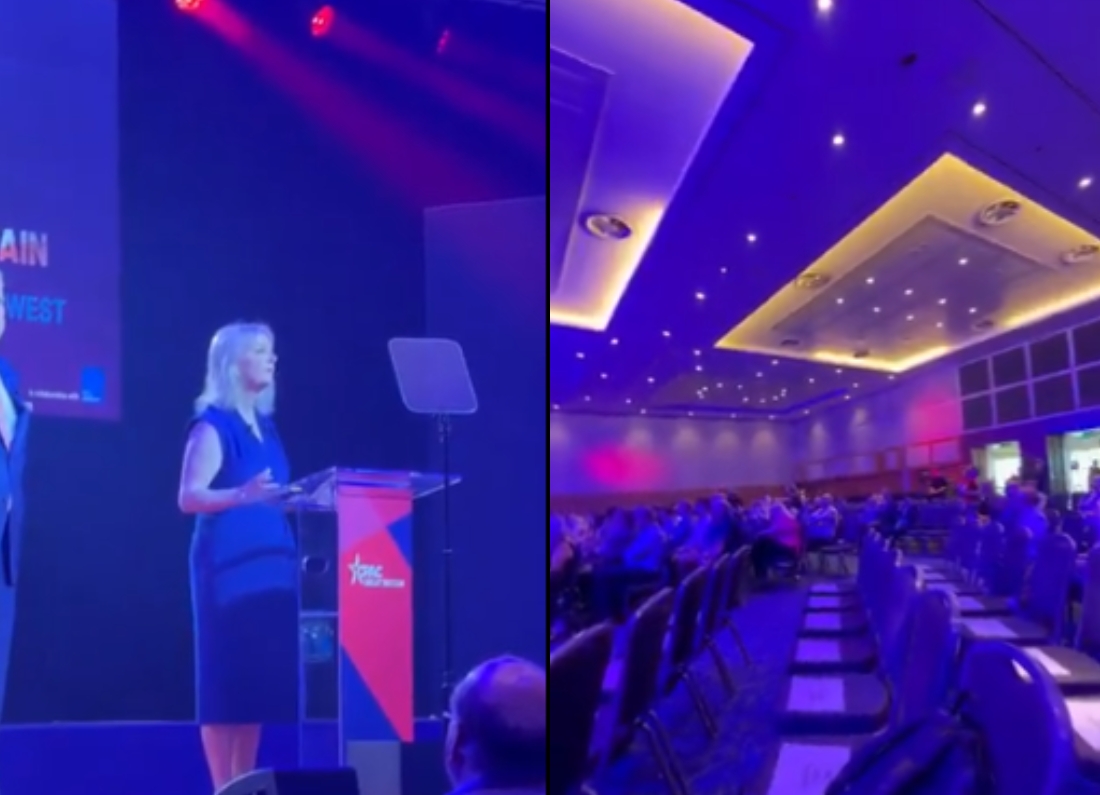
CPAC GB was supposed to be an important step in that project. The conference brought the American Conservative Political Action Conference brand to Britain, with a programme featuring figures from the Conservative Party and Reform UK alongside international right-wing speakers.
The event promised to “save Britain, save the West”, although the opening audience did little to suggest that a mass counter-revolution was gathering.
The Mirror reported that barely one-third of the approximately 500 seats were occupied for Truss’s appearance. Photographs and video from the hall showed long rows of empty chairs as she delivered her warnings about Burnham and Britain’s political future.
Perhaps all the successful people she wanted to recruit were busy.
Burnham promises to give Britain “hope back”
While Truss was predicting his failure, Burnham was formally confirmed as Labour leader after running unopposed.
The former Greater Manchester mayor returned to Parliament last month by winning the Makerfield by-election. The contest was triggered when Labour MP Josh Simons stood down, giving Burnham the Commons seat he needed to make a leadership bid possible.
His comfortable victory intensified pressure on Starmer, who subsequently announced his resignation. Burnham secured the support of 379 of Labour’s 403 MPs, along with all 11 trade unions affiliated with the party.
He will officially become prime minister on Monday after Starmer meets King Charles III and tenders his resignation.
In his first speech as Labour leader, Burnham said the party had heard “the call from the people of Makerfield on behalf of forgotten places everywhere” for the return of “the Labour they once knew”.
“And now we answer that call,” he said. “We will be that version of Labour again.”
Burnham promised to give people “hope back” and acknowledged that politicians, including himself, had failed to challenge an economic model that was not working well enough for ordinary people.
“Four decades of neoliberalism that began in the 1980s have not been kind to the places that built our party, nor to communities across the UK in rural and coastal areas,” he said. “So we pledge today to them to be better.”
His plans include moving power away from Westminster, changing Labour’s political direction and trying to bring an end to the party’s factional infighting. He has promised an approach that is “distinctively Labour” rather than one designed to imitate the Greens, Reform UK or the Conservatives.
There is still considerable uncertainty about how those ambitions will translate into policy. Burnham has spoken about reindustrialisation, public control and economic renewal, but many of the details will not emerge until after he enters Downing Street.
His Cabinet has also remained a closely guarded secret, although Shabana Mahmood has been widely tipped to become chancellor.
Burnham will have to prove Truss wrong
Burnham inherits a difficult political and economic situation.
Labour has suffered poor election results and trailed Reform in national polling for an extended period. Public services remain under pressure, growth is weak and there is limited space available for expensive new commitments.
The new prime minister will have to explain how his promise of a more recognisably Labour government can be delivered within the fiscal constraints he says he will respect.
His record should be scrutinised, his spending plans should be costed and any unrealistic promises should be challenged.
For now, though, Burnham has not even crossed the threshold of Number 10. Liz Truss predicting that he will cause a financial crisis is rather like someone setting fire to the kitchen and then warning the next owner to be careful with the toaster.
She may have intended to frighten people about a Burnham government. Instead, the comment mainly reminded everyone of her own.



Leave a Reply