

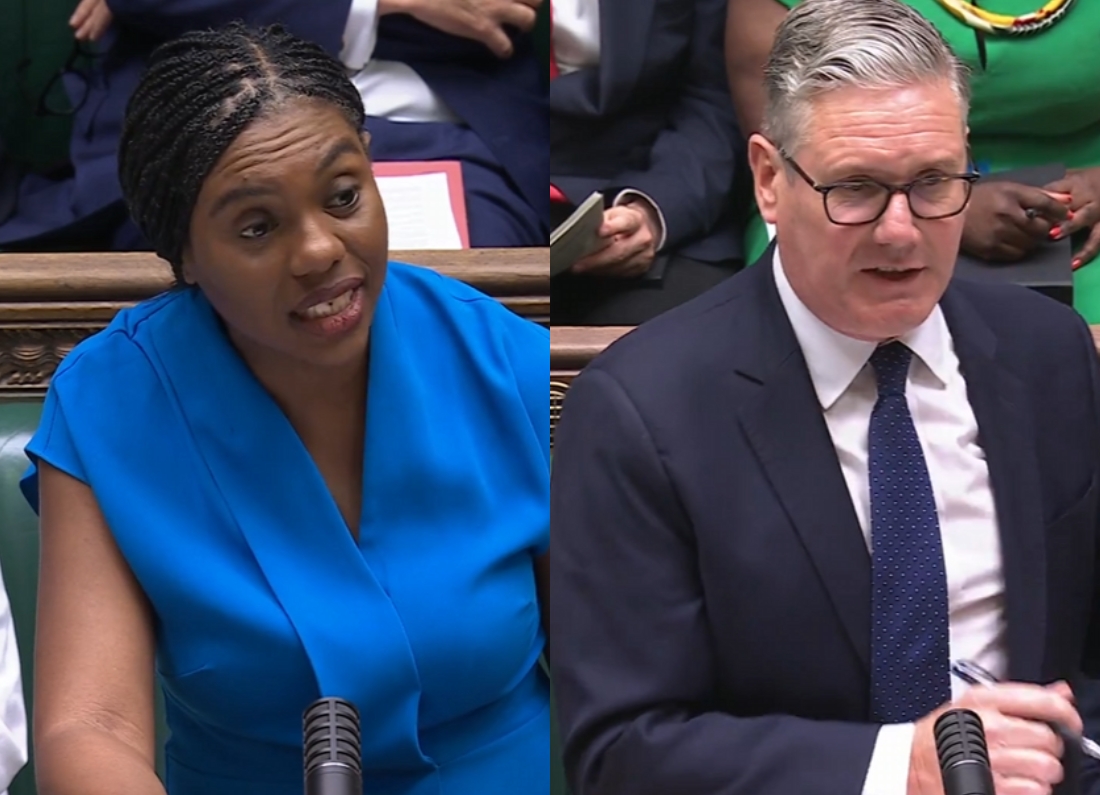
Kemi Badenoch had a target-rich environment at Prime Minister’s Questions on Wednesday. Keir Starmer was appearing in the Commons for the first time since announcing his resignation as Labour leader, his party visibly fractured, cabinet ministers who had pushed him out sitting opposite him. The political material was there. Whether she used it well is a different question.
Badenoch accused Ed Miliband of “treachery” and “betrayal” for backing Andy Burnham, called Rachel Reeves’ economic record an exercise in “killing economic growth,” and branded Starmer’s ministers “either traitors and deserters or loyal and incompetent.” She called education secretary Bridget Phillipson a “spiteful class warrior” for adding VAT to private school fees. Then she delivered the line that generated the most reaction: “I’ve never seen this much excitement on the Labour benches. They’re cheering so loudly while there are 400 knives stuck in his back.”
The Speaker intervened
Speaker Lindsay Hoyle cut in before Starmer could respond, and addressed the chamber directly. “Let us think about the language that we use. When we leave this chamber, don’t be surprised when constituents think they can use the same language against each other. Let us show a little bit more decorum and respect to each other.”
It was a significant moment. Speakers rarely intervene mid-exchange to rebuke the Leader of the Opposition by name, and Hoyle’s words – carefully framed around the effect parliamentary language has outside the chamber – carried obvious weight given the context of the week.
Starmer’s response, when it came, was measured. “Thank you Mr Speaker. I was trying to do all of this with as much good grace as I could, but I shall certainly miss these exchanges.” As a valedictory line from a prime minister in his final weeks, it was rather more dignified than the attack that preceded it.
The Jo Cox anniversary problem
The timing made Badenoch’s language particularly difficult to defend. Jo Cox was murdered nine years and one week ago by a far-right extremist outside her constituency surgery. The anniversary had been marked across parliament the previous week. Using the imagery of stabbing – “400 knives stuck in his back” – and words like “traitors,” “treachery” and “betrayal” in that context drew immediate criticism.
A Labour source said: “A week after Jo Cox’s anniversary, Kemi talking about ‘knives in back’ and ‘treachery’. Absolute gutter politics.”
That was predictable from a Labour source. More notable was the reaction from Labour peer Stewart Wood, who has previously praised Badenoch’s PMQs performances. “I have been impressed by Kemi Badenoch’s PMQs performance on quite a few occasions over the past few months,” he wrote on X. “Today her tone, language and imagery was deeply unpleasant and counterproductive. Even her front bench winced as she spoke. I am glad the Speaker called her on it.”
Davey’s cold stare
Lib Dem leader Ed Davey took a different approach. After acknowledging “how difficult it was” for Starmer to have made his resignation statement on Monday, he said: “It’s an important reminder, as we debate issues robustly in this house, that we are all human and it’s something that everyone should remember.” He then paused and delivered a prolonged cold stare directly at the Conservative front bench.
The combination of Hoyle’s formal rebuke, Davey’s pointed silence and Wood’s cross-party criticism framed Badenoch’s performance as something other than a triumph – even in a week when her target was genuinely vulnerable.
What she was trying to do
Badenoch’s political strategy is not hard to understand. She has been working hard to position the Conservatives as distinct from both Labour and Reform, and a wounded, divided Labour Party is exactly the kind of target she needs to make her case. If she can land the picture of a Labour Party that pushed out its own prime minister and is now cheering his replacement from the sidelines, that is a politically effective message – particularly aimed at voters who are suspicious of the kind of internal manoeuvring that characterises Westminster at its worst.
The problem is the execution. There is a version of that PMQs that works: forensic, pointed, focused on the policy records of the ministers who moved against Starmer. What Badenoch delivered instead leaned heavily on the language of betrayal and violence at a moment when parliament is still raw from the Jo Cox anniversary – and it cost her the moral authority the moment might otherwise have given her.
Burnham now has the Labour leadership effectively wrapped up, Labour’s internal debate has moved on to what kind of party it wants to be, and the Conservatives go into whatever comes next having spent their best PMQs opportunity of recent months being rebuked by the Speaker. It was not, as Conservative frontbenchers would have been hoping, a good day at the office.
4 responses to “‘Absolute gutter politics’: Badenoch accused of stooping too low at PMQs after ‘400 knives’ attack on Labour”
-
Badenoch is as vile as you might accept. She wants to protect the rich and privileged education for the few to allow them then to use their privilege to rise to powerful roles. Boris leading us to destructive and unhealthy choices through lies and deceit. George Osmond- ineffective and a disgrace to his position. David Cameron – wet. Sunak who really did not know the price of milk. They are all part of the old boy’s club who place personal ambition way before the good of the country. Covid and Social care , NHS , high on the list of failure by a prolonged Tory government who left a black hole of debt to be solved by anyone other than them. The conservatives will never stand for anything other than lining the pockets of the rich .
-
How many defectors from conservatives to Reform? How many Conservative councillors have voted with reform for ridiculous moves? I have been a Conservative voter for many years, but have now joined the Labour Party thanks to her behaviour and Starmer’s ĥonourable, humble decency.
-
I honestly believe that people within the UK, don’t want to listen to this continual griping, nastiness, cruel and personal comments against each other. They are supposed to be educated people why can’t they get their points across from a political point of view rather than personal.
-
j.h.shaw09@btinternet.com What is predictable is there are always going to be attempts at scoring Brownie points. Perhaps I should rephrase that. Kemi is no Brutus, and fortunately Keir is no mortally wounded Ceasar. Politicians occasionally inhabit the same planet as the rest of us and are prone to err. No problem, if the opposition want to play hardball, so be it.I personally have an extensive command of industrial language and am able to hit below the belt. However there are moments I stop short of comment. I tell this tale by way of explanation…..In the wake of the Brighton bomb, two normally sane blokes sent Norman Tebbitt a missive requesting his wife’s bike to enable them to look for work..which i considered appalling. The Speaker was 100% correct, there are repercussions that start as a ripple only to become a Tsunami…bad fom Kemi.










Leave a Reply