

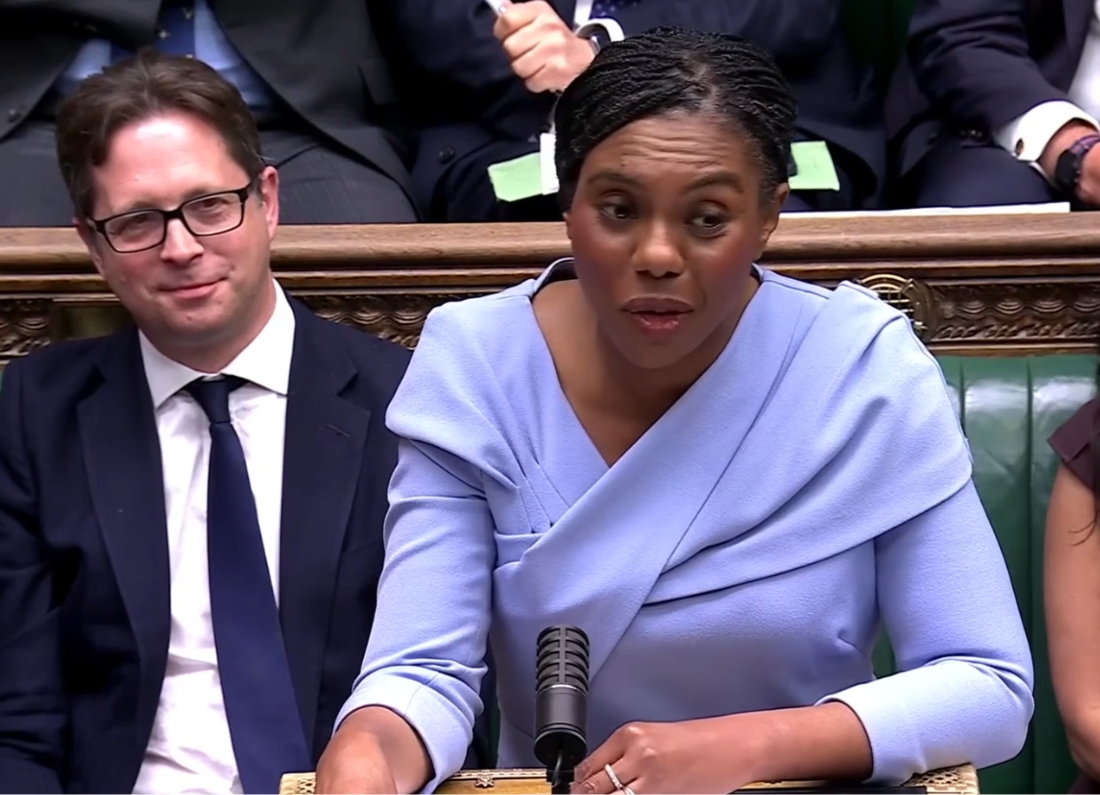
Kemi Badenoch has used the aftermath of Thursday’s byelections to launch a direct attack on Nigel Farage over the £5m personal gift he received from crypto billionaire Christopher Harborne, while declaring any prospect of a Conservative-Reform electoral pact “stone-dead.”
Writing in the Mail on Sunday, Badenoch said the results – in which Labour’s Andy Burnham won Makerfield by more than 9,000 votes and the Conservatives picked up Aberdeen South from the SNP while Reform came third – vindicated her refusal to do a deal with Farage’s party.
The attack on Farage’s character
Badenoch’s attack on the £5m gift was pointed. “What kind of character accepts £5m in cash and says it was merely a gift?” she wrote. “Mail on Sunday readers have far too much common sense to believe that. Nobody gets £5m in their pocket for nothing, whatever Nigel Farage claims.”

She framed it as a question of character more broadly, writing: “Character matters in politics because character is what is tested when things get tough.” The gift, which was not declared when it was received, is now subject to a formal Parliamentary Standards investigation that could ultimately result in suspension and a Clacton byelection.
Farage has changed his account of the gift since it was first reported. He initially said it was to fund personal security for his lifetime. He later said he considered it a reward from Harborne for having campaigned for Brexit. He also suggested at one point that Russia had hacked his phone to leak the story – a claim the Guardian described as deflection. A former Reform deputy leader has separately alleged that Harborne paid Farage and Boris Johnson £1m each in a 2019 election deal, and that the £5m “gift” was effectively payment for political services rendered.
Why she rejected the pact
Badenoch said she had faced “intense pressure” to stand the Conservatives down in Makerfield and do a deal with Reform, on the grounds that the seat had historically been out of reach for the Tories. She rejected the logic, and she is now pointing to the results as proof she was right.
“Had I listened, our emphatic victory in Aberdeen would have been diminished,” she wrote. “People would have sneered that we won only because Reform stepped aside. A win ‘helped’ by Reform would have been no real win at all.” She added: “We are not the same, and voters are not ours to trade like football cards.”
Her description of Reform was characteristically sharp: they “dress like Thatcherites but act like Corbynites.” The implication being that the party talks the language of free markets and small government while operating in ways – accepting large undisclosed gifts, relying on a handful of billionaire donors for the bulk of its funding – that sit awkwardly with that image.
Reform’s response
Reform did not engage with the substance of Badenoch’s attack on the £5m gift. A party spokesperson said: “We won’t need to ever deal with the Tories. They broke Britain and we won’t give them a chance to do it again. We have now led the national opinion polls for well over a year.”
That is true in aggregate, though the byelection week has complicated the picture. Luke Tryl of More in Common called Makerfield Reform’s worst night since the general election, with barely any increase in vote share in a seat that was one of their best second-place finishes in 2024. The Conservatives came fourth with 997 votes and lost their deposit – but that is still the context in which Badenoch is claiming the byelections as a vindication.
The bigger picture
Badenoch’s intervention matters for a number of reasons beyond the immediate back-and-forth. With Keir Starmer expected to set out a resignation timetable on Monday, British politics is entering a potentially significant period of realignment. A Labour leadership contest with Burnham as frontrunner, a Reform party facing its worst byelection run since July 2024, and a Conservative leader now openly attacking Farage’s character changes the shape of the right-of-centre argument considerably.
Badenoch has been consistently clear that she intends to rebuild the Conservatives as a distinct political force rather than a vehicle for a broader right-wing coalition. This weekend’s essay is the most direct expression of that strategy yet – using the £5m gift as a character argument and the byelection results as evidence that Reform is not the electoral force its polling suggests.
Whether that argument lands with the voters the Conservatives need to win back – particularly in the parts of England where they came fourth this week – remains the open question she will need to answer long before the next general election.






Leave a Reply