

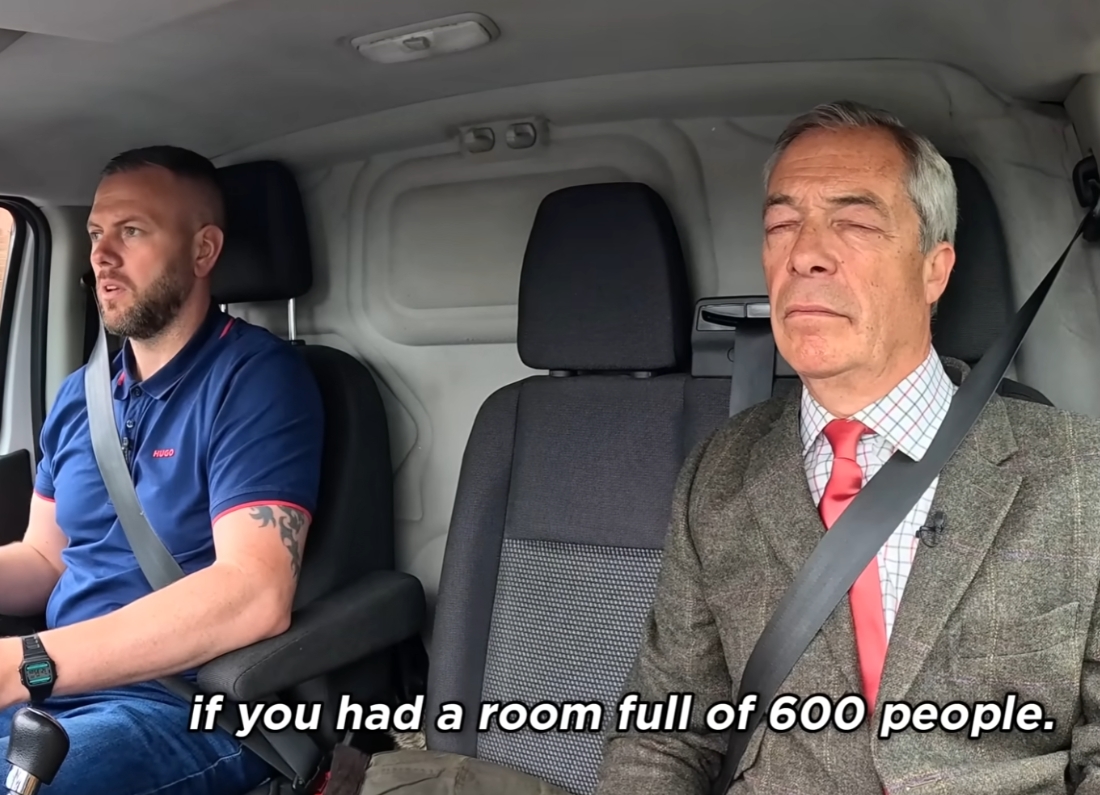
It was supposed to be Reform UK’s moment. A Labour government on the ropes, a safe northern seat, a prime minister many in his own party wanted gone. Instead, Thursday night delivered what one of Britain’s most respected pollsters is calling the party’s worst result since the general election.
Luke Tryl, director of More in Common UK, was blunt in his assessment after Andy Burnham romped home in Makerfield with a majority of more than 9,000 votes. “Think this is unarguably Reform’s worst night since the general election,” Tryl posted on X. “Barely any increase in their vote share in Makerfield. 20 point Labour win in a seat that was one of their best second places in 2024.”

Reform candidate Robert Kenyon finished second, but the gap between him and Burnham told its own story. Labour took 54% of the vote. Reform managed 35%. And then things got worse.
The Restore Britain problem
The result that will really sting Nigel Farage is what happened to Restore Britain. The hardline anti-immigration party, standing in its first major national contest, took 7% of the vote in Makerfield. For a party that markets itself as the toughest option on immigration and national identity, watching votes bleed to its right is an uncomfortable new reality.
Tryl put it plainly: “Restore Britain take 7% [in Makerfield]. Replicated elsewhere in fragmented politics, Reform’s path to govt becomes very very hard.”
It follows a pattern that has been quietly developing for months. Reform’s post-election polling bounce has already faded, and the party has been tracking back towards the mid-twenties in national surveys. What Makerfield showed is that the squeeze isn’t just coming from the left – voters who want something harder than Reform now have somewhere else to go too.
A pattern of byelection disappointment
This is not an isolated stumble. Reform’s byelection record has quietly become a problem the party hasn’t found an answer to. Four months ago they lost the Gorton and Denton byelection to the Greens – a result that was largely overshadowed by other news but which pointed to the same underlying issue: when voters are choosing between a credible local alternative and Reform, Reform keeps losing.
On Thursday night they also lost two council seats to the Conservatives, a reminder that the right-of-centre vote is not Reform’s to take for granted. Tory frontbencher James Cleverly was quick to draw the lesson. “When people see what Reform is like in office, they change their minds about Reform,” he said – a line that will land harder now that Reform’s record in local government is coming under sustained scrutiny.
The Tory complication
Adding to Reform’s difficult night, the Conservatives picked up Aberdeen South from the SNP – a seat vacated after the sitting MP Stephen Flynn moved to the Scottish Parliament following his Holyrood election last month. It was a modest result in isolation, but in the context of a night where Reform were expected to dominate the narrative, it gave the Tories a headline of their own and evidence, however limited, that the Conservative recovery story is not entirely dead.
For Farage, the arithmetic is the real headache. Reform need to hoover up votes across the right to have any realistic path to power. But the Conservatives are showing signs of life on one flank, and Restore Britain is peeling off voters on the other. The space Reform occupy – angry, anti-establishment, immigration-focused – is no longer as uncrowded as it was twelve months ago.
What it means for Farage
None of this means Reform are finished. They still poll in the mid-twenties nationally, they have significant local government representation, and they remain the most disruptive force in British politics. But the narrative that they were on an unstoppable march towards power has taken a serious knock.
Tryl’s analysis hits on the structural problem. Burnham built what looked like a broad anti-Reform coalition in Makerfield – the Conservatives, Lib Dems and Greens combined took just 3% of the vote, compared to 22% in the same seat in 2024. When voters are motivated primarily by stopping Reform, Reform loses. And in Makerfield, that motivation was about as strong as it gets.
The party also goes into the coming weeks facing the Greater Manchester mayoral byelection, triggered by Burnham’s move to Westminster. It is expected on 30 July and will involve around two million voters. After Thursday night, polling already shows Labour pulling ahead of Reform under Burnham’s influence. That contest now looks considerably harder for Farage’s party than it did 48 hours ago if Andy Burnham becomes Labour leader.
For a movement that arrived at the general election promising to reshape British politics, the question is no longer whether Reform can win – it is whether they can stop sliding before anyone serious starts asking it out loud.




Leave a Reply