

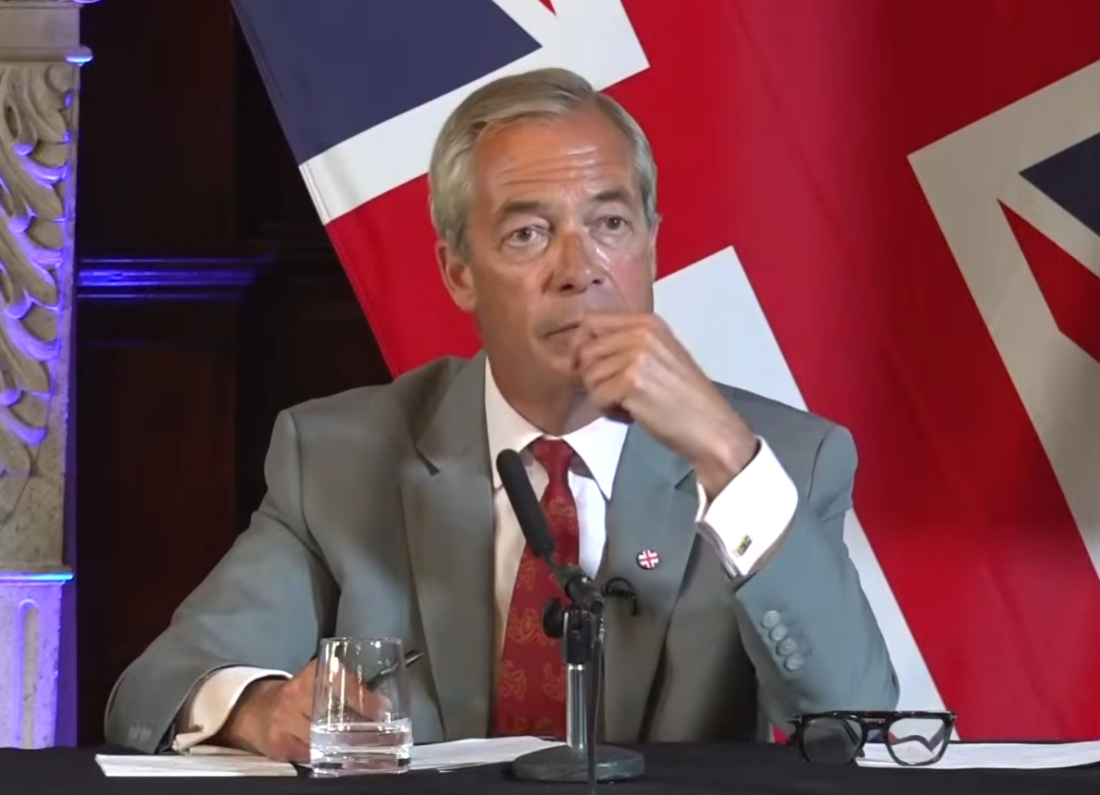
Former Archbishop of Canterbury Rowan Williams has launched a stinging attack on Nigel Farage over his increasingly prominent use of Christianity in British politics.
Williams, who led the Church of England for a decade, questioned whether the Reform UK leader has any deep interest in theology and accused him of using the language of Christian Britain for political purposes.
The intervention came during a wide-ranging interview with New Humanist about the growth of Christian nationalism in Britain.
Williams was asked what he thought was behind the increasing overlap between nationalist politics and Christian identity.
His answer put Farage firmly in the firing line.
“I suspect really that Farage and others want to channel anti-Muslim feeling,” he said.
Williams argued that talking about Britain as a Christian society gave that politics additional weight.
Reform has hit back strongly, with a party source dismissing the former Archbishop’s comments as “tasteless drivel”.
Williams questions Farage’s Christianity
Williams did not stop at criticising Farage’s political rhetoric.
He also questioned how seriously the Reform leader personally engages with Christianity.
Farage has spoken increasingly often about Britain’s Christian heritage over the past year.
At Easter he told followers that the Christian values on which Britain was built were “something to be proud of”.
Reform has also brought Cambridge academic James Orr, a professor of philosophy of religion, into the party as a senior adviser.
Williams was sceptical about what that says about Farage himself.
“I don’t think he lies awake at night thinking about his soul,” he said.
He added that he did not believe Farage cared deeply about theological questions, while acknowledging that he might be doing the Reform leader an injustice.
It is an unusually personal criticism from someone who once occupied the most senior position in the Church of England.
Farage has made Christianity a more visible part of Reform’s political message, particularly when discussing immigration, British identity and Islam.
That is the connection Williams appears to find troubling.
Farage’s comments about Muslims
The argument is not happening in isolation.
Earlier this year, Farage attacked an Open Iftar event held in Trafalgar Square during Ramadan.
The peaceful gathering brought Muslims and people of other faiths together to break the daily fast.
Farage described the event as an attempt to “overtake, intimidate and dominate our way of life” and later called for mass religious observances to be banned at historic British sites.
He said Reform would defend the “Judeo-Christian principles” on which Britain was built.
Farage has also previously claimed that a growing number of young people do not subscribe to British values. When pressed on who he was referring to, he confirmed he was talking about Muslims.
Williams sees a connection between those comments and the growing political emphasis on Christianity.
Asked what was driving Christian nationalism, the former Archbishop pointed towards anxiety about migration and hostility towards Islam.
He argued that attaching Christian language to nationalist politics could provide a convenient way of defining who belongs and, by implication, who does not.
Farage would strongly reject the suggestion that defending Britain’s Christian heritage is inherently anti-Muslim.
Reform’s response to Williams makes clear the party has no intention of accepting his analysis quietly.
Reform hits back
A Reform UK source told Premier Christian News that Williams’ comments were “tasteless drivel”.
The party has repeatedly argued that Britain’s Christian traditions are under pressure and should be defended more explicitly.
That argument is not being made solely by Christians within Reform.
Zia Yusuf, the party’s Muslim home affairs spokesperson, has himself pledged to restore Britain’s Christian heritage.
He has argued that churches should be protected from conversion into mosques and that Christianity should have a greater place in the national curriculum.
For Reform, that is about national culture rather than asking every Briton to become a practising Christian.
Williams sees something different.
His concern is that Christianity is increasingly being used as a badge of national identity against Muslims rather than as a religion with its own moral demands.
That disagreement goes well beyond Farage personally.
It touches on a much larger argument over what politicians mean when they describe Britain as a “Christian country”.
Tommy Robinson also comes under fire
Williams also turned his attention to Tommy Robinson, who has increasingly spoken publicly about Christianity.
Robinson, whose real name is Stephen Yaxley-Lennon, has said he studied the Bible while in prison and now considers himself a Christian.
Christian imagery has become increasingly visible around events linked to him, including crosses carried at demonstrations and chants of “Christ is king”.
Williams said he would be glad if Robinson was genuinely attempting to follow Christianity.
But he said he would have some “awkward questions” for him.
In particular, Williams questioned how claims of Christian discipleship could be reconciled with rhetoric he believes is designed to create hostility.
His criticism of Robinson and Farage comes amid a broader debate within British Christianity about politicians adopting Christian language.
Some church figures have welcomed renewed discussion of Britain’s Christian inheritance.
Others are uncomfortable when Christianity becomes closely tied to nationalism or arguments against immigration.
Those disagreements are likely to become more visible if Reform continues putting Christian identity at the centre of its pitch to voters.
Farage has increasingly embraced Christian language
Farage’s Easter message this year was unambiguous.
“The Christian values on which our country is built are something to be proud of,” he said.
He has also appeared alongside Christian campaigners and spoken about what he sees as a resurgence of Christianity among younger people.
In May he publicly backed an Essex street preacher involved in a dispute with a local council over restrictions on his preaching.
The pastor had previously described homosexuality as an “abomination”, although Farage’s intervention focused on free speech and religious liberty rather than endorsing those particular comments.
Taken together, the interventions show that Christianity is no longer an occasional reference in Farage’s politics.
It is becoming part of the way Reform talks about Britain.
Williams clearly thinks voters should ask why.
And Reform’s blunt response suggests this argument is only getting started.
One response to “Former Archbishop launches extraordinary attack on Nigel Farage over Christianity”
-
If Farage were a Christian he wouldn’t have made life miserable for Hews and people of colour when he was at Dulwich College or having policies which favour the rich over ordinary working people







Leave a Reply