

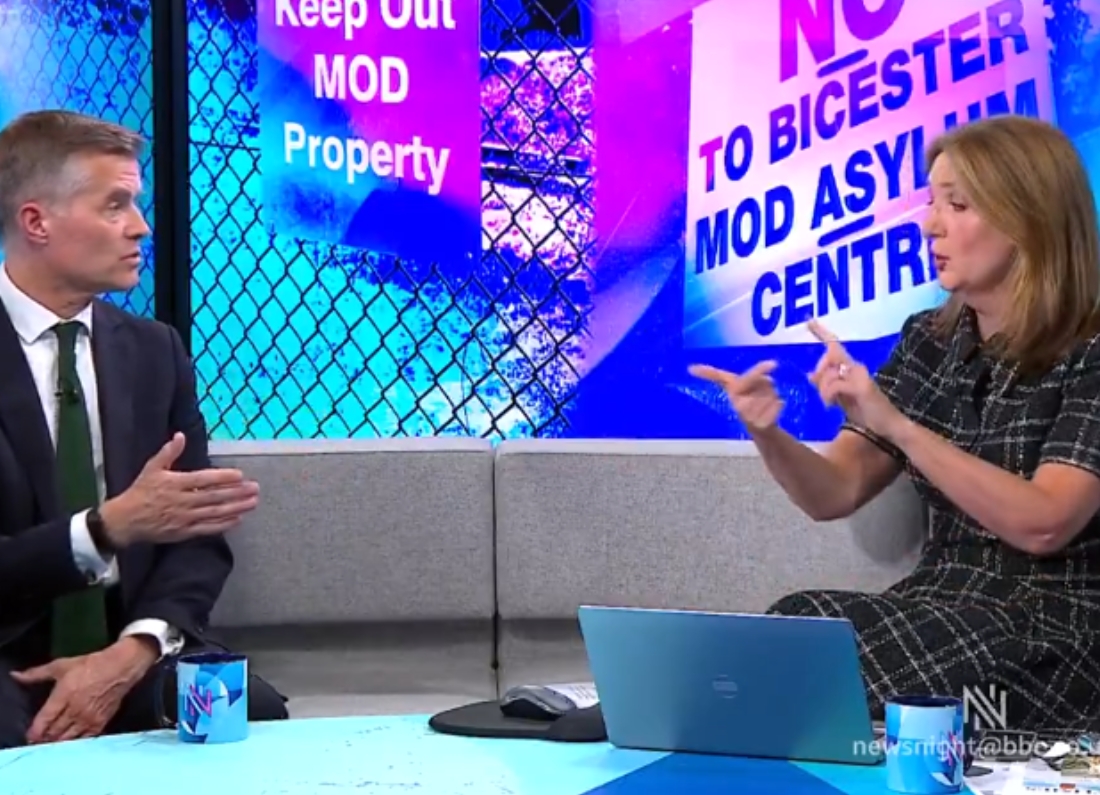
Victoria Derbyshire wanted an address, or at least a type of building. Lord Mark Harper had plenty to say about removals, the European Convention on Human Rights and the mistakes of the last Conservative government. It took rather longer to establish where his party would actually house people seeking asylum.
The exchange on BBC Newsnight followed objections to a plan to accommodate up to 1,256 men at a former Ministry of Defence site near Piddington, Oxfordshire. Harper argued that large sites had proved too expensive when the Conservatives used them in government.
Derbyshire asked the obvious follow-up: if the Tories would reject sites like that, where would people go?
“You’ve told me what the plan is,” she said as Harper began setting out the party’s wider immigration policy. “I’m just asking a really direct question.”
‘So where would you put them?’
Harper said the lesson from the Conservatives’ time in office was that housing people at large sites “ended up being more expensive and more costly”, so the party would not use them again.
That criticism has a basis. In 2024, the National Audit Office estimated that the large sites programme would cost £46 million more than equivalent hotel accommodation over its lifetime.
But ruling out a site is easier than finding somewhere else for its residents. Pressed again, Harper said: “The plan normally is you disperse them around the country. That’s what we’ve done in the past.”
“To hotels?” Derbyshire asked.
“No hotels,” he replied, before referring to “accommodation around the country”.
That is an answer, up to a point. It suggests smaller properties spread across different areas, the kind of dispersal accommodation already used in the asylum system. Harper did not say what properties a Conservative government would secure, how quickly it could secure them or how it would handle the pressure on communities receiving them.
He instead returned to the party’s aim of reducing arrivals and removing people who have no right to remain. Faster decisions and removals could reduce the need for accommodation. They do not settle where someone sleeps while those decisions are being made.
The Piddington dispute shows why the detail matters. Residents held a symbolic vote to “leave” the UK in protest at the proposed site near Bicester; 285 voted in favour and 26 against. The vote has no legal effect, but the opposition to the site is real.
Harper defends the Conservatives’ removals policy
The Conservatives’ published immigration plan calls for the UK to leave the European Convention on Human Rights and remove people who arrive irregularly to their country of origin or a third country. These are proposals the party says it would pursue in government.
Derbyshire asked whether leaving the convention might make European countries less willing to cooperate on returns. Harper argued that it would make removals to safe third countries more straightforward and said similar ideas were being discussed elsewhere in Europe.
That led to another practical question: which countries would agree to receive people, and on what terms? A change to UK law would not, by itself, produce an agreement with another government. Harper said he believed more countries would be willing to engage, but gave no specific arrangement during the exchange.
Viewers pick up on the repeated question
The clip drew attention partly because Derbyshire kept bringing Harper back to the point he was trying to move past.
@implausibleblog described the interview this way:
“Victoria Derbyshire asks him 10 times where he would house asylum seekers, he obfuscates shamelessly.”
@mehdirhasan praised the questioning:
“Imagine if American TV interviewers would do interviews like this one from @vicderbyshire”
And @AgelicaKim2014 focused on the third-country proposal:
“‘safe third country’? Which is that? Will those ‘3rd countries’ will agree? Plan? That’s not a plan.”
Harper did eventually identify dispersal accommodation as his answer. The difficulty for the Conservatives is that “around the country” leaves a great deal to work out. How many places would be needed before their proposed removals system was operating at scale? Who would provide them? Those are the details Derbyshire was trying to get at.








Leave a Reply