

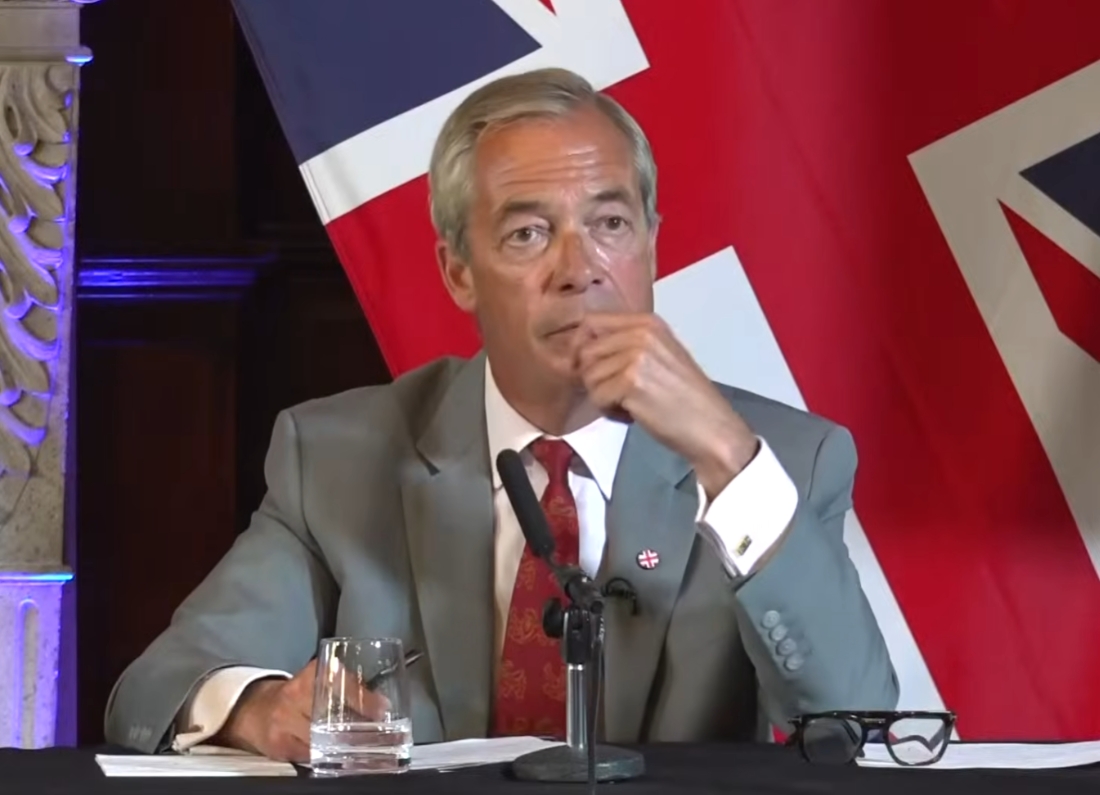
Reform UK could be required to return millions of pounds from its record-breaking £72 million fundraising haul after Angela Rayner suggested new political donation restrictions would apply retrospectively.
Cryptocurrency billionaires Christopher Harborne and Ben Delo each reportedly gave Nigel Farage’s party £36 million within the space of 48 hours.
Both donations are lawful under the rules currently in force, Reform says. However, their timing and the donors’ links to countries outside Britain may bring them within legislation passing through Parliament.
The proposed rules would impose a £100,000 annual limit on donations from registered overseas electors. People who recently moved back to Britain would remain subject to the same cap until they had been resident for a full calendar year.
Whether either £36 million gift is affected will depend on the donors’ precise status when the payments were made and the final wording approved by Parliament.
Angela Rayner points to retrospective rules
Rayner, the communities secretary responsible for the Representation of the People Bill, was questioned about the donations on the BBC’s Sunday with Laura Kuenssberg.
She said the Government had already announced that its restrictions would be applied retrospectively following an independent review into foreign financial influence.
The Government’s official response to the Rycroft Review says the £100,000 cap will apply to donations from overseas electors made on or after 25 March 2026.
Any donations exceeding that limit would need to be returned once the relevant provisions come into force.
Similar restrictions would cover people returning to Britain after living overseas. Registered overseas electors would remain subject to the cap until they had lived in the UK for one full calendar year.
A modified version of the limit would also cover people who were not registered as overseas electors but moved to Britain after 6 July, when the Government published its response to the review.
Rayner stressed that the plans had been announced before Reform received the two donations and were not designed around a particular party or donor.
She said the measures were intended to protect British politics from foreign financial interference and confirmed that she had written to the Electoral Commission about whether further safeguards were needed.
Why the donors’ residency matters
Harborne and Delo are both British citizens, but each has significant connections outside the country.
Harborne is also a Thai citizen and has been based in Thailand for years. It is not publicly clear whether he remains resident there or how he was registered when his £36 million donation was made.
Delo, a co-founder of the BitMEX cryptocurrency platform, recently returned to Britain after living in Hong Kong. The date on which he resumed UK residency could be decisive.
Reform’s economy spokesperson Robert Jenrick said Delo had returned partly to comply with the changes being made to donation law.
Moving back to Britain would not necessarily take a donor outside the new regime immediately. The Government’s proposed minimum-residency provision is designed to prevent somebody avoiding the cap simply by relocating before making a large payment.
The legislation has not yet completed its passage through Parliament, and no official determination has been published on either donation.
The fact that both men made their fortunes through cryptocurrency is not enough on its own to engage the separate proposed moratorium on donations made using cryptoassets. Their business backgrounds do not establish that the Reform payments themselves were made in cryptocurrency.
Reform insists both donations comply with the law
Reform maintains that both gifts were properly made by permissible British donors.
A party spokesperson said its donations complied “strictly with Electoral Commission rules and UK law” and accused political opponents of trying to obstruct lawful support for the party.
Under the existing Electoral Commission rules, there is no general limit on the amount a permissible donor can give.
Political parties must check the source, determine whether it is permissible and report qualifying donations to the regulator. That is the law applying when the two £36 million gifts were reported.
The dispute is therefore not an allegation that Reform has already been found to have accepted unlawful money. It concerns whether Parliament will pass legislation that retrospectively limits donations which were permissible at the time they were made.
If either donor falls within the overseas or recently returned categories, the amount exceeding the applicable £100,000 cap could have to be returned after the legislation takes effect.
Reform would be able to retain the money if the donors’ circumstances place them outside those categories, unless further restrictions were introduced.
Labour MPs demand a wider donation cap
The controversy has also renewed pressure for a limit covering large donations from people who are firmly resident in Britain.
Labour MP Stella Creasy proposed an amendment that would have capped most domestic political donations at £100,000 annually. It attracted support from 60 MPs representing several parties but was not put to a vote after ministers agreed to refer the proposal to a taskforce.
Some Labour MPs are reportedly angry that the Government did not adopt the amendment before Reform received the £72 million.
That domestic cap is not part of the legislation currently progressing through Parliament.
The distinction matters. The Government has committed to restricting donations from overseas electors and recently returned residents. It has not yet agreed to prohibit an established UK resident from donating £36 million.
Rayner said ministers were examining domestic donation rules, leaving open the possibility of additional changes later.
The House of Commons Library’s guide to the bill confirms that an individual donation cap was among the proposals considered but not approved during the earlier stages.
Farage’s election war chest faces uncertainty
Harborne and Delo said their donations were intended to help Reform build the organisation required to compete with Labour and the Conservatives.
The party could use the money to recruit headquarters staff, strengthen its policy operation and employ campaign managers in constituencies it hopes to win.
Jenrick described the fundraising breakthrough as a major vote of confidence and said it would leave Reform “battle ready” for an election.
That planning will now take place under considerable uncertainty.
The bill is due to enter the House of Lords this week. Its provisions could still be amended before receiving royal assent, while the Electoral Commission may have to examine the circumstances surrounding each donation once the new rules commence.
Reform has not been ordered to return any of the money. Nor has either donor been accused of breaking the law by making the payments.
The potential difficulty is that donations lawful when accepted could subsequently fall within restrictions deliberately backdated to prevent donors avoiding a regime announced months earlier.
For a party celebrating an unprecedented £72 million boost, the question is no longer simply how the money will be spent. It is how much Reform will ultimately be permitted to keep.




Leave a Reply