

It is time for another check-in on Liz Truss and her increasingly strange attempt to build a second political career from the wreckage of her first.
Britain’s shortest-serving prime minister has spent much of the period since leaving Downing Street courting the American right, appearing at conservative conferences and presenting herself as a victim of the same shadowy establishment she once led.
This week, she finally brought the show home.
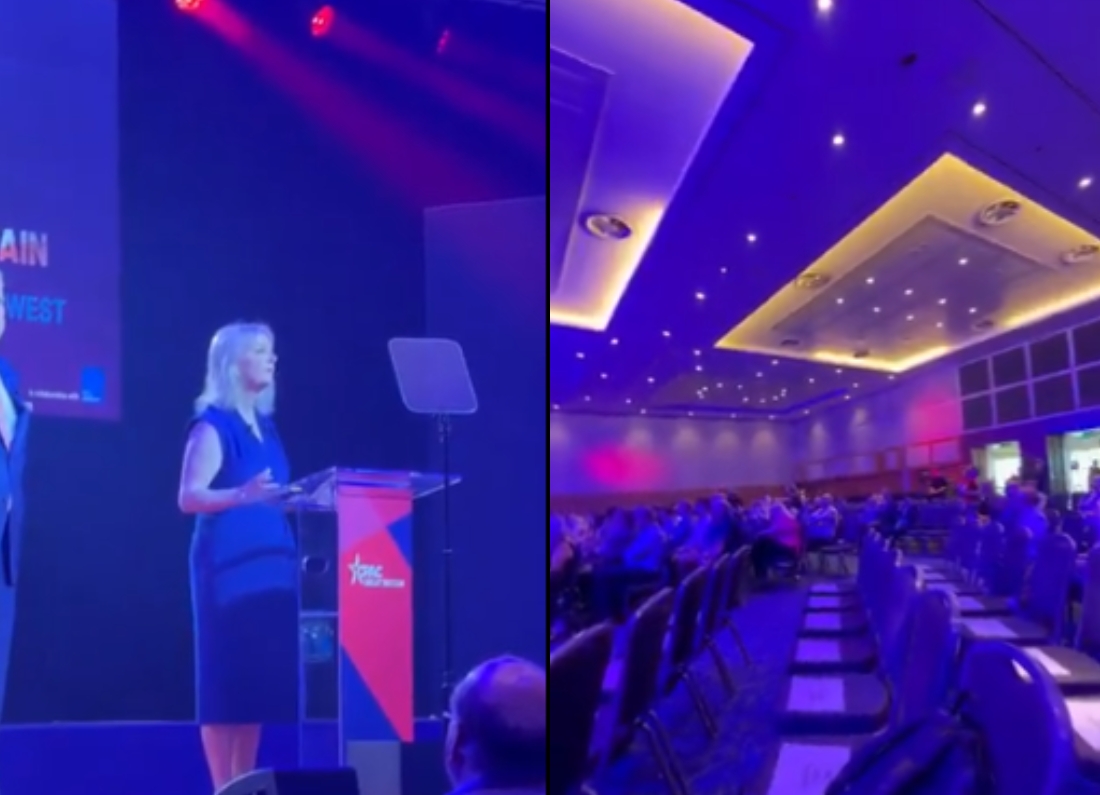
Truss opened Britain’s first Conservative Political Action Conference, better known as CPAC GB, in London on Thursday. The event was supposed to import the noise and confidence of America’s MAGA movement to Britain. Unfortunately for those involved, it appeared to have imported everything except the audience.
Footage from the opening speech showed Truss standing on stage before rows of unoccupied chairs. The hall was reportedly capable of holding about 500 people, but Mirror political journalist Mikey Smith estimated that it was only around one-third full.
Journalist Rob Lownie shared photographs from inside the venue that told much the same story. Whatever political revolution CPAC GB believed it was beginning, most of its potential foot soldiers appeared to have found something else to do.
What CPAC GB actually is
CPAC stands for the Conservative Political Action Conference. It began in the United States and has evolved into one of the most prominent annual gatherings of the Trump-supporting right. Donald Trump has repeatedly used the American event as a platform, while its stages have hosted politicians, activists and media personalities from across the international right. The event has become closely associated with MAGA politics and the culture-war grievances that now dominate much of the US Republican movement.
The British version was promoted under the characteristically understated slogan: “Save Britain, save the West.”
Its official website promised to combine “common-sense politics” with a “fiercely pro-growth, pro-sovereignty agenda”. Truss presented it as a chance to bring different parts of the British right together, regardless of their formal party affiliation.
The programme included Nigel Farage, Suella Braverman, Jacob Rees-Mogg, Toby Young, Andrew Griffith and Matt Goodwin. International speakers included American right-wing activist Jack Posobiec, Australian senator Pauline Hanson and Romanian nationalist George Simion.
What it did not include was much enthusiasm from the current Conservative leadership. Kemi Badenoch was notably absent, underlining the awkward position Truss now occupies. She is a former Tory prime minister trying to lead a wider populist movement while the party she once led keeps its distance.
Truss also used the conference to promote her latest organisation, the Atlantic Strategy Institute, another venture designed to connect right-wing politics on both sides of the ocean.
The ambition was certainly there. The audience was another matter.
Liz Truss complains about political instability
During her opening address, Truss turned her attention to the latest change in Downing Street. “This week, we will have yet another prime minister installed in Downing Street, Andy Burnham,” she told the audience. “The seventh within ten years.”
She then asked: “What do you all think of Andy Burnham?”
The scattered crowd responded with boos, although the noise struggled to fill the empty space around them.
There is something quite extraordinary about Liz Truss criticising Britain for changing prime ministers too frequently. Her own premiership lasted just seven weeks and ended after her economic programme triggered turmoil in the financial markets, sent borrowing costs climbing and forced the Bank of England to intervene.
Truss entered Downing Street on 6 September 2022 and announced her resignation on 20 October. She remains the shortest-serving prime minister in British history.
Since then, she has spent remarkably little time reflecting on why her government collapsed. Instead, she has blamed a collection of institutions and political opponents, including the economic establishment, the Bank of England, civil servants and elements within her own party.
Her argument is essentially that the programme was right but Britain’s institutions refused to allow it to happen. This has helped her find a receptive audience on the American right, where attacks on supposedly hostile institutions have become central to Trump-era conservatism.
The problem for Truss is that the audience appears to be more receptive in America than it is at home.
A political comeback without the politics
Most former prime ministers leave office with some degree of international standing, even when their time in government ended badly. They establish charitable foundations, write memoirs or deliver carefully managed speeches reflecting on their time in power.
Truss has taken a different route.
She lost her South West Norfolk seat at the 2024 general election, removing even the parliamentary platform normally available to a former leader. Since then, her political identity has drifted further towards the international populist right.
She has appeared repeatedly at CPAC in the United States, published a book called Ten Years to Save the West and launched her own online show. Her speeches frequently describe Britain as being controlled by an unaccountable establishment that needs to be dismantled.
The transformation has been striking. Truss was not an outsider who had been kept away from power. She served in several senior Cabinet positions before becoming prime minister, including foreign secretary, justice secretary and chief secretary to the Treasury.
She had spent years at the centre of the government she now describes as fundamentally broken.
That contradiction does not appear to have slowed her down. CPAC GB represents the clearest attempt yet to turn her post-premiership complaints into an organised political movement. Judging by the opening turnout, Britain may not be waiting for it.
A difficult week for the Reform-adjacent right
The empty seats also arrived during an awkward period for the wider political movement CPAC GB hopes to unite.
Nigel Farage has faced renewed questions over a £5 million gift from billionaire Reform donor Christopher Harborne. The Guardian reported that Farage had previously told senior Reform figures he would need “at least £1m a year” to return to frontline politics because of the income he would lose from his media work.
The £5 million payment arrived shortly afterwards, before Farage changed his mind and announced that he would stand in the 2024 general election. Farage has described it as an unconditional personal gift and denied breaking any rules.
Reform has also been complaining about the safety of its MPs. That prompted critics to recirculate footage of Sarah Pochin laughing during a television discussion about arson attacks on property and a vehicle linked to the then-prime minister, Keir Starmer.
Meanwhile, Farage’s decision to resign his Clacton seat and immediately fight the resulting by-election has given Count Binface another opportunity to enter British politics.
The satirical candidate has attracted considerable attention since announcing his campaign, with his live comedy show reportedly selling out. At the time of writing, the man wearing a silver bin on his head appears to have generated rather more public excitement than Truss managed with an imported conference, an international cast of speakers and a promise to save Western civilisation.
The empty chairs deliver their own verdict
It would be easy to dismiss the opening turnout as a scheduling issue. Conferences are not always full first thing in the morning, and CPAC GB was due to continue across several days.
But the pictures were still politically damaging because they captured the gap between the scale of Truss’s rhetoric and the size of her actual following.
She speaks as though she is assembling a mass movement capable of overturning the political order. On Thursday morning, she struggled to fill a modest London auditorium.
The online reaction was inevitably brutal. Many people focused on the spectacle of Britain’s shortest-serving prime minister warning about the rapid turnover of prime ministers. Others suggested the audience had come dressed as empty seats.
Truss might insist that her revolution is only beginning. Yet after the mini-budget, the market turmoil, the lettuce, the loss of her parliamentary seat and now this, the opening of CPAC GB looked less like the start of a political comeback and more like another instalment in one of the most extraordinary post-Downing Street careers Britain has ever witnessed.
The event was created to show that the MAGA right had arrived in Britain. The empty chairs suggested that Britain had received the invitation and politely declined.




Leave a Reply