

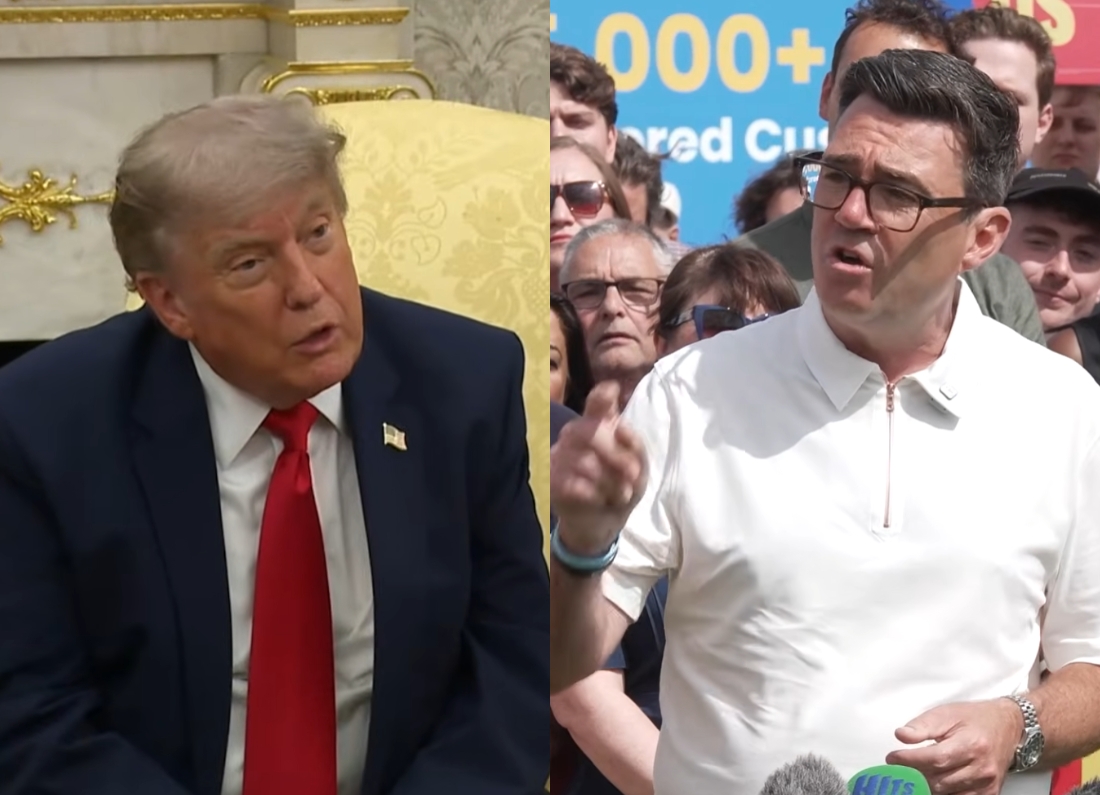
Donald Trump has given his first public assessment of Andy Burnham, describing Britain’s near-certain next prime minister as “extremely liberal, extremely” and suggesting the UK was heading in the wrong direction. The comments came as reporters at the White House asked the US president what he knew about the man poised to replace Keir Starmer.
“I don’t know, I think I see that he was, I guess, the mayor of a town,” Trump said. “I hear he’s extremely liberal, extremely, so that means he probably won’t open up the North Sea.” He added that “the UK is dying” – a phrase that will be familiar to anyone who has watched Trump’s commentary on European politics and which typically signals a fraught relationship ahead.
What Burnham has said about Trump
The Trump-Burnham dynamic was always going to be complicated. During the Makerfield campaign, Burnham described American politics as “polarised” and “poisonous” – a barely disguised reference to the Trumpian style he has consistently positioned himself against. When rioters stormed the US Capitol in January 2021, Burnham was among the first British politicians to react, posting on X: “Any UK politician who gave Trump the time of day should be ashamed right now.”
Trump, characteristically, appears to be aware of this distance – hence the “extremely liberal” framing, which in American political parlance is intended as an insult, and the immediate leap to the North Sea oil question, which Trump has pushed as a litmus test of how serious European governments are about energy and economic development.
What it means for the special relationship
Keir Starmer initially earned praise for his careful handling of Trump, navigating the early months of the relationship with studied conciliation. But their dynamic deteriorated significantly over the Iran conflict – the central foreign policy crisis of the last year – and by the time of Starmer’s resignation, the relationship with Washington was one of the complicating factors his successor will need to manage.
Burnham’s route to that relationship starts from a different place. Where Starmer tried to keep Trump onside, Burnham has been more directly critical. That is a more authentic position – and one that carries real risks in terms of trade negotiations, defence cooperation and the broader diplomatic relationship with an unpredictable White House.
The Al Carns question
Trump’s comments land as the Labour leadership picture continues to take shape. With Streeting’s endorsement all but sealing Burnham’s path to the leadership, the most discussed potential rival is Al Carns – the former armed forces minister who resigned earlier this month over the defence spending row. Carns has stopped short of formally declaring he will stand, but on X he set out a series of tests any contender should meet: spending 3% of GDP on defence, adding a trillion pounds to UK GDP within the decade, fixing youth unemployment and improving energy infrastructure. “None of this is complicated,” he concluded.
The contrast with Burnham’s positioning is reasonably clear. Carns is pushing a more hawkish defence line, one more aligned with the demands of the post-Iran global environment and one that might find more favour in Washington. Whether he can reach the 81 MP nominations required to enter the race – with Burnham already holding more than 200 – is a different question.
The economic backdrop
Burnham will also hear from British business this week as the leadership process begins in earnest. Shevaun Haviland, director general of the British Chambers of Commerce, is set to tell the group’s global annual conference that successive governments have “hobbled” business prospects and that the incoming prime minister must ease burdens on business if the UK economy is to prosper.
Chancellor Rachel Reeves – widely expected to be replaced if Burnham takes over, though he has not confirmed his Chancellor choice – is also due to speak at the conference. Burnham is said to still be considering candidates for the role, with names from across Labour’s ideological spectrum in contention.
Meanwhile, a temporary VAT cut to reduce prices at family attractions including zoos, theme parks, children’s cinema tickets and restaurant meals comes into effect this week after Reeves announced the measure as part of what the government has called “Great British Summer Savings.” It is the kind of cost-of-living intervention that Burnham has championed throughout his career – and one that will sit squarely within the politics he plans to make his own at No 10.
The bigger picture
New More in Common polling this week put Labour one point ahead of Reform under Burnham for the first time in over a year, with Burnham beating Farage 62-38 in a head-to-head preferred PM question. Trump’s description of him as “extremely liberal” will not dent that momentum domestically – if anything, it may reinforce it with voters who share Burnham’s assessment of American politics as “polarised” and “poisonous.”
The incoming prime minister has time to manage the Washington relationship carefully before the next general election, and the reality is that whoever leads Britain will need to find a working arrangement with whoever leads the United States. Burnham’s early positioning – critical of Trump’s style while not explicitly hostile to the relationship – is calibrated accordingly.
Whether Trump’s “extremely liberal, extremely” amounts to a formal diplomatic chill or just an off-the-cuff remark to reporters will become clearer once Burnham actually takes office. For now, it is a reminder that the challenge of managing a volatile White House is not going away – and that the incoming prime minister is already on Trump’s radar, for better or worse.







Leave a Reply