

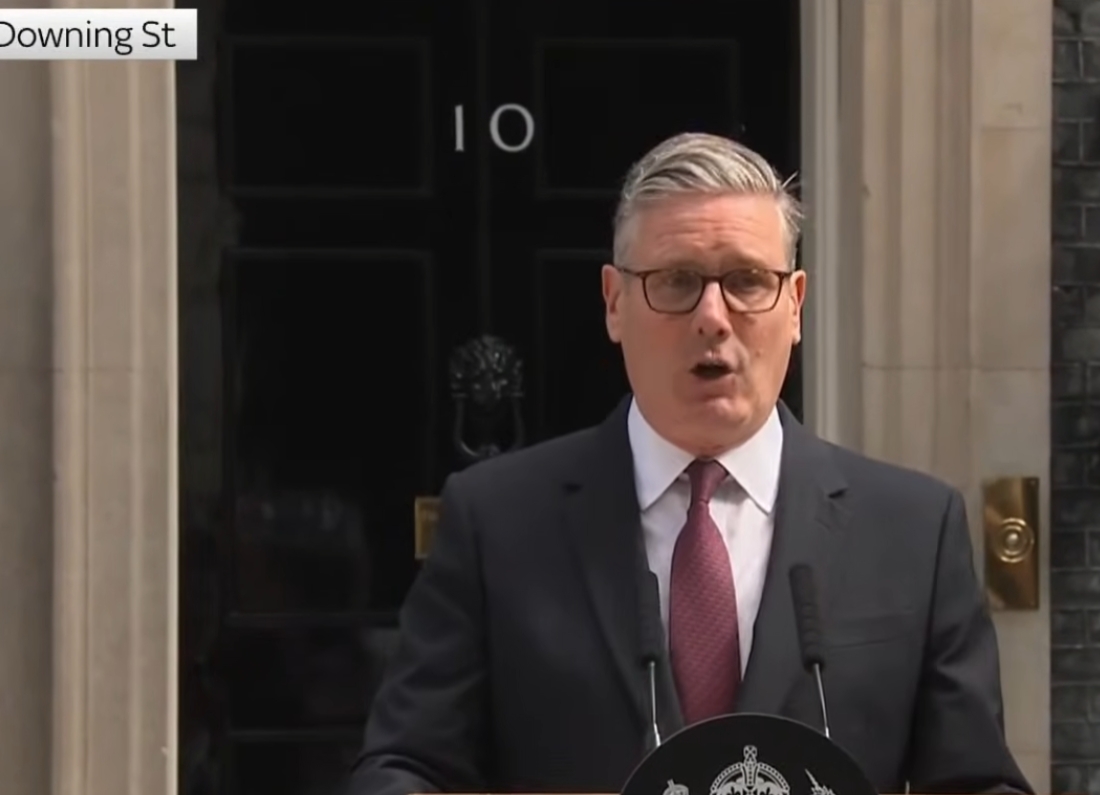
Keir Starmer has resigned as leader of the Labour Party and set out a timetable for his departure from Downing Street, in a statement delivered outside No 10 on Monday morning that ended weeks of mounting pressure and days of near-certain expectation.
“I have heard the answer of my parliamentary party to that question and I accept that answer with good grace,” Starmer said. “That is why I will resign as leader of the Labour Party. I have spoken to His Majesty the King this morning to inform him of my decision.”
The timetable
Starmer will remain in post as prime minister until a successor is in place. The Labour Party’s National Executive Committee will set out the formal process, with nominations opening on 9 July – a week before parliament’s summer recess. If a contest is required, it will be completed by 1 September when MPs return to Westminster.
“I will give my successor my full and unequivocal support,” he said.
Tearing up as he addressed the media, Starmer said he would focus on what he called “the most important job” – being “the best husband I can to my fantastic wife Vic, who has been a rock by my side through good times and bad. And being the best dad that I can to my beautiful children, who are my pride and joy.”
What led to this moment
The proximate cause was Andy Burnham’s landslide victory in the Makerfield byelection last Thursday, which gave Burnham the mandate and the momentum to push for a leadership transition. Burnham had already secured the backing of more than 201 Labour MPs – over half the Parliamentary Labour Party – and had made clear he would present the list to Starmer if he did not step aside voluntarily.
But the pressure had been building for far longer. 77 Labour MPs had called publicly for Starmer to quit before polling day. John Healey resigned as Defence Secretary, accusing Starmer and the Chancellor of putting national security at risk over a spending dispute. Wes Streeting resigned as Health Secretary in a ferocious written attack on Starmer’s leadership, describing a vacuum where vision should be.
Cabinet ministers including Ed Miliband, Shabana Mahmood, Yvette Cooper, Heidi Alexander and Jonathan Reynolds had all privately urged Starmer to set a timetable. Scotland Secretary Douglas Alexander was also among those pressing for an orderly transition. In the end, the weight of the Parliamentary Labour Party proved impossible to resist.
His final days in No 10
As recently as Friday morning, Starmer had been telling reporters he would fight on. Asked if he would stand in any possible leadership contest, he said “there isn’t one at the moment” and that holding one would send “the country into chaos.” He added: “If there is a contest, then yes I will run, I will stand.” By Sunday evening, those around him were describing a man who had come to see resignation as “the dutiful option.” By Monday morning, it was done.
His allies had predicted the outcome over the weekend, with one senior Labour source saying: “As LBJ said, ‘The first rule of politics is to learn how to count.’ There’s no way that Keir stays beyond the week because Andy has the numbers.”
The contest ahead
Burnham is the overwhelming favourite. Polling showed Labour would overtake Reform by eight points under his leadership, and his Makerfield performance – 54% of the vote, Reform beaten by 9,231 – demonstrated in concrete terms what his supporters have long argued: that he can assemble the broad anti-Reform coalition that Labour needs to win the next general election.
Whether anyone else enters the race remains to be seen. Streeting indicated before his resignation that he intended to stand, and Ed Miliband had been mulling a candidacy as a “stop Streeting” option. But Burnham’s position going into the contest is formidable – and the 81 MP threshold required to trigger a challenge means that any rival will need to demonstrate serious parliamentary support before nominations close on 9 July.
The Labour Party now has until 1 September to choose a new leader. The person who wins that contest will walk into Downing Street as prime minister, with a general election required by 2029 and a country that, on almost every measure, is looking for something different from what the last year has delivered.
Here is his speech in full:
“A page in our country’s history turned after years of disappointment and despair. The chance to change the lives of millions of people for the better.
That’s what I came into politics for. The journey to that point was not easy. 6 years ago, I inherited a Labour Party that was politically, financially, and morally bankrupt.
I was told time and time again that my party was finished, that we were consigned to history, that a majority at the general election, let alone a landslide majority, was impossible. But we] proved those people wrong because we changed our party, ripping out the poison of antisemitism, restoring trust on the economy, defence, and national security, and becoming a party that once again stood proudly with, not against, our national flag.
The hard work of change was with a singular purpose—Not power for power’s sake, but to change Britain for the better. To build a fairer country with dignity and respect, where everyone is seen, everyone is valued, wealth and opportunity for all, not just the privileged few.
And look at what we’ve achieved in just 2 years: an economy that is stronger, growing faster than our peers, wages rising faster than inflation in every single month since we came to power. Investment secured, infrastructure being built, an end to austerity with the fastest fall in NHS waiting lists for 17 years, the biggest improvement in rights for workers and renters in a generation, the biggest uplift in defence spending since the Cold War, small boat crossings falling, asylum hotels closing, protecting young people from social media, and half a million children being lifted out of poverty because of the choices that I made.
Our reputation in the world restored, with Britain once again standing up for decency, respect, and the rule of law, securing trade deals, standing with Ukraine, standing up for our values and rebuilding our relationship with our allies in Europe.
Change promised by a Labour government, change fought for by a Labour government, change delivered by a Labour government. But I know the question being asked now is not who was best placed to change the Labour Party, to take us into power, and to begin the vital work of improving lives for millions of people. Those questions have been answered.
The question my party is asking now is whether I am best placed to lead us into the next General Election. I have heard the answer of my parliamentary party to that question, and I accept that answer with good grace. Every decision I’ve taken has been about putting the country I love first.
That is why I will resign as leader of the Labour Party. I have spoken to His Majesty the King this morning to inform him of my decision. I will ask the National Executive Committee of the Labour Party to set out a timetable with nominations opening on the 9th of July. And completed by the summer recess.
In the case of a contest, this will ensure a new leader is in place before Parliament returns in September. I will remain in post as Prime Minister until the contest is complete, and I will do everything I can to ensure an orderly handover of power.
I will also give my successor my full and unequivocal support, knowing that they will inherit a Britain that is far stronger and fairer than the one I inherited 2 years ago, better prepared for the challenges ahead, and better able to ensure the Labour Party secures a second term in office.
I want to thank all of those friends and colleagues who have been at my side for these past 6 years or so for their incredible commitment, service, and support.
I want to thank the brilliant Number 10 staff and our country’s extraordinary civil service who dedicate their lives to public service.
And when I leave the biggest job in the country, I shall spend more time on the most important job: being the best husband I can to my fantastic wife Vic, who has been a rock by my side through good times and bad, and being the best dad I can to my beautiful children, who are my pride and my joy. Thank you very much.”




Leave a Reply