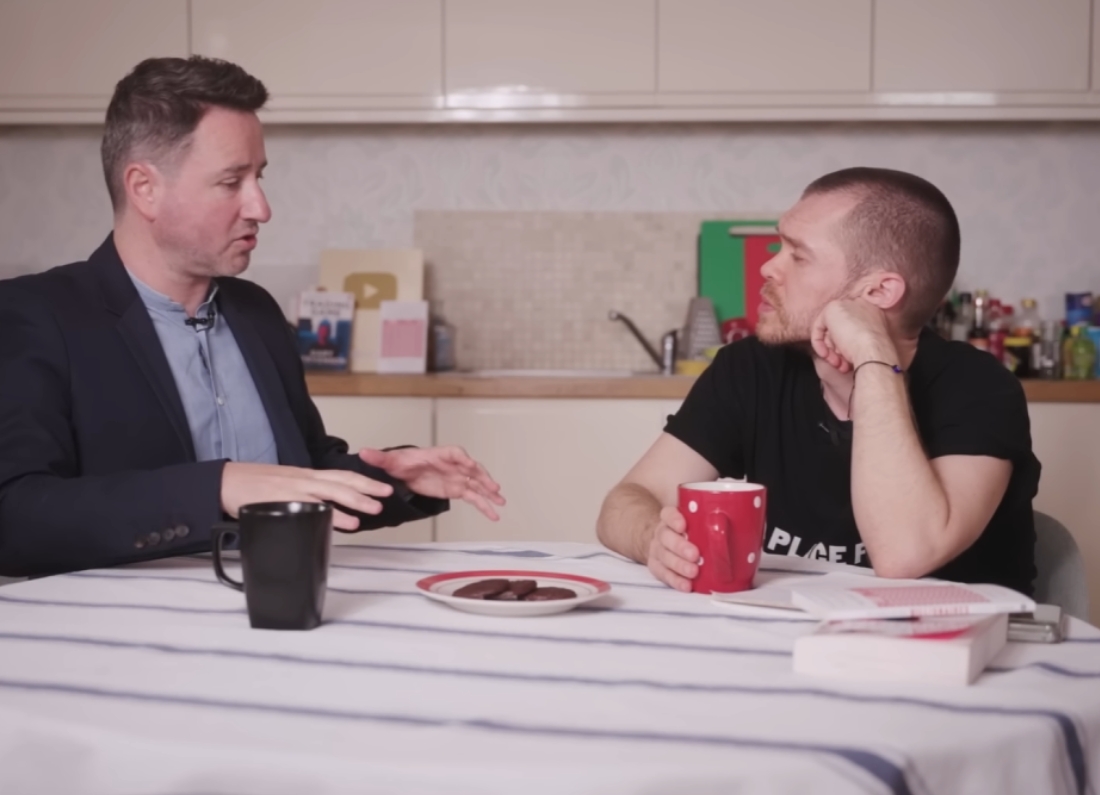
Gary Stevenson – the former Citibank trader who grew up in poverty in Ilford, won a scholarship to LSE, became a millionaire by betting on rising inequality, burned out at 27 and is now one of Britain’s most influential economic voices with 1.5 million YouTube subscribers – has interviewed Gabriel Zucman, director of the International Tax Observatory, for his Gary’s Economics channel. In the interview, Zucman explains how a 2% minimum tax on wealth above £100 million would raise £15 billion annually from approximately 1,000 UK families, why it cannot be avoided, and why the UK could lead the world in implementing it just as it led with the progressive income tax in 1909.
Stevenson has been following Zucman’s work for eleven years, having first emailed him in May 2015. His book The Trading Game – published by Penguin in 2024 and the most popular audiobook among Spotify Premium users in the UK in 2025 – documents his experience at Citibank and his conclusion that extreme inequality was not an accident but the product of deliberate policy failures. The interview is his first with Zucman on UK soil.
The scale of the problem
Zucman opens with numbers that put the political debate in context. The top 0.001% of the UK wealth distribution – roughly 200 families – owned wealth equivalent to 5% of the UK’s GDP in 1989 when the Sunday Times Rich List began. The latest Rich List shows the same group now owns wealth equivalent to 25% of GDP. Those 200 families could, if they spent everything they owned, purchase a quarter of everything the entire country produces in a year. In 1989 they could have bought 5%.
Globally, billionaire wealth increased by 40% in just two years – coming on top of decades of acceleration that began in the 1980s and intensified after the 2008 financial crisis and again during COVID.
The specific tax anomaly this produces is documented across ten countries through Zucman’s research partnerships with tax administrations. “The working class and the middle class pays roughly 40-50% of their income in all taxes – VAT, payroll taxes, property taxes, income tax, all included. And then the billionaires pay like 20-25% of their income. Only half as much as the rest of the population. We didn’t know that five years ago. Now it’s established fact.”
Why income tax doesn’t touch them
The reason billionaires pay lower effective rates is structural rather than illegal. Jeff Bezos, Zucman explains, as CEO of Amazon paid himself no wage. As controlling shareholder he instructed the company not to distribute dividends. He did not sell shares, so he realised no capital gains. His officially taxable income was therefore zero. His wealth was in the billions.
“His true economic income is very large. His wealth is gigantic. But he paid no income tax. And that’s legal and that’s the way the system works. But of course it’s not a good system.”
ProPublica’s revelations showed Elon Musk paid zero income tax in one year. Any tax based on income will fail to reach people who engineer their income to zero. This is the structural gap Zucman’s proposal is designed to close.
The proposal – and why it’s different from past wealth taxes
Zucman’s proposal is a 2% annual minimum tax on all wealth above £100 million, with no exemptions and no deductions whatsoever. The rate ensures billionaires pay roughly the same proportion of their income in tax as everyone else.
He is specific about why previous European wealth taxes failed. France’s Socialist government created a wealth tax in 1981 and immediately exempted professional assets – effectively exempting the billionaires it was supposed to tax. “It’s like if the US was creating a wealth tax today and exempting Elon Musk or Jeff Bezos.”
The Zucman proposal works differently: a very high threshold – only those with over £100 million are affected – but in exchange, zero exemptions. The tax must also be based on wealth rather than income, because billionaires can engineer their income to zero but cannot reduce their wealth to zero.
For the UK: approximately 1,000 families. Revenue: £15 billion per year. “The sun is going to keep rising in the morning.”
Solving the migration problem
The standard objection is that the rich will move to Dubai or Monaco. Zucman’s response: governments are not powerless. “Any country on its own could say: if someone has lived for a long time in the UK and has become extremely rich in the UK and now moves to another country – that’s their right – but we, the UK, will keep taxing that person as if they were still a UK resident for five years or ten years.”
The US taxes its citizens abroad until death. The UK currently does the opposite: someone who has spent their entire life here and accumulated vast wealth here can leave on January 1st and be immediately tax-free. The Zucman proposal offers a middle path that removes the financial incentive to leave.
Seven Nobel Prize winners – and a message for Rory Stewart
Stevenson raises Rory Stewart of The Rest Is Politics, who has said there is “no academic consensus” on wealth taxes and asked where the professors are. Zucman’s response is direct: “I say to Rory Stewart that he should read a bit more and listen a bit more to what’s happening in the rest of the world. In July 2025, there was an op-ed in Le Monde signed by seven Nobel Prize winners supporting this proposal – Paul Krugman, Joseph Stiglitz, Daron Acemoglu and others. They wrote: France should lead by example. Do it.”
Olivier Blanchard, former chief economist of the IMF, also wrote in support. Zucman estimates 80-90% of the general population supports the measure and broadly the same proportion of economists. He said he would be willing to go on The Rest Is Politics to explain this directly.
The proposal passed France’s National Assembly in February 2025 – not a left-wing parliament. It was blocked by the Senate. Zucman is confident it will eventually pass and that one country doing so starts an international movement.
Why democracy itself is at stake
Zucman’s broader argument connects wealth inequality to democratic collapse. “Wealth, for the super rich, is not accumulating billions for their old age. For them, wealth is power. The power to influence the prevailing ideology. The power to influence markets by buying competitors. The power to influence politics by buying elections. There is always a fundamental tension in democratic societies between extreme wealth concentration and the very possibility of a democratic society. Aristotle wrote about this.”
In France, billionaires own 85% of the private press. When the 2% minimum tax came close to passing, they used their media to threaten elected representatives. In the US, Trump has signed a deal shielding himself and his family from IRS tax audits for life – as we reported in our Trump midnight rant piece.
“You have to realise how fast it can happen. Sometimes people look at the US and say whatever happens there cannot happen here. But no – it’s a global trend.”
The UK’s moment – and Lloyd George’s precedent
The progressive income tax was an international movement of the early 20th century. The UK led in 1909 with Lloyd George’s People’s Budget, which introduced a 2.5% super tax on the 10,000 wealthiest people in the country. France followed in 1914, the US in 1913 – not through an international agreement but through one country leading and others following.
“The UK was one of the first countries to create a progressive income tax. The UK was the first country to create a welfare state in 1945. Now is the time to lead again.”
For Stevenson, the interview represents the connection he has been trying to make for eleven years between the academic work on inequality – work that radicalised him when he read Thomas Piketty as a Citibank trader – and the political class that has the power to act on it. Stevenson himself signed an open letter to Rishi Sunak alongside 29 other millionaires in 2021 calling for a wealth tax. He has 1.5 million YouTube subscribers and 187 million channel views. Zucman has the academic framework and the political blueprint. The interview is an attempt to bring both to the attention of whoever forms Britain’s next government.
You can watch the interview in full below:
As we reported in our Mazzucato interview piece, Mazzucato argues Labour has had low public investment for two decades and that there is always money when it is war. Zucman’s £15 billion annual figure from 1,000 families is the specific answer to the question every leadership candidate is now being asked: where does the money come from?