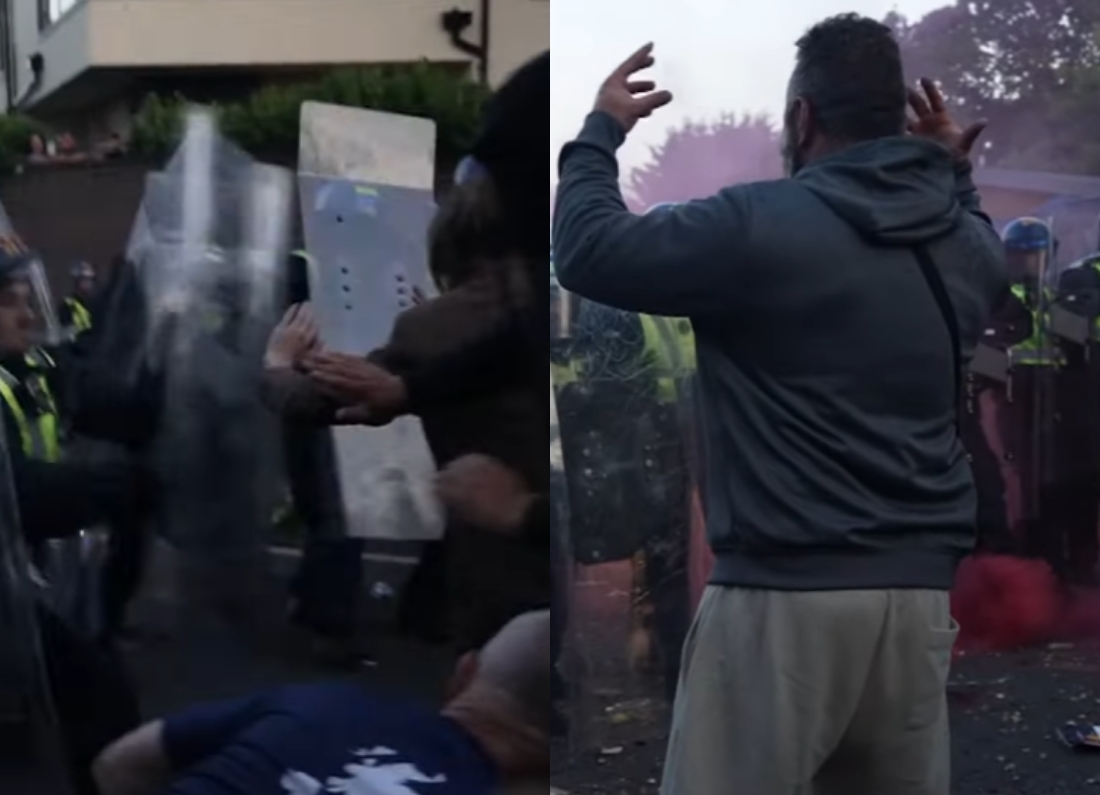
Dozens of people clashed with police in Southampton on Tuesday evening after hundreds gathered outside Southampton central police station for a “Justice for Henry Nowak” protest at which Tommy Robinson, Nick Tenconi and Laurence Fox spoke. Rioters hurled bottles, beer cans and wheelie bins at officers and threw stones at police cars at a nearby station. Police charged with perspex shields. Home Secretary Shabana Mahmood condemned the scenes as “completely unacceptable” and said those responsible could expect to face “the full force of the law.”
Henry Nowak’s father, Mark, had explicitly asked two days earlier that his son’s death not be used to “create further division, hatred or tension” and that he wanted Henry’s story to “help make our streets safer for everyone.” As we reported in our Farage and Nowak piece and our O’Brien on Farage piece, Nigel Farage responded to the family’s wishes by calling for “pure, cold rage” and promoting “white lives matter” language. James O’Brien warned that “pure, cold rage” meant a repeat of what happened after Southport. The riots came within 48 hours.
What happened
Hundreds gathered outside Southampton central police station for the protest. Signs read “Henry’s blood is on your hands,” “Save our kids” and “Prison 4 police on scene.” Crowds chanted “Racist police, off our streets” and “Shame on you.” Some chanted Nowak’s final words – “I can’t breathe” – directed at officers watching over the demonstration.
A few hundred then marched to the area where the murder took place. Police held them back from the street where Digwa’s family lives. Protesters hurled bottles, beer cans and wheelie bins at officers. Police charged with perspex shields in an attempt to push the crowd back. A helicopter hovered overhead. Officers were pelted with stones. At Portswood police station, glass bottles were thrown at police cars.
Laurence Fox, who attended, claimed there were 4,000 people present. Others estimated approximately 1,000.
Who spoke
Tommy Robinson – whose real name is Stephen Yaxley-Lennon – addressed the crowd outside Southampton central police station. He accused Hampshire Police of institutional racism and said: “As white people we are treated like second-rate citizens by our own government.” Responding to the resignation of one of the officers involved in the incident, he said: “We want him in prison.”
Nick Tenconi, leader of the UK Independence Party, led a prayer and said: “The arresting officers believed persecuting him was more important than saving him because he was white.” He added: “I am here to fight for an end to woke policing.”
Both framed the police conduct – which Hampshire Police have apologised for – as evidence of anti-white institutional racism rather than as a specific failure of policing procedure that needs investigation.
The legitimate complaint and how it was hijacked
The facts of the Henry Nowak case include a genuine and serious complaint about police conduct that the family has called for a transparent investigation into. As we reported in our original Nowak piece, bodycam footage shows officers handcuffing the dying teenager after Digwa falsely claimed he had been racially abused and acted in self-defence. Nowak told officers multiple times that he had been stabbed and couldn’t breathe. Hampshire Police has apologised. The PCC called it a “national tragedy.”
Those are legitimate questions. The family’s call for a transparent inquiry into what went wrong, why Digwa’s lie was believed and what needs to change in policing procedures is a reasonable and proportionate response.
That question has been entirely absent from the protest’s narrative. Neither Robinson nor Tenconi called for an inquiry into procedure. Neither addressed what specific changes would prevent a recurrence. The legitimate institutional failure was converted into a framework of racial grievance in which the demand is not accountability but revenge. The Sikh community – as we have reported – has been demonised for the actions of one individual. The Sikh Federation has clarified that the blade used was not a Kirpan.
As O’Brien said on LBC when Farage made his “pure, cold rage” call: “What does that mean, if not, do what you did after the Southport killings?” The riots that followed the Southport murders – which were driven by false information about the attacker’s identity amplified by figures including Reform’s Makerfield candidate Robert Kenyon as we reported in our full Kenyon investigation – injured 26 police officers, destroyed homes and businesses and were the worst civil unrest in Britain since 2011. The Southampton disorder follows a similar script: a genuine public outrage about institutional failure, a family begging for calm, political figures calling for rage, and riots within 48 hours.
The government response
Home Secretary Shabana Mahmood said: “The scenes this evening in Portswood are completely unacceptable. The Nowak family made a powerful call to us all yesterday to not let Henry’s death be used to create further division, hatred or tension. There can be no justification for hijacking this tragedy to stir up violence and disorder. Those responsible can expect to face the full force of the law.”
A Southampton resident who attended, Jamie Smith, said: “I am here for Henry. I saw the video online when he was handcuffed and dragged on the floor after being stabbed and I want the police to be held accountable. We don’t want trouble but emotions are high.”
The distinction in those two statements – between wanting accountability and wanting violence – is the distinction that the protest’s leadership collapsed, and that the family, from the moment Digwa was sentenced, tried to maintain.