

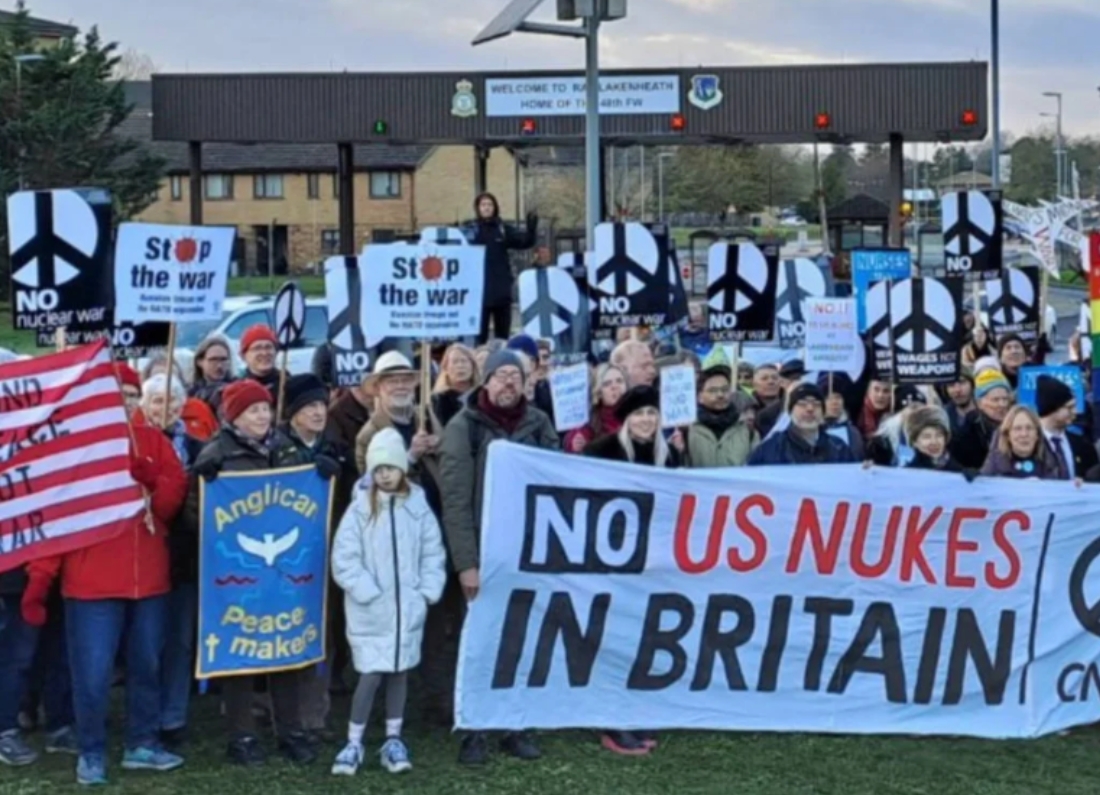
Nine people have been arrested at anti-war protests outside RAF Lakenheath in Suffolk after military analysts concluded that a US F-15E fighter jet shot down over Iran on 3 April was most likely based at the airfield – raising significant questions about Britain’s legal liability for military operations being conducted from its sovereign territory.
The arrests took place over Easter weekend during a six-day peace camp organised by the Lakenheath Alliance for Peace, which drew hundreds of protesters to the gates of the base and included a three-hour blockade of the main entrance on Saturday.
The downed F-15 – and the Lakenheath connection
The context that gave this particular protest its sharp political edge was the shooting down of a US F-15E Strike Eagle over Iran on 3 April – the first confirmed loss of a US aircraft in the conflict. The crash triggered immediate questions about where the plane had been based.
Justin Bronk, a senior research fellow at the Royal United Services Institute who studies air power, told the New York Times that markings on the wreckage seen in photographs published by Iranian state media were consistent with those of the 494th Fighter Squadron based at RAF Lakenheath.
Iran’s Islamic Revolutionary Guard Corps stated explicitly that the jet came from Lakenheath. The Ministry of Defence and United States Central Command have not commented on the claim.
RAF Lakenheath is owned by the British Ministry of Defence but leased to the US Air Force. It is the largest US fighter operation in Europe, hosting the 48th Fighter Wing. The base last year became home to US nuclear weapons on UK soil, with B61 gravity bombs delivered during the summer after a long period of preparation.
Protest organisers said they had observed between 116 and 118 US bomber and fighter aircraft departing the base since the Iran war began. On 24 March, five F-35C fighter jets were seen landing at the base. Local activists also reported seeing more than 20 planes taking off from the base on the morning of 2 April – the day before the F-15 was shot down.
The arrests – and the legal complexity
The arrests carried a legal dimension that made them immediately controversial. Seven protesters were arrested on Sunday on suspicion of supporting Palestine Action, a direct-action group that campaigns against Israeli military operations. The Lakenheath Alliance for Peace said the seven had been arrested wearing clothing bearing the message “We oppose genocide, we support Palestine Action.”
Palestine Action was banned by the Labour government in July 2025, when it was formally proscribed as a terrorist organisation. But earlier this year, the High Court ruled that that proscription was unlawful. The government is now appealing that ruling – which means the ban remains technically in force while the appeal proceeds.
Suffolk Police acknowledged the situation directly in a statement: “Although the High Court found the proscription of Palestine Action to be unlawful, it also confirmed that the impact of that judgement will not take effect until the government’s appeal has been considered. As such, where offences are believed to have occurred appropriate action will be taken.”
The result is that protesters can currently be arrested for supporting a group whose ban a court has already declared unlawful – a state of legal limbo that critics argue creates a chilling effect on legitimate political protest.
Two further protesters had been arrested on Saturday and charged with obstructing a public thoroughfare following the blockade of the main gate.
The accountability question
The central political argument being made by protesters concerns Britain’s legal responsibility for what is launched from its soil. Lakenheath Alliance for Peace organiser Peter Lux put it plainly: “It’s definitely an RAF base, it’s sovereign territory, and so Britain is actually legally liable for what actually happens at that base.”
That claim is legally and constitutionally significant. Under international law, states bear responsibility for military operations conducted from their territory, even when those operations are carried out by allied foreign forces. The extent of that responsibility – and whether it extends to active participation in a conflict that the British government has publicly described as “not our war” – is a question that has not been definitively resolved.
The peace camp heard from a range of speakers, including CND General Secretary Sophie Bolt. It also included an address from former British Army Colonel Chris Romberg, who was arrested last year in Parliament Square for carrying a sign in support of Palestine Action. Craig Raeside, a veteran who served 14 years in the Royal Engineers, also attended the blockade on Saturday, saying: “Veterans know. We are trained on Rules of Engagement, Geneva Convention and Genocide Convention. The US and Israel are and have been ignoring every article relating to civilian infrastructure, property and people. It’s our duty to speak up.”
The wider picture of UK base involvement
Lakenheath is not the only British base being used in connection with the Iran war.
RAF Fairford in Gloucestershire has also been used by US bombers to launch missions over Iran. RAF Mildenhall in Suffolk – another base supporting US Air Force operations – saw significant activity in the past week, with two US EA-37B Compass Call electronic warfare aircraft photographed landing there on 31 March.
The Iranian ambassador to London, Seyed Ali Mousavi, told Times Radio last week that Tehran was “considering” whether to strike British bases in retaliation for their use by American forces. That warning has added urgency to the debate about Britain’s exposure – both militarily and legally – from the use of its territory in the Iran war.
The political timeline – and its tensions
The story of Britain’s involvement in the Iran war through its bases has been one of incremental escalation accompanied by consistent public statements that Britain is not a belligerent.
When the US-Israeli strikes began on 28 February, Britain initially refused permission for American forces to use Diego Garcia for offensive operations. Within two days, Starmer reversed that position, authorising the use of British bases for what he described as “defensive” strikes on Iranian missile sites. Two weeks later, he authorised a further expansion – allowing the US to use British bases to launch strikes on Iranian sites to protect shipping in the Strait of Hormuz.
Throughout this period, Starmer has maintained publicly that the conflict is “not our war” and that Britain is not engaged in offensive action. The protesters outside Lakenheath – and the military analysts connecting the downed F-15 to the base – present a picture that is considerably more complicated.
You may also like: Trump compares Starmer to Neville Chamberlain in latest attack over Iran war stance





Leave a Reply