

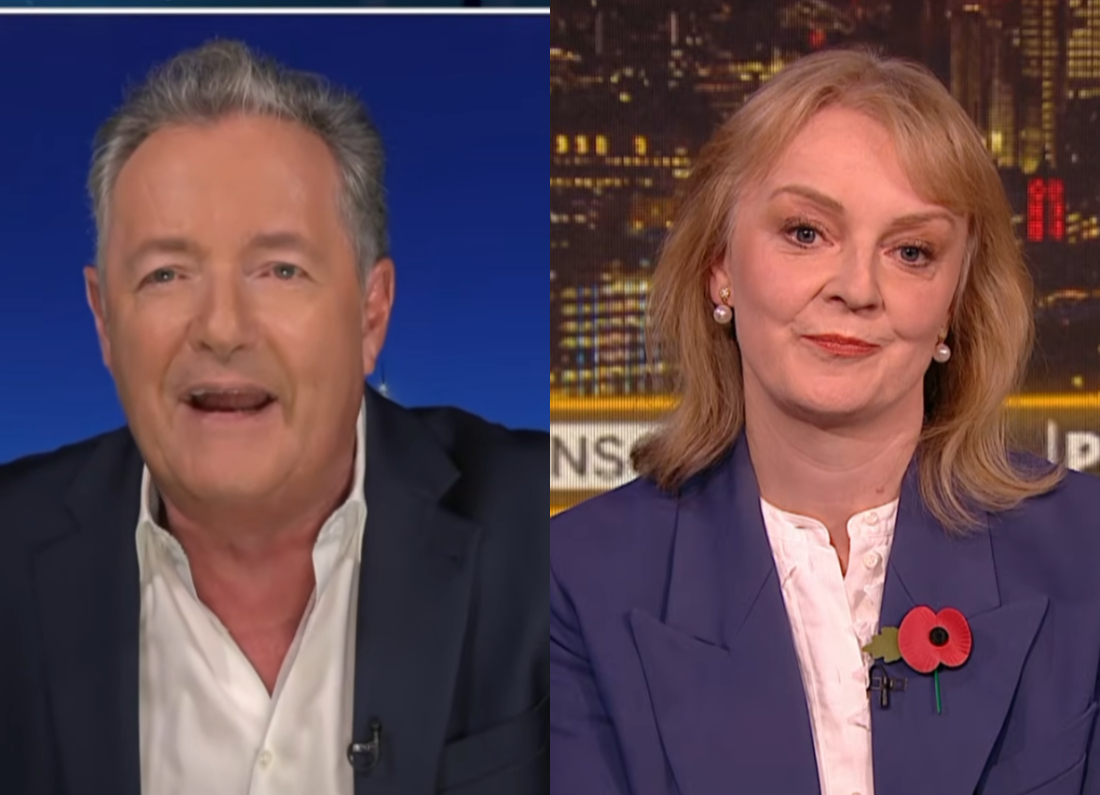
Liz Truss has faced a bruising interview with Piers Morgan after repeatedly resisting demands to accept responsibility for the financial turmoil that brought her 49-day premiership to an end, eventually offering an extraordinary answer when asked to identify a single personal fault.
The former Conservative prime minister appeared on Piers Morgan Uncensored to promote her new book, Bank Job, in which she argues that the Bank of England, unelected officials and members of her own party were responsible for the collapse of her government in October 2022.
Morgan repeatedly challenged that explanation, questioning why Truss had dismissed her Chancellor, Kwasi Kwarteng, and then resigned herself if she was convinced her economic programme had been right.
He also confronted her with the timeline of the Bank of England’s actions, pointing out that planned gilt sales had been publicly discussed before her mini-budget and did not begin until after the market crisis.
But the most memorable moment came at the very end of the interview.
Having spent much of the discussion listening to Truss blame financial institutions, Conservative colleagues and the media, Morgan asked her to identify just one personal shortcoming.
“Maybe I interrupt people too much, Piers,” she replied.
Morgan opens with the lettuce that outlasted Truss
The interview began with a reminder of one of the most enduring images from Truss’s extraordinarily short time in Downing Street.
Morgan revisited the Daily Star’s famous lettuce stunt, in which a supermarket lettuce was placed on a live stream to see whether it would outlast the prime minister.
It did.
Truss resigned after just 49 days, becoming Britain’s shortest-serving prime minister and leaving office amid the financial turmoil that followed her government’s September 2022 mini-budget.
Morgan began by asking whether she actually liked lettuce.
Truss said she liked vegetables but made clear that she was tired of the joke.
“It’s just a puerile joke, Piers, isn’t it?” she responded, arguing that the obsession with her short premiership distracted from what she considered the more serious problems facing Britain.
She insisted that she had attempted to change a political and economic system which she believed was fundamentally broken.
Her argument was that successive prime ministers had failed because they were unwilling or unable to confront powerful institutions operating beyond direct democratic control.
Morgan was unconvinced that this explained her own departure.
He pointed out that Britain had gone through an extraordinary succession of prime ministers since the Brexit referendum, while Truss’s time in office had become an international symbol of political instability.
For Truss, however, her 49 days were evidence of the system’s resistance to change rather than a failure of her own leadership.
‘You blame pretty much absolutely everyone apart from yourself’
Morgan’s central challenge was straightforward: could Truss acknowledge that she had made serious mistakes?
He said she had written an entire book explaining why other people and institutions were responsible for the disaster, while appearing unwilling to accept that her own decisions had played a significant role.
Truss rejected the premise.
She argued that the Bank of England had failed to recognise serious vulnerabilities in pension funds and had pursued monetary policies which destabilised the bond market.
Her account placed particular emphasis on liability-driven investment strategies, known as LDIs, which were used by pension funds and became a source of financial instability during the gilt market turmoil.
Truss maintained that the Bank had subsequently acknowledged these problems, while the media continued to place the blame on her mini-budget.
Morgan pressed her to explain why, if her interpretation was correct, she had not simply remained in office and defended her position.
Instead, she had reversed key policies, sacked her Chancellor and eventually resigned.
Truss argued that she had been placed under extraordinary pressure by Conservative MPs and financial institutions, with warnings that further instability would follow if she refused to change course.
But Morgan kept returning to the question of political responsibility.
“You blame the Bank of England. You blame the media. You blame your Conservative colleagues,” he said, before pointing to her dismissal of Kwarteng.
He expressed disbelief that, after writing a book about the episode, she still appeared reluctant to accept that the decisions made by the prime minister herself were part of the problem.
The Bank of England timeline becomes a major flashpoint
One of the most substantive exchanges concerned Truss’s claim that the Bank of England’s quantitative tightening programme helped trigger the crisis.
She argued that the Bank had announced plans involving £80 billion of gilt reductions immediately before her government’s mini-budget on 23 September 2022, without properly briefing her.
Morgan challenged her account of the timing.
He pointed out that the Bank’s plans to reduce its gilt holdings had already been announced before Truss became prime minister, and that active gilt sales were subsequently postponed because of the financial turmoil.
The Bank’s official records support the distinction.
The Monetary Policy Committee announced plans in August 2022 to begin active gilt sales, subject to economic conditions. In September it confirmed a programme to reduce its holdings by £80 billion over twelve months, with that total including bonds maturing as well as active sales.
Crucially, the active selling of government bonds did not begin before the mini-budget.
The Bank postponed its planned sales during the market disruption, and active gilt sales eventually started on 1 November 2022.
The Bank also intervened on 28 September by purchasing long-dated government bonds to restore order to markets after the sharp rise in gilt yields.
Its subsequent analysis acknowledged that vulnerabilities in pension funds using LDI strategies had amplified the turmoil.
But the Bank also identified the abrupt change in the government’s fiscal stance as an important factor behind the initial market shock.
That is not the same as accepting Truss’s claim that the Bank alone caused the crisis or that her government’s mini-budget was effectively blameless.
Truss nevertheless maintained that she had not been properly informed about the relevant risks and insisted that officials had failed to give her the information she needed.
“I was the one in Number 10,” she told Morgan.
She argued that Treasury officials had not warned her about the dangers associated with the Bank’s actions and that she had been forced to make decisions without understanding the full financial picture.
Why did Truss sack Kwasi Kwarteng?
Morgan then turned to one of the most consequential decisions of her premiership.
If Truss was convinced that the mini-budget was right and the Bank of England was responsible for the turmoil, why had she fired the Chancellor who delivered it?
Kwarteng was dismissed on 14 October 2022, just three weeks after presenting the government’s economic programme.
Truss explained that she believed the market situation would deteriorate further unless she made changes demanded by those around her.
She said she had been placed under pressure to reverse policies and change personnel, with warnings about the potential impact on financial markets.
Morgan offered a less sympathetic interpretation.
He suggested that Truss had sacrificed Kwarteng in an attempt to save her own position, only for the strategy to fail.
The presenter then asked why she had not followed the example of Margaret Thatcher, whom Truss admires, and stood her ground against the people trying to force her out.
Truss insisted that the situation was already exceptionally serious and that refusing to act could have caused further damage.
She maintained that she was trying to protect the country from additional instability, even though she believed the underlying problems were not her fault.
The argument exposed the difficult position at the centre of her account.
She wanted to portray herself as a politician willing to confront powerful institutions, but her own description of events involved repeatedly abandoning policies and personnel under pressure from those institutions.
Morgan continued to question why a prime minister who believed so strongly in her programme had ultimately accepted defeat.
‘I resigned with a gun against my head’
Truss offered a dramatic explanation for her resignation.
She said Graham Brady, then chairman of the Conservative Party’s 1922 Committee, had told her that MPs were preparing to remove her within 24 hours.
According to Truss, continuing to resist would have created further turmoil and potentially caused additional damage to the economy.
“I resigned with a gun against my head, Piers,” she said.
She maintained that she would have remained prime minister if she had been given the choice.
But later in the interview, Morgan challenged another remark which appeared to complicate that explanation.
Truss argued that she could have remained in Downing Street for years if she had simply accepted the existing political system and avoided attempting major reforms.
Morgan immediately pointed out that she had previously said Conservative MPs were about to remove her.
Both claims, Truss responded, were compatible because she believed MPs would only have forced her out because of the policies she had attempted to introduce.
Had she entered office and done nothing controversial, she argued, she might have survived for considerably longer.
She maintained that she had become prime minister to change the country rather than simply occupy the office.
The exchange went to the heart of Morgan’s criticism.
He was not disputing that Truss had faced intense political pressure or that Conservative colleagues had helped bring her premiership to an end.
His question was why she appeared unwilling to consider whether the scale of that opposition and the market reaction might also have reflected serious flaws in the decisions she had made.
Truss admits possible mistakes, but says they were minor
After another lengthy explanation of the Bank of England’s role, Morgan interrupted with a direct question.
“What did you get wrong?”
Truss initially replied that every prime minister made mistakes.
She then acknowledged that she had probably made some errors involving personnel and communication.
But she immediately qualified the admission, arguing that none of those mistakes approached the seriousness of the failures she attributed to the Bank.
It was a partial concession, but not the kind Morgan had spent much of the interview trying to obtain.
He suggested that delaying the mini-budget might have allowed Truss more time to prepare, particularly because she had entered Downing Street shortly before the death of Queen Elizabeth II.
The Queen died on 8 September 2022, two days after Truss became prime minister, with the national mourning period interrupting the government’s early programme.
Morgan asked whether it might have been more prudent to delay the 23 September announcement and carry out further discussions with Treasury officials and the Bank of England.
Truss rejected the suggestion.
She argued that delay would have given officials greater opportunity to obstruct or dilute her policies, insisting that politicians who wanted meaningful change had to act quickly.
She also criticised the Office for Budget Responsibility and repeated her argument that the machinery of government was fundamentally hostile to her economic agenda.
‘You’ve been one of the elite’
The confrontation broadened into an argument about Britain’s political establishment.
Truss blamed Tony Blair’s governments for creating institutions and laws which she believes prevent elected politicians from exercising sufficient control over public policy.
She criticised the independence of the Bank of England, the Human Rights Act and the constitutional arrangements governing the civil service.
In her account, these changes had created a permanent bureaucratic establishment capable of frustrating governments even when they had won elections.
Morgan questioned the argument that Truss herself had been powerless against this supposed elite.
After all, she had served as a minister in successive Conservative governments before becoming prime minister.
“You were one of the elite. You had a chance to fix it,” he told her.
Truss insisted that she had tried.
She argued that the failure of previous Conservative governments to deliver tax cuts, reduce immigration and change Britain’s relationship with its institutions demonstrated how difficult reform had become.
Morgan said the country had needed better political leadership, and suggested the Brexit referendum had contributed to years of economic and political instability.
Truss dismissed that assessment, maintaining that Brexit had been a response to a public increasingly frustrated by unaccountable institutions.
Neither appeared close to persuading the other.
Morgan asks one final question
The interview ended much as it had continued, with Morgan pressing Truss for a more convincing acknowledgement of her own shortcomings.
He had spent much of the conversation challenging her account of the mini-budget, the dismissal of Kwarteng and the circumstances of her resignation.
Truss had conceded possible communication and personnel mistakes but continued to insist that the Bank of England bore far greater responsibility.
She also maintained that the institutional problems identified in her book had never been properly addressed.
Morgan made one final attempt.
“Can you think of a single fault about Liz Truss? Just generally?”
This time, the former prime minister did not return to quantitative tightening, pension funds, the Treasury or Conservative MPs.
“Maybe I interrupt people too much, Piers,” she replied.
You can watch it below:
One response to “Piers Morgan humiliates Liz Truss in bruising interview over her complete lack of self-awareness”
-
What a joke, everyone else is wrong and to blame, good grief shut the **** up, the torries put her in to show how bad they were at governing the country. Nice to know she was a total muppet.






Leave a Reply