

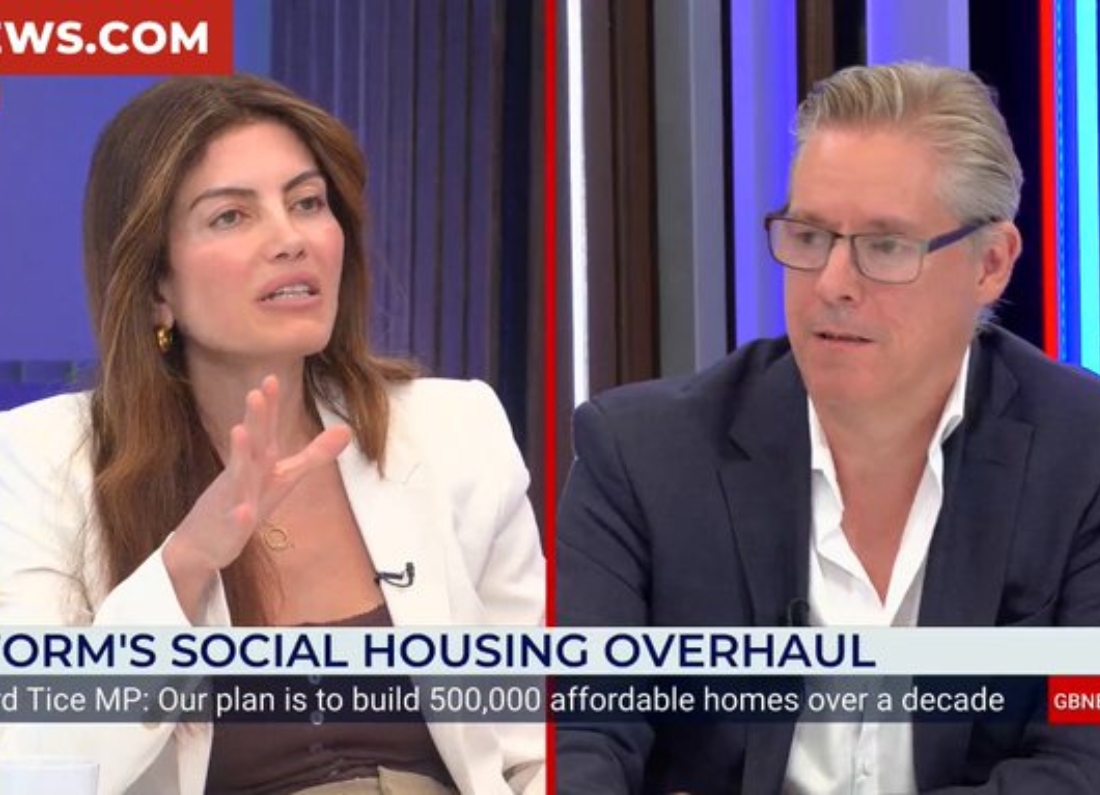
Reform chose GB News to sell its new social housing plan. It should have been one of the easier interviews of Laila Cunningham’s week.
Then Dan Hodges read what the policy actually said.
Reform’s London mayoral candidate had claimed that “vulnerable people will always go to the top of the list” for social housing. Hodges interrupted with an awkward correction:
“That is not what your policy says.”
And he was right.
What Reform’s policy actually says
Reform’s announcement promises to put British-born workers under 35 “at the front of the queue” for social housing.
The party also wants priority given to married couples with children and military veterans, while saying social housing should be reserved primarily for British nationals who are working.
Its published policy says:
- British-born workers under 35 would move up the waiting list.
- Married couples with children would receive priority.
- Veterans would receive priority.
- Foreign nationals would be removed from social housing after a short grace period.
- Reform would build 500,000 affordable homes over ten years.
The party has tied the plan to its wider campaign for marriage and what it calls “family formation”. Richard Tice said the policy was designed to encourage marriage, while Lee Anderson has suggested tenants could also face eviction for repeatedly failing to maintain their properties.
None of that amounts to “vulnerable people will always go to the top of the list”.
Cunningham’s answer sounded more like a description of the existing system than Reform’s proposed replacement.
The answer that created another question
Local authorities in England are already required to give “reasonable preference” to certain applicants.
Government guidance says that includes people who are homeless, living in overcrowded or insanitary accommodation, or needing to move on medical, disability or welfare grounds. Councils must also consider people who would suffer hardship if they could not move to a particular area. The full guidance is available here.
That does not mean every vulnerable applicant automatically receives absolute priority. Councils can consider other factors, provided the statutory categories remain properly favoured overall.
Reform therefore needs to explain how its new priorities would fit into those legal duties.
If vulnerable households remain at the top regardless of birthplace, age, employment or marital status, what exactly changes under Reform’s plan?
If British-born workers and married couples move ahead of them, Cunningham’s reassurance on GB News cannot be right.
Hodges kept asking for that distinction. Cunningham did not provide it.
Even GB News spotted the contradiction
The exchange was particularly uncomfortable because it happened on GB News, where Reform figures are generally assured of a sympathetic hearing.
Hodges was hardly conducting an ambush. He was asking Cunningham to reconcile her answer with the words her party had published.
The official @GBNEWS account highlighted the contradiction itself:
“Vulnerable people will always go to the top of the list.”
“That is not what your policy says.”
Cunningham could have defended the hierarchy openly and argued that young workers, married families and veterans deserved greater priority.
Instead, she appeared to replace Reform’s policy with a softer version during the interview.
That may have made the answer sound more palatable, but it did nothing to explain who would move down the waiting list to make room for the groups Reform wants to move up.
British-born is not the same as British
There is another distinction Reform has yet to explain properly.
Its announcement specifically refers to “British-born” workers. That would potentially place a British citizen born overseas behind somebody born in Britain, even if both had lived and worked here for decades.
The policy would also remove foreign nationals from social housing after a grace period. That could affect people who have lived legally in Britain for years, including workers in the NHS and other public services.
Shelter has warned that changing allocations in this way risks disadvantaging people in urgent need, including families facing homelessness and survivors of domestic abuse.
Reform says its wider housebuilding programme would ease the shortage by delivering 500,000 affordable homes over a decade. Its policy document says this would be achieved without new taxes or government borrowing, although it provides limited detail on how the programme would be financed and delivered.
The reaction was unforgiving
The clip travelled quickly, helped considerably by the spectacle of a Reform policy being challenged on GB News.
@leftsidehist wrote:
“It’s quite the moment watching Reform policy fall apart on GB News of all places.”
@AEHALL1983 asked:
“You don’t seriously expect one of the most senior Reform UK politicians to have actually read her own policy, do you?”
@reporterboy noted that Hodges was not being especially hostile:
“He’s not even being vindictive about it, but asking for clarity.”
@I_amMukhtar said Reform’s housing proposal “crumbles under even a little bit of scrutiny”.
@Eccothe2k argued:
“Every time Reform announce a new policy it’s completely torn apart and then either scrapped or never mentioned again.”
Meanwhile, @sipeachem reduced the proposal to its apparent hierarchy:
“Priority given to married couples, working and born in Britain. And if you’re also a veteran it’s almost guaranteed.”
That final comment is an interpretation rather than wording found in Reform’s document, but it gets to the problem Cunningham could not solve.
Prioritising one group necessarily affects another. A policy cannot place British-born workers and married couples at the front while simultaneously promising that vulnerable applicants will always stay there.
Reform may have an answer to that. Its spokesperson did not produce one when asked.
And if a policy cannot survive a straightforward question on GB News, selling it to the rest of the country could be considerably harder.










Leave a Reply